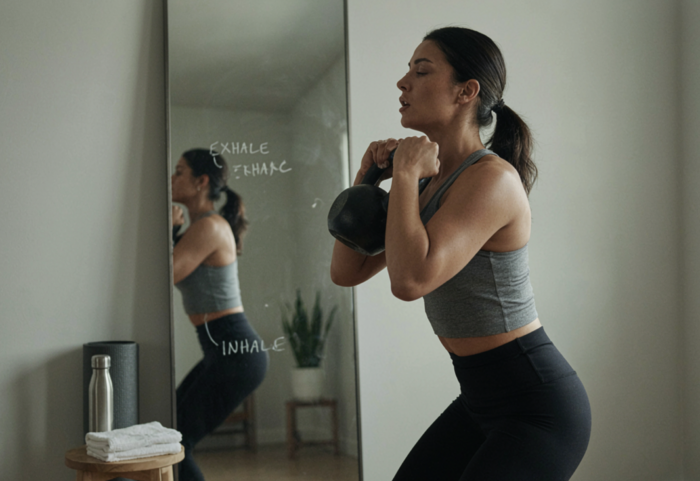
At a glance:
- Exhale during exertion (e.g. as you rise from a squat) and inhale during the initial phase — this is the basic rule for most strength exercises.
- The Valsalva maneuver, which braces your abdomen, protects your spine under heavy loads but is not suitable if you have high blood pressure.
- Incorrect breathing — particularly holding your breath without a deliberate technique — increases injury risk and reduces performance.
- Learning proper breathing technique takes time but noticeably improves both spinal stability and training results.
Breathing while lifting is one of the most underrated technical aspects of strength training. The right breathing pattern not only improves performance but also protects your spine and significantly reduces injury risk. Here, we explain exactly how breathing works when you lift and what you should know for every workout.
Why is breathing while lifting important for spinal health?
Lifting generates pressure inside your abdomen (intra-abdominal pressure), which acts as a natural support corset for your spine. Research shows that properly activating the deep abdominal muscles — particularly the transversus abdominis — before exertion significantly increases spinal stability (Hodges & Richardson, 1997). Without proper breathing, this muscle remains underactivated, leaving your spine unprotected under load.
Proper breathing also affects performance: an incorrect breathing pattern leads to earlier fatigue and inconsistent technique. Just as proper breathing benefits your health in general, it is doubly important during strength training — the coordinated action of your diaphragm and abdominal muscles is the main mechanism that keeps your body stable while lifting.
How should you breathe while lifting — what is the basic rule for all exercises?
The basic rule is:
- Inhale before exertion or during the initial phase (e.g. as you lower into a squat or lower the barbell to your chest).
- Exhale during exertion (e.g. as you rise from a squat, press or lift the barbell during a deadlift).
Breathe diaphragmatically, or into your belly: as you inhale, your abdomen should expand through 360 degrees — to the front, sides and back — rather than just your chest expanding. This pattern activates the deep stabilizing muscles and creates a band of pressure around your torso.
A step-by-step drill for squats:
- Stand with a loaded barbell across your shoulders and your feet shoulder-width apart.
- Take a deep breath into your belly — feel your abdomen, sides and lower back expand.
- Brace your abdominal muscles like a corset (but do not exhale yet).
- Maintain a gentle breath hold as you lower.
- As you rise, exhale through your mouth in a controlled manner.
Bear in mind that deep diaphragmatic breathing is much harder on a full stomach — for more on how nutrition affects training, read: Are you eating right.
What is the Valsalva maneuver, and when is it recommended?
The Valsalva maneuver involves taking a deep breath, bracing your abdominal muscles and briefly holding your breath during maximal exertion. This significantly increases intra-abdominal pressure and protects your spine under heavy loads — research confirms that the maneuver substantially reduces the load on your spine during heavy strength exercises (Hackett & Chow, 2013).
When to use it:
– During submaximal and maximal lifts (sets of 1–3 repetitions).
– During exercises that place substantial loads on your spine: barbell back squats, deadlifts and bench presses.
When NOT to use it:
– If you have high blood pressure, heart disease or problems with eye pressure, because the Valsalva maneuver temporarily increases systemic blood pressure (Hackett & Chow, 2013).
– If you are a beginner who has not yet mastered basic breathing technique.
– During lighter exercises, where continuous inhalation and exhalation is a better choice.
As a rough guideline: below 70% of your maximum lifting weight — breathe normally; above 70% — experienced athletes can use the Valsalva maneuver for short sets.
What are the common breathing mistakes when lifting, and how can you avoid them?
1. Holding your breath throughout the entire set
Many beginners hold their breath for an entire set without realizing that this is dangerous. During multiple repetitions, your body needs a continuous exchange of oxygen — otherwise, you become dizzy and your blood pressure rises dangerously.
2. Exhaling as you lower
Many people exhale precisely when they should inhale. This leaves your torso poorly supported during exertion and fails to activate the stabilizing muscles.
3. Breathing only into your chest
Shallow breaths into your chest do not effectively activate your diaphragm or abdominal muscles (McGill, 2001). Practice belly breathing outside the gym as well.
4. Forgetting to breathe altogether
Under stress, you may lose track of your breathing completely. The result is premature fatigue and inconsistent technique from one repetition to the next.
Just as it is important to fuel your muscles properly to achieve results, proper breathing is essential for muscle growth and strength development — without it, your muscles cannot work effectively during training.
Practical breathing exercises for the gym
Exercise 1: The basics of diaphragmatic breathing
Lie on your back with one hand on your abdomen and the other on your chest. Inhale through your nose — feel your abdomen rise while your chest stays still. Exhale through your mouth — your abdomen lowers. Do 10 relaxed repetitions before each workout.
Exercise 2: 360° torso bracing
Stand upright, take a deep breath into your belly and feel the pressure spread around your entire torso. Hold for 3–5 seconds, then exhale in a controlled manner. This is exactly the corset-like bracing technique you use when lifting.
Exercise 3: Breathing during unweighted squats
Practice the correct pattern while squatting with an unweighted stick: inhale as you lower and exhale as you rise. Do 3×10 repetitions with deliberate breathing before moving on to weighted exercises.
For better recovery, pay attention to what you eat in the evening, too — eat right in the evening to help your muscles get the most out of your workouts.
Who is this especially important for?
Proper breathing when lifting is especially important for:
– People with back problems — incorrect breathing increases the load on the intervertebral discs and can worsen existing symptoms.
– Beginners — developing good technique early prevents bad habits from taking hold.
– Strength athletes — for experienced lifters, mastering the Valsalva maneuver and breathing technique is an integral part of competition readiness.
The World Health Organization (WHO) emphasizes that muscle-strengthening training is an important part of a balanced approach to physical activity across all age groups — and performing it safely requires proper technique, including conscious breathing.
References
- Hodges PW, Richardson CA (1997). Contraction of the abdominal muscles associated with movement of the lower limb. Phys Ther. 77(2):132–142. PMID: 9037214
- Hackett DA, Chow CM (2013). The Valsalva maneuver: its effect on intra-thoracic pressure and determinants of any adverse cardiovascular effects. J Strength Cond Res. 27(8):2338–2345. PMID: 23222073
- McGill SM (2001). Low back stability: from formal description to issues for performance and rehabilitation. Exerc Sport Sci Rev. 29(1):26–31. PMID: 11210443
Frequently asked questions
Should I always breathe into my belly when lifting?
Yes, diaphragmatic or belly breathing is fundamental to strength training. It activates the deep abdominal muscles that stabilize your spine during lifting. Chest breathing does not provide enough support for your torso.
Is the Valsalva maneuver dangerous?
For experienced athletes without cardiovascular disease or high blood pressure, the Valsalva maneuver is safe during short, heavy sets and protects the spine. It is not recommended for beginners or people with heart disease.
How many seconds can I hold my breath while lifting?
For heavy singles, hold your breath only for the duration of that one repetition — usually 2–4 seconds. In sets with multiple repetitions, you need to breathe out and then breathe in again at the end of each repetition.
Does breathing differ between the deadlift and the squat?
The basic pattern is the same: breathe in before exertion and breathe out at the point of maximum effort. For both the deadlift and the squat, breathe in before rising with the barbell and breathe out once you reach the top position.
How do I know if I am breathing correctly when lifting?
Signs of proper breathing include your belly expanding as you breathe in (not just your chest), a feeling of even pressure around your torso during exertion, and no dizziness or flashing lights in your vision after repetitions.
Come and work out! ArtGym