
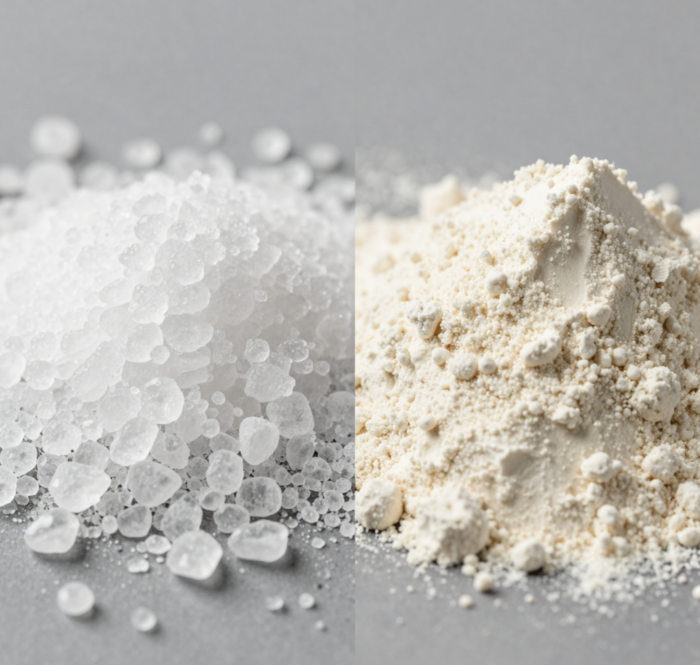
In short:
- Taking creatine and protein at the same time is safe and scientifically supported.
- Both supplements affect muscle mass growth through different mechanisms and don’t interfere with each other.
- The best time to take both is the post-workout period, but your total daily dose matters more than exact timing.
- Combining creatine and protein with resistance training may give a synergistic advantage over using either one alone.
Creatine and protein are the two most-studied supplements in sports, and they’re often used together – for good reason. Whether creatine and protein go well together, whether you can mix them in one shake and whether there’s any added benefit: science answers these questions clearly and positively. Let’s look at what the studies say.
Do creatine and protein work better together?
Creatine and protein affect muscle growth and performance through entirely different mechanisms – which is exactly why they don’t interfere with each other but complement each other. Creatine is a nitrogen-containing organic acid that the body synthesizes in the liver and stores mainly in the muscles as phosphocreatine. Protein, on the other hand, is a source of amino acids, which muscle cells use to build and repair themselves.
Studies confirm that taking both at the same time gives better results than either one alone. In a 10-week randomized controlled trial, Cribb et al. (2007) found that whey protein combined with creatine and resistance training increased muscle mass and strength significantly more than whey protein with training alone (Cribb et al., 2007). This points to a clear synergistic effect, which is explained by the two substances’ entirely different mechanisms of action.
How does combining creatine and protein affect muscle mass?
Building muscle mass requires two key components: an adequate training stimulus and adequate protein synthesis. Creatine’s role is to increase phosphocreatine stores in the muscles, which allows more adenosine triphosphate (ATP) to be produced during short, intense efforts – meaning more repetitions, with a heavier training load and, ultimately, a greater training volume (Hultman et al., 1996).
What is protein – this question is key to understanding muscle mass growth. Protein gives muscles building material in the form of amino acids. After training, muscle protein synthesis (MPS) kicks in, which is the basis of muscle mass growth. Phillips and Van Loon (2011) recommend 1.6–2.2 g of protein per kilogram of body weight per day for athletes to support optimal adaptation to training (Phillips & Van Loon, 2011).
When you take creatine and protein together, you therefore get a double effect: creatine lets you train harder and with greater volume, while protein supplies the muscles with the material needed for recovery and growth. The two substances complement each other with no direct competition at the level of absorption or action.
When is the best time to take creatine and protein together?
The post-workout period is known as the “anabolic window” – the time when muscles are most receptive to nutrients. Although this window isn’t as narrow as once thought (nutrition across the whole day plays a bigger role), most studies show that taking a protein supplement after training speeds up muscle recovery.
What is creatine and how does it work – this article explains that with creatine, the total daily dose matters more than exact timing. Even so, many athletes prefer to take creatine and protein together after training – it’s convenient and fits in with your general nutrition routine.
Practical tip: mix 3–5 g of creatine monohydrate into your usual post-workout protein supplement. You don’t need to take the two at separate times – taking them together is both safe and practical, and it doesn’t affect the bioavailability of either.
Is it safe to mix creatine and protein?
Yes – it’s one of the most thoroughly studied supplement combinations, and its safety profile is well established. The European Food Safety Authority (EFSA) has concluded that creatine is safe and supports performance in short-term, high-intensity training at a dose of 3 g per day (EFSA, 2011).
Protein is a natural nutrient for the body, and no significant side effects have been observed in healthy people at normal doses. Taking creatine and protein together doesn’t change the safety profile of either and hasn’t been found in studies to cause stomach or digestive problems.
Creatine – for a more detailed overview of creatine’s safety, dosing and scientific background, see this in-depth article.
People with kidney problems are advised to consult a doctor before using creatine, because creatine raises creatinine levels in the blood – a marker of kidney function, but not in itself a sign of kidney damage in healthy people. For reliable additional information on the safety of dietary supplements for athletes, see the official guide from the NIH Office of Dietary Supplements.
References
- Cribb PJ, Williams AD, Stathis CG, Carey MF, Hayes A. (2007). Effects of whey isolate, creatine, and resistance training on muscle hypertrophy. Med Sci Sports Exerc. 39(2):298-307. PMID: 17277987
- Hultman E, Söderlund K, Timmons JA, Cederblad G, Greenhaff PL. (1996). Muscle creatine loading in men. J Appl Physiol. 81(1):232-7. PMID: 8828669
- Phillips SM, Van Loon LJ. (2011). Dietary protein for athletes: From requirements to optimum adaptation. J Sports Sci. 29(Suppl 1):S29-38. PMID: 22150425
- EFSA Panel on Dietetic Products, Nutrition and Allergies (NDA). (2011). Scientific Opinion on the substantiation of health claims related to creatine. EFSA Journal. 9(7):2303. DOI: 10.2903/j.efsa.2011.2303
Frequently asked questions
Can you mix creatine and whey protein in one drink?
Yes, it’s completely safe and convenient. Creatine monohydrate dissolves well in water and doesn’t noticeably change the taste or effectiveness of the protein. Most athletes simply add 3–5 g of creatine to their post-workout protein supplement.
Does creatine hinder protein absorption?
No. Creatine and amino acids are absorbed via different transport mechanisms and don’t compete with each other. Taking them at the same time doesn’t affect the bioavailability of either.
How much creatine should you take per day?
EFSA confirms the safety and efficacy of a dose of 3 g of creatine monohydrate per day. A loading phase (20 g per day for 5–7 days, then a maintenance dose of 3–5 g) fills muscle stores faster, but it isn’t essential – the same result is reached more slowly with the maintenance dose alone.
Is combining creatine and protein just as effective for women?
Yes. Studies show that creatine works in both women and men. The absolute gains in strength and mass may vary from person to person, but the mechanism is the same, and so is the safety profile.
What is the difference between creatine and protein?
Creatine supports the energy system, increasing ATP production during intense muscle work. Protein is a structural nutrient that supplies amino acids for muscle protein synthesis. Both play different but complementary roles, which is why together they have greater potential than either one alone.
Come and work out! ArtGym




