
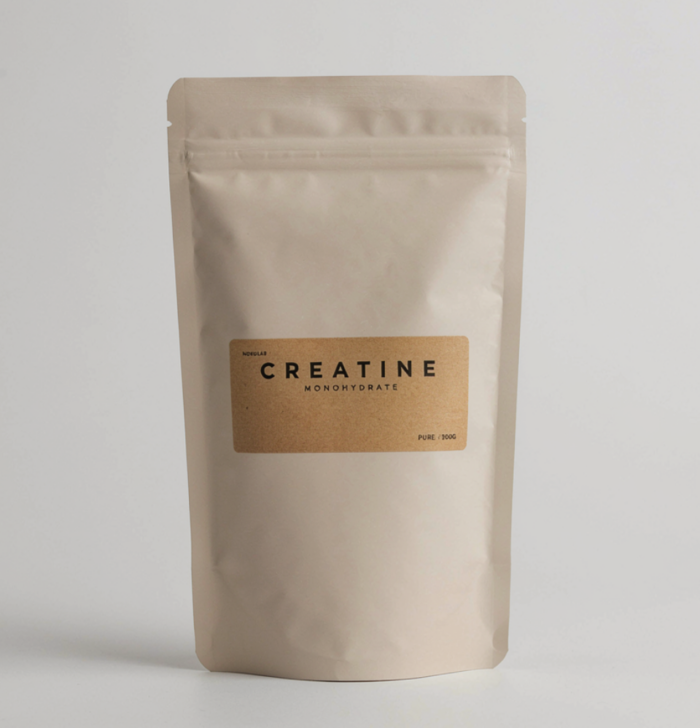
What is creatine and how does it work in your muscles?
Creatine is one of the few supplements whose effects have actually been confirmed by decades of research. But what is it really, why does it work, and is it useful for the average gym-goer too? A short, honest overview without the marketing hype.
What is creatine?
Creatine is a compound your body produces on its own — mainly in the liver, kidneys and pancreas. Three amino acids are used for its synthesis: glycine, methionine and arginine. Creatine isn’t synthesized in skeletal muscle itself, even though that’s where about 95% of the body’s total stores sit. The remaining stores are divided between the heart muscle, the brain and other tissues.
The human body holds about 120 grams of creatine in total. The average person uses almost 2 grams a day: half of that comes from a mixed diet (mainly red meat and fish) and the other half is synthesized by the body itself. If you train hard or are under prolonged mental strain, your requirement rises to 3–6 grams a day or more. This is where the idea of supplementing comes from — getting that amount from food would mean eating roughly half a kilo of steak every day, which isn’t a very practical solution.
How does creatine work in your muscles?
The short answer: creatine helps your muscle produce energy faster. The longer answer involves ATP, or adenosine triphosphate.
ATP is the energy currency of the cell. A muscle cell can’t use the energy from glucose directly — it first has to be repackaged into the form of ATP. Every muscle contraction, every rep in the gym and every sprint burns through ATP stores. The problem is that the muscle itself holds only enough ATP for a few seconds. After an explosive effort, it has to be produced again right away.
This is where creatine phosphate comes in. Creatine bound to phosphate donates its phosphate group to ADP and turns it back into ATP. The more creatine there is in the muscle, the faster you can regenerate ATP — and the sooner you’re ready for the next rep or sprint. The mitochondria do the same job using glucose and fats, but they are slower. Creatine is the muscle’s quick-access reserve.
In practice, this means a bit more strength when lifting weights, better explosive power and the ability to squeeze out one or two more reps per set. Don’t expect miracles. But the extra reps that accumulate over months add up to a measurable training effect — more volume, more stimulus, more muscle mass. The brain and heart use creatine too, and studies from recent years suggest the supplement may also benefit mental performance during sleep deprivation or periods of intensive studying.
Creatine in practice: what to keep in mind
The most common form is creatine monohydrate. It is also the best-studied and the cheapest. There’s no need to pay extra for “novel” forms (HCl, ethyl ester, buffered) — their advantage over monohydrate has rarely been demonstrated in studies.
The usual dose is 3–5 grams a day. Some people start with a so-called loading phase: about 20 g a day for five to seven days, split into four servings. This fills the creatine stores in your muscles faster. Loading isn’t mandatory — with a smaller daily dose you’ll reach the same level in about three weeks.
- Water. Creatine draws water into muscle cells. Drink a little more than usual each day, especially in summer and after the sauna.
- Weight. In the first couple of weeks, 1–2 kg is often added. That isn’t fat but water bound in the muscles — if anything, it makes the muscles look fuller.
- Sport. The benefit is clear in strength, speed and strength-endurance sports. Studies don’t show a clear advantage in classic endurance sports (marathon, long-distance running).
- Coffee. The old legend that caffeine cancels out the effect of creatine hasn’t been confirmed by modern studies. Morning coffee and creatine in the same drink is fine.
- Kidneys. In a healthy person, long-term use isn’t dangerous for the kidneys — this has been checked across many studies. If you have existing kidney disease, though, ask your doctor before using it.
You’ll find the largest and most affordable selection of creatine here: Turg.Fitness.ee
FAQ
Should you take creatine every day or only on training days?
Every day. The goal is to keep your muscle creatine stores consistently full. One missed day won’t ruin anything, but consistent daily intake gives the best results.
Do you have to take creatine at a specific time of day?
No. It works just as well in the morning, before training or after it. The easiest way is to add it to one of your daily drinks — a protein shake, coffee or just a glass of water. The main thing is that you actually drink it.
Can women take creatine?
Yes. Women start out with slightly lower creatine levels in their muscles, which means the effect from supplementation may be even more noticeable. Creatine has no hormonal effect — it is not an anabolic steroid or a plant-based hormone activator.
Come and train! ArtGym




