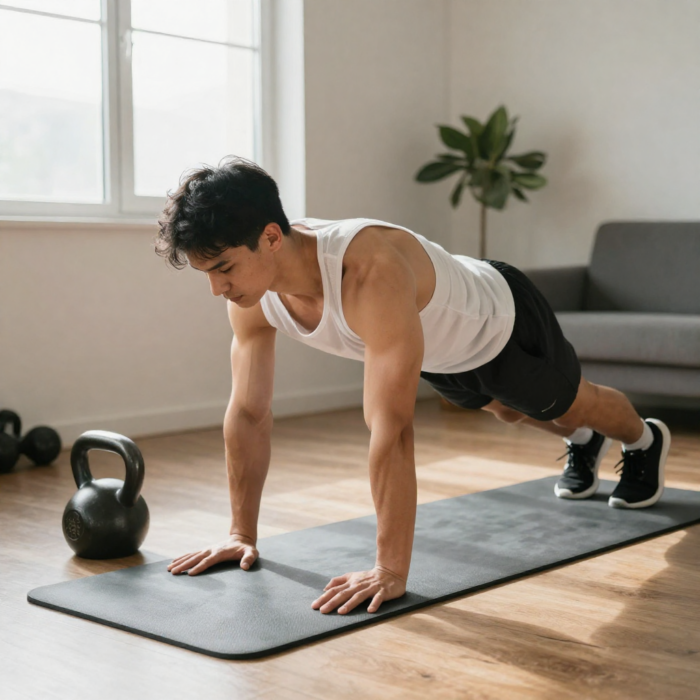
Triceps and balanced arm training
Your triceps are the muscle that gives your arms a complete look, even if your biceps get more attention in the mirror. If you only train what catches your eye, your body becomes unbalanced. Here, we look at what deliberately pairing muscle groups means for training your arms, legs, chest and back.
Why do your triceps deserve a place alongside your biceps?
Many people start arm day with biceps. That is understandable. Your biceps get a pump quickly, the exercises are familiar and the results are immediately visible. But if your triceps take a back seat, your arms will lack the strong, rounded shape most people are actually after.
The simple truth is that one muscle does not make a whole. Your arms work better when both the front and back share the training load. The same principle applies to your legs. Both the front and back of your thighs need to work. The balance between your chest and back matters too. If one side is strong and the other lags behind, your body will start compensating sooner or later.
The original idea was sound: train the muscles around the full 360 degrees of a body part. This is about more than appearance. Balance helps you move with better form, maintain a better training rhythm and distribute the training load more evenly across your body.
How do your triceps and their opposing muscle work together?
Here, deliberately pairing muscle groups means treating opposing muscles as connected rather than entirely separate. When training your arms, you can alternate between one set for your biceps and another for your triceps. This keeps the workout moving and lets one muscle rest while the other works.
So what actually happens? While your biceps work, the extensor muscle gets a brief breather. Your biceps then get a rest as you continue training your arms. That way, you do not have to sit on a bench waiting until you feel ready for the next set. The workout stays brisk without becoming frantic.
You can apply the same logic elsewhere. Pair a quadriceps exercise with a hamstring exercise. Pair chest work with back work. This does not mean every workout needs a complicated structure. The point is to avoid training one side of your body and forgetting the other.
An example for arms
On arm day, you can start with a familiar pairing: one pulling movement for your biceps and one extension movement for your triceps. What matters is not an exercise’s impressive name, but giving both sides equal attention. If you choose heavy, focused work for your biceps, do not leave your triceps with just a light finisher.
An example for legs and upper body
For your legs, think about your quadriceps and hamstrings. For your upper body, think about your chest and back. If you do a lot of pressing, make sure you pull too. If you train the front of your body, give the back some work as well. It sounds simple, but that simplicity is exactly what tends to get lost in training plans.
Triceps training: practical tips
Start by building pairings into your workout. Choose them logically, not at random. For your arms, pair your biceps with their opposing muscles. For your legs, pair the front and back. For your upper body, pair your chest and back. This structure simplifies your plan and helps prevent you from spending all your energy on the favorite muscle you train first.
Keep your form strict. If fatigue makes you swing your body, the set has lost its purpose. When training your triceps, it is especially easy to let your shoulder and torso take over. Choose a weight that lets you control the movement. Steady, precise work is better than a heavy weight that only moves because of momentum.
Pay attention to how things feel, too. Do your left and right sides work similarly? Does one muscle tire much sooner? Does your chest always get a high training load while your back is left until the end? These small signs tell you a lot. Honestly, the mirror only gives you half the picture. How you feel and the quality of your movement often tell you more.
If you are used to training body parts separately, you do not need to change everything at once. Start by trying one paired section of your workout. Your arms, for example. Work your biceps, then immediately work your triceps, and rest afterward. If that rhythm suits you, you can later apply the same approach to your legs or upper body.
Triceps and training FAQ
Can you train your biceps and triceps on the same day?
Yes, you can. In fact, it is a very logical choice if your goal is balanced arm training. Alternating between them helps you maintain the pace and gives each muscle its share of the training load.
Is pairing opposing muscle groups suitable for beginners?
Yes, as long as the exercises are simple and you can maintain proper form. As a beginner, you do not need a complicated system. Simply including both sides in your plan is enough.
What should you do if your triceps lag behind your biceps?
Give your triceps an equally important place in your training. Do not leave them until the end, when you have already run out of strength. Choose an exercise you can perform with strict form, and make sure your shoulder does not take over all the work.
Author: joker
Source: WHO – physical activity.
Come work out! ArtGym