
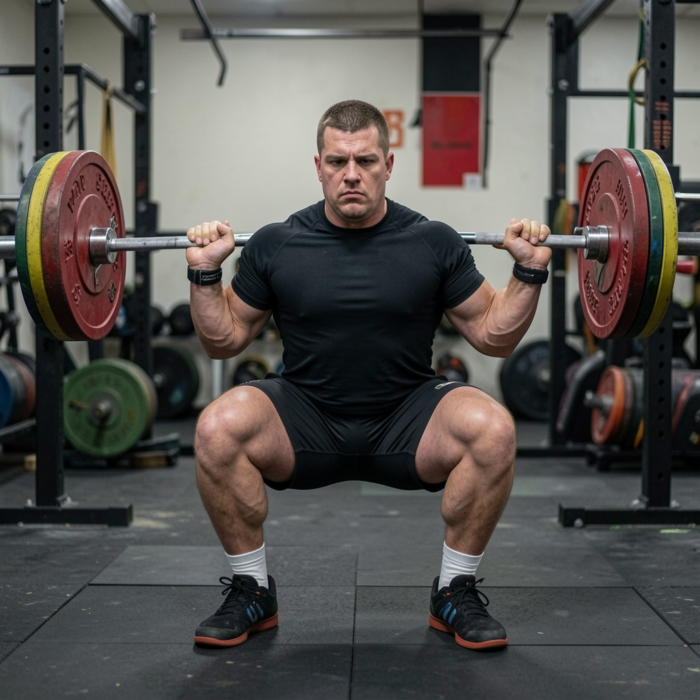
At a glance:
- A powerlifting program for 4 days a week uses an upper/lower body split, with each major muscle group receiving a training stimulus twice a week.
- The main exercises are the barbell squat, bench press, deadlift and overhead press—progressive overload ensures continued strength gains.
- Rest between training days is just as important as training itself—four workouts a week provide the optimal balance between training load and recovery.
- A daily protein intake of 1.6–2.2 g/kg of body weight supports both strength gains and muscle growth.
A powerlifting program for 4 days a week is an effective, science-based approach if you have moved beyond the beginner stage and want a structured way to build strength and muscle mass. Four workouts give your body enough stimulus while allowing time for recovery.
Why does a powerlifting program for 4 days a week work?
Training four days a week distributes the training load so that each major muscle group receives two training stimuli per week—an optimal frequency for hypertrophy and strength gains, according to research. In a systematic review, Schoenfeld et al. (2016) found that training muscles twice a week produced greater increases in muscle size than training them once a week (Schoenfeld et al., 2016). Managing total training volume is also important: Ralston et al. (2017) showed that weekly training volume has a statistically significant effect on strength gains up to a certain saturation point (Ralston et al., 2017).
If you are just starting out, we recommend first exploring a beginner program for two or three days a week to build the foundation you need before moving to four workouts a week.
What does a 4-day powerlifting program look like?
The following program uses an upper/lower body split (Upper/Lower): you train your lower body on Monday and Thursday (focusing on squats and deadlifts) and your upper body on Tuesday and Friday (pressing and pulling movements). Wednesday and the weekend are reserved for recovery.
Monday – Lower body A (squat)
| Exercise | Sets × reps | Intensity |
|---|---|---|
| Barbell squat | 4 × 4–6 | 80–85% 1RM |
| Romanian deadlift | 3 × 8–10 | Moderate |
| Leg press | 3 × 10–12 | Moderate |
| Leg curls | 3 × 10–12 | Moderate |
| Calf raises | 3 × 15 | Light–moderate |
Tuesday – Upper body A (bench press)
| Exercise | Sets × reps | Intensity |
|---|---|---|
| Barbell bench press | 4 × 4–6 | 80–85% 1RM |
| Incline dumbbell press | 3 × 8–10 | Moderate |
| Lat pulldown | 4 × 8–10 | Moderate |
| Bent-over barbell row | 3 × 8–10 | Moderate |
| Triceps pushdown | 3 × 10–12 | Light |
Thursday – Lower body B (deadlift)
| Exercise | Sets × reps | Intensity |
|---|---|---|
| Deadlift | 4 × 3–5 | 82–87% 1RM |
| Bulgarian split squat | 3 × 8–10 | Moderate |
| Leg extension | 3 × 12–15 | Light |
| Leg curl | 3 × 12–15 | Light |
| Abdominal exercises | 3 × 15–20 | — |
Back strength and mobility are key to deadlifting—read more in Get your back in shape, which features back exercises to help prevent injuries and improve technique.
Friday – Upper body B (overhead press)
| Exercise | Sets × reps | Intensity |
|---|---|---|
| Barbell overhead press (OHP) | 4 × 5–7 | 77–83% 1RM |
| Dumbbell lateral raises | 3 × 12–15 | Light |
| Lat pulldown (close grip) | 3 × 8–10 | Moderate |
| Bent-over dumbbell row | 3 × 10–12 | Moderate |
| Biceps curls | 3 × 10–12 | Light |
For more ideas on specifically developing your arm muscles, explore the one-day arm program, which you can add as an extra session or use to expand your exercise selection.
How can you progress and avoid plateaus?
Strength gains depend on progressive overload—consistently increasing weight, volume or intensity. Rhea et al. (2002) compared linear and undulating periodization and found that both produce similar strength gains when volume and intensity are appropriately balanced (Rhea et al., 2002).
Practical principles:
– Increase the weight on your main exercise by 2.5 kg per week if you can complete the prescribed reps with proper form.
– Increase the weight on accessory exercises by 1–2.5 kg every 1–2 weeks.
– Schedule a deload week every 4–6 weeks (50–60% of your usual volume) to prevent overuse injuries.
For a more detailed look at the principles of designing a training program, read How to design a training program: a complete guide.
What should you consider for nutrition and recovery?
Getting an optimal protein intake is important for maintaining and building muscle mass through strength training. In a large meta-analysis, Morton et al. (2018) found that increasing protein intake beyond 1.62 g/kg of body weight per day provides no additional benefit for muscle growth (Morton et al., 2018)—making 1.6–2.2 g/kg per day a practical target.
The Estonian Health Board recommends that adults get at least 150 minutes of moderate-intensity physical activity per week and do muscle-strengthening exercises at least twice a week. A 4-day powerlifting program exceeds both recommended thresholds.
Pre-workout supplements – such as formulas containing creatine and caffeine – may support workout performance, but they do not replace proper nutrition or adequate sleep. Optimal sleep (7–9 hours per night) and rest between workouts are essential foundations for long-term strength gains.
References
- Schoenfeld, B.J., Ogborn, D., Krieger, J.W. (2016). Effects of Resistance Training Frequency on Measures of Muscle Hypertrophy: A Systematic Review and Meta-Analysis. Sports Medicine, 46(11), 1689–1697. PMID: 27102172
- Ralston, G.W., Kilgore, L., Wyatt, F.B., Baker, J.S. (2017). The Effect of Weekly Set Volume on Strength Gain: A Meta-Analysis. Sports Medicine, 47(12), 2585–2601. PMID: 28455679
- Rhea, M.R., Ball, S.D., Phillips, W.T., Burkett, L.N. (2002). A comparison of linear and daily undulating periodized programs with equated volume and intensity for strength. Journal of Strength and Conditioning Research, 16(2), 250–255. PMID: 12436270
- Morton, R.W., Murphy, K.T., McKellar, S.R., et al. (2018). A systematic review, meta-analysis and meta-regression of the effect of protein supplementation on resistance training-induced gains in muscle mass and strength in healthy adults. British Journal of Sports Medicine, 52(6), 376–384. PMID: 28698222
- Health Board. (2023). Physical activity recommendations for adults.
Frequently asked questions
Is a powerlifting program with 4 training days a week suitable for beginners?
A 4-day program is better suited to you if you already have at least 3–6 months of regular training experience. If you are a complete beginner, we recommend starting with 2–3 workouts a week to learn proper technique and get used to the training load.
How should you arrange your training days?
The classic schedule is to train on Monday–Tuesday, rest on Wednesday, and train on Thursday–Friday. This allows enough recovery time between workouts.
How many sets are optimal in each workout?
Research suggests that an effective training volume is 10–20 sets per muscle group per week. In a 4-day program, this means approximately 5–10 sets per muscle group in each workout, depending on your training level and recovery.
Do you have to squat and deadlift?
The barbell squat and deadlift are core exercises in foundational powerlifting programs, but if an injury prevents you from doing them, you can substitute variations or alternative exercises (e.g., Smith machine squats, sumo deadlifts or leg presses).
Does a 4-day program also help you lose fat?
Strength training increases your metabolic rate and muscle mass, supporting long-term improvements in body composition. However, when it comes to directly burning fat, your diet and energy balance matter more than the number of days in your training program.
Come and train! ArtGym




