In short: Properly composed meals regulate your brain’s neurotransmitters and make fat burning a natural part of the day. Protein and fat in the morning, carbohydrates in the evening — and the energy crashes disappear.
Why food determines the speed of fat burning
Very little is said about how food affects brain chemistry, even though it determines whether at around three in the afternoon you are slumping in an armchair or still going strong. The body synthesizes neurotransmitters from precursors obtained from food — chemical messengers that carry commands to the brain and determine whether you feel energized or drained.
This process can be steered quite well with food. The race between two amino acids — L-tyrosine and L-tryptophan — at the blood-brain barrier decides which hormonal wavelength dominates the hours after a meal. And that is also what drives fat burning.
L-tyrosine and L-tryptophan — two amino acids that drive your energy
When L-tyrosine reaches the brain first, catecholamines — adrenaline, noradrenaline and dopamine — are synthesized with the help of vitamins B-3, B-5, B-6 and C and the minerals zinc, iron and copper. These are wakefulness hormones that raise your energy level, help you cope with stress and make it possible at all to use body fat for energy. Stressed? Eat protein, not carbohydrates.
But if L-tryptophan wins, serotonin is synthesized with the help of vitamins B-3 and B-6 — a relaxing, even pain-relieving feel-good hormone, which in turn is a precursor of melatonin. Good for the evening, bad for the morning.
What tips this race? The composition of your meal. Protein-rich foods — meat, fish, eggs — contain a lot of L-tyrosine and little L-tryptophan. Starchy, low-protein foods (all grain products), on the other hand, give L-tryptophan the upper hand, and the insulin rise they cause also helps L-tryptophan get into the brain.
Breakfast and lunch that support fat burning
Conventional wisdom says carbohydrates are fine in the morning. They are — but do you need them? Today’s mornings are no longer followed by heavy physical work that would use up the carbohydrates right away. You need to achieve the opposite: steady, long-lasting energy without blood sugar swings.
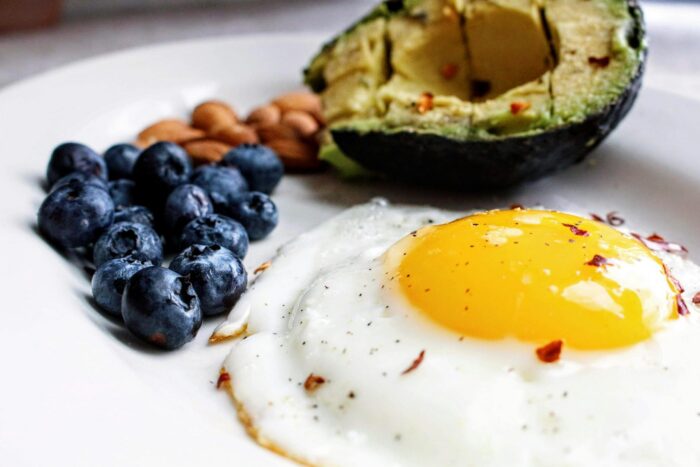
A breakfast rich in protein and fat and low in carbohydrates supplies the brain with L-tyrosine and its companions. As a bonus, you teach your body to draw energy from body fat as well — which is exactly what fat burning means. A side effect I have experienced first-hand: over the course of the day, sweet cravings all but disappear.
Lunch works on the same principle if you need to be active in the afternoon. Chicken, fish, turkey or red meat (which contains everything needed to synthesize L-tyrosine) with non-starchy root vegetables and fruits, and a salad with cold-pressed olive oil. The Spanish siesta culture is lovely, but the Estonian workday doesn’t allow for it — so hold back on starch.
Dinner — the meal that ends the day — can finally include starch. Carbohydrates together with protein and a moderate amount of fat raise serotonin, help you unwind and top up your glycogen stores for overnight recovery. For overweight “skinny-fat” people, this is worth allowing only occasionally — excess fat mass is mostly caused precisely by indulging in carbohydrates for long periods.
Pre-workout food and fat burning
The temptation is to eat fast carbohydrates before a workout. Bad idea. A sharp rise in blood sugar brings a high insulin level, which in turn drops blood sugar — and you feel an energy crash instead. Even worse: a high insulin level inhibits both glycogenolysis and lipolysis, meaning that the muscles’ energy supply during training is blocked.
To avoid this, do two things: don’t overdo carbohydrates before training (a moderate amount of complex carbohydrates at lunchtime is fine) and teach your body to use fat as an energy source. Otherwise you wouldn’t be able to carry a low-carbohydrate breakfast and lunch through to the evening.
Long, intense training lasting several hours is a different story. When glycogen stores are full, amino acids are used for energy only to the extent of 5%; when glycogen drops, already 3 times as much. In that case, taking simple carbohydrates and BCAAs during your workout to prevent muscle catabolism is justified. There is no need to fear an insulin rise — the muscles take up the carbohydrates right away.
After training, the classic recommendation is 0.4–0.8 grams of fast carbohydrates and 0.4 grams of whey protein per kilogram of body weight in a 10% aqueous solution. This is mandatory only if you train twice a day or again the next morning. Otherwise you will achieve the same recovery with regular food, just a little later.
FAQ about fat burning and nutrition
Why do I feel sleepy after a pasta lunch?
A starch-rich meal raises the L-tryptophan level in your blood, and insulin helps it get into the brain. The result is serotonin-induced drowsiness and a drop in blood sugar. Swap it for a protein- and fat-rich lunch and the drowsiness goes away.
Does fasted training speed up fat burning?
Only if the body is fat-adapted — meaning breakfast and lunch are low in starch. For a body running on carbohydrates, a fasted workout tends to result in an energy crash and the breakdown of muscle tissue.
Do I really have to give up sweets?
No. If breakfast is rich in protein and fat, sweet cravings usually disappear on their own. The urge for something sweet is largely a result of blood sugar swings, not a matter of willpower.
Author: Fred Antson
Source: WHO – healthy eating.
Come and train! ArtGym