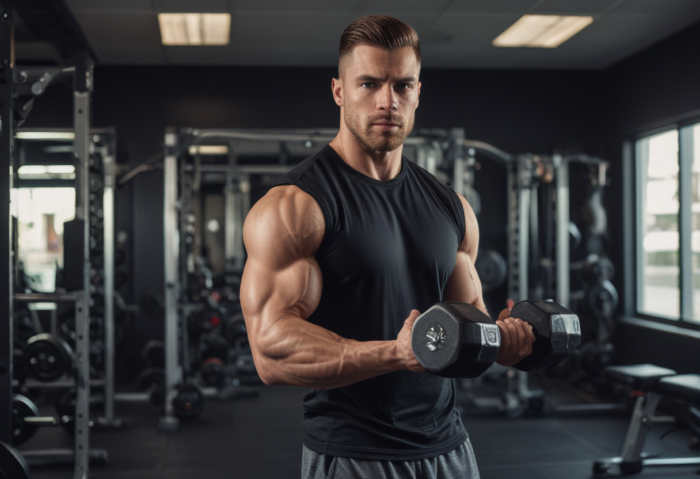
Arm training: 6 weeks for upper arms
Arm training works best when the biceps and triceps get a fixed place in your weekly plan, without the rest of your body being neglected. Below is a 6-week cycle that prioritizes the upper arms: weeks 1-2 build volume, weeks 3-4 add heavier work, and weeks 5-6 put the muscle to the test with descending sets and maximum repetitions.
Why do your arms need a separate plan?
If you want bigger upper arms, it isn’t always enough to tack a couple of exercises onto the end of chest day and back day. The biceps and triceps do get worked indirectly, but growth often calls for more targeted volume, different angles and a steady increase in training load.
A simple truth: the triceps make up a large part of upper arm size. That’s why this plan gives the triceps plenty of work, from dips and close-grip pressing to cable pressdowns. The biceps also get several angles: incline bench, preacher bench, barbell, dumbbells and cable.
Keep your technique clean. If your elbow drifts in every direction and your body helps with every repetition, your ego gets more of a workout than the muscle does. The weight should be heavy enough, but not so heavy that a repetition turns into a yank.
Arm training, weeks 1-2: volume and feel
The first 1-2 weeks are about finding your rhythm. Do your repetitions under control and leave some in reserve, because the same muscle gets trained several times during the week.
Mon
- chest 8-10 sets
- shoulders 8-10 sets
- dips for triceps (parallel-bar dip) 2 x 8-10
- dumbbell French press for triceps (dumbbell French press) 2 x 8-10
- dumbbell arm curls on an incline bench for biceps, changing the bench angle with every set (multi-angle incline dumbbell curl) 4 x 8 -10
- raise the bench angle to 45-90 degrees, increasing it with each set
Tue
rest
Wed
- back 8-10 sets
- standing barbell curl for biceps (barbell curl) 3 x 8 – 10, with a different grip width on each set: 1st wide, i.e. wider than your shoulders, 2nd medium, 3rd narrow
- hammer curl for the forearm and the upper-arm muscle (dumbbell hammer curl) 2 x 8 -10
- cable pressdown with an overhand grip for triceps (straight-bar pressdown) 4 x 8 -10
Thu
rest
Fri
- close-grip bench press for triceps (close grip bench press) 2 x 8 – 10
- cable rope pressdown for triceps (rope pressdown) 2 x 8 – 10
- isolated one-arm dumbbell preacher curl for biceps (dumbbell preacher curl) 2 x 8 – 10
- standing barbell curl for biceps (barbell curl) 2 x 8 – 10; the forearm doesn’t travel all the way up, but stays parallel to the floor in the final phase
- legs 8-10 sets
Arms, weeks 3-4: heavier work and assistance
Weeks 3-4 take the training load up a notch. This is where forced and negative repetitions come in. Don’t do them carelessly. Your partner helps only when a repetition would otherwise stall, not by doing half the set for you.
Mon
- chest 10-12 sets
- shoulders 8-10 sets
Tue
- back 10-12 sets
Wed
rest
Thu
- close-grip bench press on the Smith machine for triceps (close grip bench press on smith machine) 3 x 4-6
- forced (assisted) / negative cable pressdown for triceps (forced/negative-rep pressdown) 3 x 4-6; your partner helps on the way down, and you let the handle rise slowly. After 3 sets, immediately cut the weight by 50% and do as many repetitions as you can without help.
- seated barbell curl for biceps (seated barbell curl) 3 x 4 -6
- forced (assisted) / negative preacher curl with 1 dumbbell for biceps (forced/negative-rep dumbbell preacher curl) 3 x 4 -6; lower the dumbbell slowly, raise it with assistance
Friday
- legs 10-12 sets
Arm training, weeks 5-6: finishing sets
Weeks 5-6 are the most demanding part. Here you get drop sets, + max work and a short mental test: can you hold your form even when the muscle is burning? Don’t rush. Have your weights ready before the set, especially for dumbbell drop sets.
Monday
- chest 10-12 sets
- shoulders 8-10 sets
Tuesday
- one-arm underhand-grip cable pressdown for triceps (one-arm reverse-grip pressdown) 3 x 10-12
- close-grip bench press for triceps (close grip bench press) 3 x 6-8 + max, i.e. in the last set do 6-8 repetitions, then take 30 % off the weight and do as many repetitions as you can
- barbell preacher curl for biceps (EZ-bar preacher curl) 3 x 6-8
- standing dumbbell biceps curl drop sets, both arms together (dumbbell curl down the rack) 4 x 8-12; do 8-12 repetitions, then immediately pick up lighter dumbbells and do another 8-12 repetitions, then drop the weight 2 more times and still aim for 8-12 repetitions each time. That adds up to the 4 sets.
Wednesday
- legs 10-12 sets
Thursday
- back 10-12 sets
Friday
- seated one-arm cable concentration curl for biceps, elbow braced on the knee (cable machine concentration curl) 3 x 10-12
- standing barbell biceps curl (barbell curl) 3 x 6-8 + max, i.e. in the last set do 6-8 repetitions, then reduce the weight by 30 % and do as many repetitions as you can
- close-grip dumbbell bench press (dumbbell close grip press) 3 x 6-8
- rope cable pressdown for triceps, drop sets (rope pressdown, strip sets) 3 x 6-8; in each set do 8-12 repetitions, reduce the weight, keep going until you can’t do any more, then reduce the weight once more and go until you can’t do any more
Practical tips before you start
Warm up your elbows and shoulders properly before the first heavy set. Arm training can seem like a small thing, but your tendons will quickly let you know if you go in cold with too much weight.
Choose a weight so that the first set isn’t a complete failure. If the plan calls for 8-10 repetitions, they should come with clean technique. If it calls for 4-6, the weight is heavier, but the movement should still stay controlled.
Recovery counts. If your elbow aches or your grip gives out already during the warm-up, ease off. Bigger upper arms don’t come from one heroic workout, but from being able to follow the plan for 6 weeks in a row.
FAQ
Can a beginner do this arm plan?
For a complete beginner it’s rather too dense. The basic exercises should be clear first, and your body should be used to regular training.
Can you train biceps and triceps on the same day?
Yes, and this plan does exactly that several times. The important thing is to keep an eye on volume and not turn every set into an uncontrolled max attempt.
What should you do if your elbow starts to hurt?
Reduce the weight, skip the painful exercise and check your technique. If the pain doesn’t go away, don’t push on through it.
Author: Kristjan Koik (source: Muscle&Fitness)
Source: WHO – physical activity.
PS Come and train! ArtGym