
In short:
- The standard box jump suits beginners and is the choice for developing maximal explosive power.
- The depth jump is the most effective way for experienced athletes to train reactive strength.
- The single-leg box jump improves the strength balance between both legs and suits correcting asymmetries.
- The choice of box jump variation depends on the athlete’s level, training phase and sport.
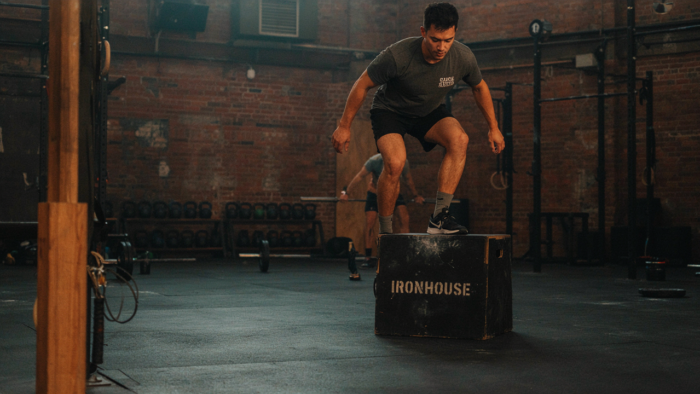
Box jump variations are among the plyometric exercises and are an effective tool for developing lower-limb power, reactive strength and coordination. Different variations load the muscles differently, so it is important to know when to use which. In this technique guide you will get an overview of the main box jump variations, along with evidence-based recommendations.
What are box jump variations and what do they develop?
Box jump variations are a family of exercises in which the athlete jumps onto a box, off a box, or performs a reactive jump involving a box. Plyometric training improves vertical jump height by an average of 4.7–8.5% (Markovic, 2007), increasing the explosive output of the lower limbs. From a neuromuscular perspective, each variation activates a slightly different muscle co-activation pattern, which affects both the training effect and injury risk (Chimera et al., 2004).
The main variations at a glance:
- Standard box jump — jumping onto the box with two feet from a standing start
- Depth jump — stepping off a box and immediately performing a maximal upward jump
- Single-leg box jump — jumping onto the box with one leg
- Lateral box jump — jumping sideways onto the box
- Step-down box jump — you jump onto the box but step down in a controlled way
When to use the standard box jump
The standard box jump is the most versatile variation and suits beginners and experienced athletes alike. Its main purpose is to develop maximal concentric power — the athlete concentrates all their energy into one explosive phase of the movement. Cormie et al. (2011) emphasize that maximal neuromuscular power depends on both strength and speed, and the standard box jump trains precisely the interplay of those two factors.
The standard box jump is recommended:
- In the base power-building phase — in the preseason preparation period, when the goal is to build a plyometric foundation
- For beginners — before adding more complex variations (e.g. the depth jump) to training
- As an activation exercise — before a heavy strength session or a sprint session
Box height should match the athlete’s level: 40–50 cm suits beginners, 60–75 cm experienced athletes. Land softly, with knees and hips slightly bent and body weight distributed evenly. To track progress systematically, it is worth keeping a record of your performances — why using a training log is useful explains why this helps speed up results.
When is the depth jump more effective?
The depth jump is the most demanding box jump variation. The athlete steps off a box, lands and immediately performs a maximal vertical jump, making use of the muscle’s stretch-shortening cycle (SSC). Bobbert (1990) showed that the depth jump produces up to 10% higher vertical push-off than an isolated concentric jump, because the SSC amplifies elastic energy in the tendons and muscles.
The depth jump suits:
- Experienced athletes who have at least 6 months of plyometric training behind them
- Speed-strength athletes — basketball, volleyball, sprinting
- Developing reactivity in sport-specific preparation for the season
Contact time between landing and the next jump should be under 250 ms — this ensures optimal use of the SSC. Box height is usually 40–60 cm; a box that is too high increases landing load without any added benefit. NIH MedlinePlus stresses that performing plyometric exercises requires an adequate strength base beforehand and proper technique (NIH MedlinePlus: Plyometric exercises).
Intense depth jump sessions deplete glycogen stores considerably. Fast-acting carbohydrates support the muscles before and after training — how to use Vitargo wisely offers practical guidance.
How to choose the right box jump variation for your goal
The choice of variation depends on four factors: the athlete’s level, training phase, goal and injury history. Saez-Saez de Villarreal et al. (2010) found that plyometric training improves both jumping ability and speed-strength most effectively under a progressive training load — starting with simpler variations and moving toward increasingly complex ones.
| Variation | Main goal | Suitable level | Focus |
|---|---|---|---|
| Standard box jump | Maximal power | Beginner–advanced | Concentric strength |
| Depth jump | Reactive strength | Experienced | SSC efficiency |
| Single-leg box jump | Correcting asymmetries | Intermediate–advanced | Unilateral stability |
| Lateral box jump | Agility, knee stability | Intermediate | Frontal-plane strength |
| Step-down box jump | Technique, recovery | Beginner–recovering | Eccentric control |
The single-leg box jump is especially recommended for athletes with a significant strength asymmetry between the legs (Chimera et al., 2004). The lateral variation activates the hip abductors and improves frontal-plane stability, which is important in preventing knee injuries.
Recovery is one of the most critical aspects of plyometric training. Micronutrient intake supports muscle adaptation — how to use creatine explains how this supplement supports explosive strength. Tracking your nutrition precisely makes it easier to link results to changes in food choices — why use a food diary gives concrete reasons for doing so.
References
- Markovic G. (2007). Does plyometric training improve vertical jump height? A meta-analytical review. Br J Sports Med. 41(6):349–355. PMID: 17138575
- Chimera NJ, Swanik KA, Swanik CB, Straub SJ. (2004). Effects of plyometric training on muscle-activation strategies and performance in female athletes. J Athl Train. 39(1):24–31. PMID: 15085215
- Cormie P, McGuigan MR, Newton RU. (2011). Developing maximal neuromuscular power: Part 1 — biological basis of maximal power production. Sports Med. 41(1):17–38. PMID: 21244105
- Bobbert MF. (1990). Drop jumping as a training method for jumping ability. Sports Med. 9(1):7–22. PMID: 2408033
- Saez-Saez de Villarreal E, Requena B, Newton RU. (2010). Does plyometric training improve strength performance? A meta-analysis. J Sci Med Sport. 13(5):513–522. PMID: 19914856
Frequently asked questions
What is the difference between a standard box jump and a depth jump?
The standard box jump builds concentric explosive strength — the jump is performed from a static start. The depth jump also uses the muscle’s stretch-shortening cycle: stepping off the box stores elastic energy, which is released immediately in the next jump. The depth jump is more demanding and suits experienced athletes.
Which box jump variation suits a beginner?
The best choice for a beginner is the standard box jump onto a low box (40–50 cm) or the step-down, a variation in which you step off the box (no jumping). This lets you get used to landing technique before adding more intense variations.
How high should the box be for box jumps?
Box height depends on your goal and level. For the standard box jump, 40–50 cm suits beginners and 60–75 cm suits experienced athletes. For the depth jump, the optimal height is 40–60 cm — a box that is too high increases the risk of injury without any added benefit.
How many times a week should you do box jumps?
The NSCA recommends plyometric exercises 2–3 times a week, with adequate recovery time between sessions. For beginners, 2 times a week is enough; for experienced athletes, 3 times suits well. You should do less depth jump volume over the week than standard box jump volume.
Are box jumps suitable for female athletes too?
Yes, box jumps suit female athletes well. A study by Chimera et al. (2004) showed that plyometric training improves muscle activation patterns and reduces the risk of knee joint injury in female athletes. It is especially useful to add lateral variations and exercises that demand knee stability.
Let’s get training! ArtGym




