Fitness: the basics of the women’s competition stage
Women’s fitness on stage is about much more than a good-looking physique: the judge looks at proportions, posture, movement and whether the whole package works. This overview explains how women’s bodybuilding, gymnastic fitness and body fitness differ, and what is actually monitored in a competitor’s preparation.
Fitness and the background of women’s competitive disciplines
At the international course for instructors, coaches and judges of the EUROPEAN BODYBUILDING AND FITNESS FEDERATION in Budapest, Hungary, in May 2004, Andrew Michalak, M.Sc, a member of the EBFF judges’ committee, covered the development of women’s bodybuilding, fitness and body fitness. The text is a document of its era, but the basics still help us understand what is judged on stage today.
Women have always wanted a strong, fit body. In the gym this grew into a broader movement in the 1970s, when women began to train, often alongside experienced male bodybuilders. They quickly saw that the body responds to strength training in the same way: muscle grows, shape changes and confidence improves.
From there came a logical next step: to compete and compare achievements. The first women’s world championships were held in 1979 in Los Angeles. The first Ms Olympia was crowned in 1980 in Philadelphia, Pennsylvania. So by the time of this course, competitive women’s bodybuilding already had about 25 years of experience.
The idea spread quickly among the IFBB’s national federations. In the early 1980s, more and more countries organized their own women’s championships. By the time of the course, participation had grown so large that 3040 national teams took part in the women’s bodybuilding and fitness world championships.
The original aim of women’s bodybuilding was to develop the body’s balance, symmetry, muscle shape, muscle density, separation and definition. The simple truth: what was judged was a strong, proportionate body that was convincing on stage.
For the first 15 years, many women trained much the same way as men and were judged by similar logic. Over time, female bodybuilders became heavier and more muscular. Competition weight could reach 6070 kilograms, and in the off-season 8090 kilograms. The top female bodybuilders of the 1990s were so developed that earlier competitors looked much smaller beside them.
The development of testing also played a part. The IFBB introduced doping control at the 1986 men’s bodybuilding world championships, and at the same time the best female amateur bodybuilders began to be tested as well. Professional bodybuilders were not tested in the same way, apart from a diuretics test. As a result, amateur and professional sport moved in different directions.
In the 1990s the IFBB discussed at length how to change the judging so that the race in muscle building would not go too far. More and more female bodybuilders said openly that they did not want to overdevelop their bodies. They wanted a strong, beautiful physique built in the gym, not necessarily extreme mass. From this discussion grew a new sport: fitness.
How does fitness differ on stage?
Fitness consists of two major parts: the athletic development of the body and the athletic ability of the body. Competitors need a proportionate physique, but that alone is not enough. They must also perform a free routine that shows off strength, agility and flexibility.
The IFBB officially accepted fitness at its international congress in 1995. The first amateur competitions were held in 1996. The sport got off to a successful start and later split into clearer directions.
At that time, two types of fitness were distinguished: GYMNASTIC FITNESS and BODY FITNESS. Gymnastic fitness includes free-standing poses and a free routine lasting 1.5 minutes. Body fitness includes free-standing poses but does not require the gymnastics routine in the same form.
BODY FITNESS was a new sport that the IFBB introduced in 2002. The idea was to offer an opportunity for women who have a beautiful physique and a gym background but lack gymnastics experience or the skill to perform a complex free routine. Interestingly, when fitness arrived, it was at first expected that women’s bodybuilding would fade away. That did not happen. Women’s amateur bodybuilding kept its own athletes and fans.
What do judges look for in the physique?
The judge’s eye first goes to the overall picture. Are the shoulders wide enough, the waist narrow and the ratio of legs to body length proportionate? Do the arms, neck, head and legs fit the whole? These are the body’s proportions.
Balance means that muscle groups are developed evenly. No body part should clearly lag behind. Symmetry is even more precise: the right and left biceps should have similar mass and shape.
When it comes to muscle mass, judges look at how large, dense and massive the muscles are. This is not assessed in a vacuum but together with the skeletal structure. Muscle shape describes the curve of the muscle from origin to insertion. Genetics plays a big role here, but the right training can improve the picture.
Muscle density means maturity and the impression of a well-trained body. Separation is the dividing line between muscle groups, for example the deep vertical lines between the thigh muscles. A muscle with good definition is hard and detailed; the skin is thin, and there is no excess fat or water under it.
For female competitors, femininity comes into play. The goal was not simply to find the biggest body, but the ideal feminine physique: muscular, yet still feminine.
Fitness, body fitness and bodybuilding in the rules
Women’s bodybuilding had three weight classes: up to 52 kg, up to 57 kg and over 57 kg. If there were more than 15 competitors, a prejudging round was held. After that came the semifinal and the final. In all rounds, competitors wore two-piece bikinis and went barefoot. The bottom piece had to cover two thirds of the glutes. Glasses, watches and jewelry were not allowed, but creams and body oils could be used.
- In the semifinal, four mandatory poses were performed in groups of five, in numerical order.
- In the semifinal, five mandatory poses were performed for comparisons.
- In the final, a 60 sec. free routine was performed.
- In the final, five mandatory poses were performed in one group.
- In the final, a 60 sec. posedown was held.
In bodybuilding, overall body shape and a harmonious, classic physique count. Good posture, correct anatomical structure, broad shoulders, a high chest, straight legs and good proportions provide a strong foundation. Skin tone must be good. Competitors must move gracefully on stage. The free routine must show off the physique to music and be fluid, clearly choreographed and well presented.
In women’s gymnastic fitness there were two height classes: up to 164 cm and over 164 cm. If there were more than 15 competitors, a prejudging round was used. After that, three rounds were judged.
In round 1, competitors wore two-piece bikinis and high-heeled shoes. Half of the glutes had to be covered. In all rounds, wearing G-strings was strictly forbidden. Competitors performed 4 quarter turns clockwise in groups of five, in numerical order, and the judges could ask for comparisons.
Round 2 was the free routine, which lasted 1.5 minutes. The costume was the competitor’s own choice. A certain amount of sparkle was allowed, but no substance or oil could be left on the stage. Body oil was forbidden. Competitors could go barefoot or wear gymnastics shoes.
In round 3, two-piece bikinis and high-heeled shoes were worn again, as in round 1. Four quarter turns were performed in one group. The free routine was also shown, but this part was not scored. In rounds 1 and 3, the quarter turns were judged, along with comparisons when needed.
Fitness does not look for the extreme muscularity, vascularity or deep muscle definition typical of bodybuilding. The athlete is judged as a whole: athletic appearance, carriage, balance, confidence, hairstyle, facial expression and stage presence. The physique must be symmetrical, the muscles round and strong, and body fat low, but the body must not be too muscular or too thin.
In round 2, the free routine is judged, not the physique. The routine must include strength elements, such as push-ups and V press, flexibility elements, such as splits and bridges, and agility elements, such as somersaults and jumps. Stage presence, charm and charisma matter too. The routine must suit the music.
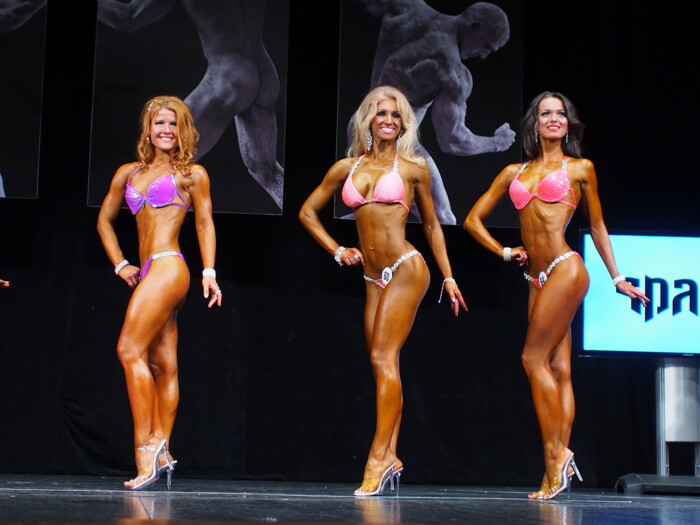
Women’s body fitness also had two height classes: up to 164 cm and over 164 cm. Body fitness has three rounds, but no free routine. All rounds are physique-judging rounds, and in each round four quarter turns are performed clockwise. The outfit changes between rounds, and this affects the overall impression.
- Round 1: plain black two-piece bikinis that are not shiny and have no embellishments.
- In round 1, the bikinis had to cover ½ of the outermost glute muscle.
- Round 2: a one-piece leotard whose color, material and texture the competitor chose.
- Round 3: two-piece bikinis whose color, material and texture the competitor chose.
Body fitness pays attention to the overall athletic impression, muscular balance, symmetry, skin condition, confidence and grace. Muscle groups must be round and strong, with low body fat. The physique must not show clear muscle separation and/or veins. The face, hair and make-up must complement the whole package.
Practical preparation for the competition stage
The foundation of all three disciplines is similar: gym training, aerobic exercise and diet. Bodybuilding adds 5 mandatory poses and a free routine to this. Gymnastic fitness adds agility, gymnastics, stretching and a free routine. Body fitness focuses more on the physique, the outfit and stage presentation.
A bodybuilder has to practice the mandatory poses and the free routine to music of their own choice. This takes several weeks. In fitness, practicing the free routine can take several months, because besides the poses you also have to settle the music, special effects, costume, strength and flexibility elements, and choreography.
The main goal of female bodybuilders is to build muscle mass to a high level. Training is usually done 56 days a week. No more than 12 body parts are trained in one session. For each body part, 34 exercises are done, and each exercise is performed 34 times. The repetitions fall in the range of 8 to 12. Free weights and Weider training principles are used a lot, such as progressive resistance, the pyramid and forced repetitions.
Training cycles are used throughout the year. The main ones are the strength cycle, the muscle-building cycle and the cutting cycle. In addition, aerobic training is done during the year and in the pre-contest cycle, most of the time no more than 3 times a week for 3040 minutes. In the pre-contest cutting cycle, the aerobic training load is increased to 56 hours a week and session length is extended to 60 minutes.
Training for fitness and body fitness has a different goal. There is no need to push muscle mass beyond acceptable limits, unless a body part needs extra work to improve symmetry. The general aim is to stay lean year-round, with strong muscles and smaller swings in body weight.
Most fitness competitors use two cycles: a muscle-toning cycle and a pre-contest cutting cycle. Fitness also has three additional practical goals: strength, energy and the ability to perform the free routine with great dynamism over 1.5 minutes. Body fitness doesn’t have this problem in the same form.
Fitness competitors usually train in the gym four days a week. A common system is two days of training, two days off and two days of training. Sometimes a different rhythm is used: 3 days of training, one day off and one day of training. You do 45 exercises per body part and each exercise 34 times. The rep count is 1215 repetitions, and the training loads make up 70% of the gym training loads bodybuilders use. The tempo is faster and more dynamic, and the pauses between exercises are shorter.
Aerobic training is done 56 times a week for 60 minutes a day all year round. In the pre-contest cutting cycle, the load can rise to two sessions a day and up to 7 days a week. That sounds harsh, but stage condition doesn’t happen by accident. It comes from a plan, consistency and the ability to ease off at the right moment.
Fitness FAQ
Does fitness mean the same thing as women’s bodybuilding?
No. Women’s bodybuilding focuses more on muscle mass, muscle definition and the mandatory poses. Fitness also judges athletic ability, the free routine, flexibility, agility and overall stage presence.
Why was body fitness created?
Body fitness was created for women who had a strong, proportionate physique but lacked a background in gymnastics or a complex free routine. The division gives them a chance to focus on the physique, stage posture and overall impression.
What should a beginner competitor learn first?
First, it’s worth learning the rules of your division: the rounds, attire, turns, poses and judging emphases. A training plan alone isn’t enough, because on stage the whole package is judged.
Author: EBFF
Source: WHO – physical activity.
Come and train! ArtGym