
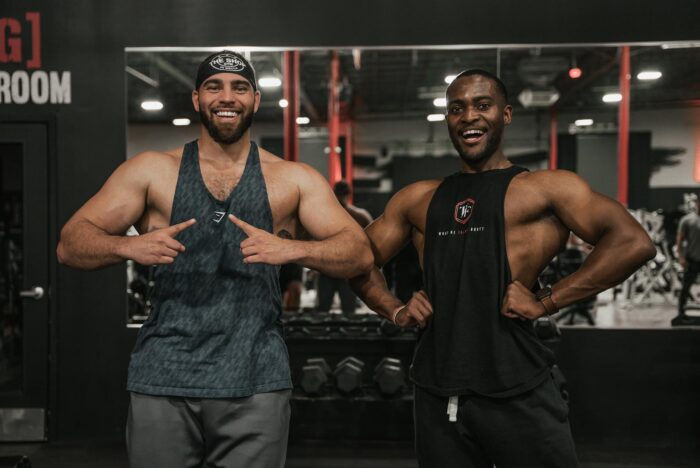
A gym travelogue on strength and stage condition
This travelogue from the Energy Club gym shows one simple thing: strength numbers can be insane, but on the bodybuilding stage the whole package decides. Aleksander Artjomenko was a man who was hard to miss there, but competing isn’t only about the weight on the barbell.
Why does this gym travelogue resonate?
As mentioned earlier, the workouts took place at the Energy Club sports club. To clarify: it wasn’t the Saue club. Training alongside was the club’s star, Aleksander Artjomenko, who has already come up a lot before, because to a gym-goer’s eye he was a special figure.
He stood out for two reasons. First, the visual picture: a powerful upper body, big arms and a physique that filled the room before he even touched the barbell. Second, the strength numbers. They were the kind that make some people simply shake their heads and say: “No way.”
If somewhere people were arguing about whether you can do a biceps curl with a 100 kg barbell, Aleksander Artjomenko could. And not with a single random rep, but for 10 sets. In the bench press, we’re talking about a level of 200 kg x10, and once he pressed 250kg.
Numbers like that stick in your mind. They make a young lifter think the answer has been found: whoever is stronger is better. Honestly, in the gym that is a very natural thought. When the barbell is moving and the muscle is big, everything seems clear.
The travelogue shows what the stage actually judges
This is where the difference comes in. The bodybuilding stage isn’t a bench press contest. Nor is it only about measuring arm circumference. In competition the body is judged as a whole: proportions, symmetry, dryness, poses and how all of these work together.
Despite phenomenal strength numbers and a very powerful upper body, Aleksander Artjomenko finished the Kuldne Kastan competition in 11th place in a field of 14 men. As you may remember, the author was at this competition 5 times. They were never even called out together for comparisons.
This doesn’t diminish Aleksander Artjomenko’s strength or the impression he made in the gym. On the contrary, it’s the contrast that makes the story interesting. In the gym one man can clearly be bigger and stronger, but on stage another can be better put together.
So what actually happens? A judge doesn’t look at just one body part. If the chest and arms are big but the legs lag behind, the picture looks out of balance. If the upper body is wide but the waist doesn’t cooperate in the poses, part of the stage impact is lost. If conditioning isn’t sharp enough, the muscle lines don’t come through.
How do you build the whole package in the gym?
A simple truth: strength is a big plus, but it doesn’t replace structure. If the goal is only to train and get stronger, then a 100 kg barbell biceps curl or a 200 kg x10 press is an impressive level in its own right. If the goal is the bodybuilding stage, you need to look at training more broadly.
The first question is proportion. Do the chest, back, shoulders, arms and legs grow together? A beginner often looks in the mirror at only the muscle that responds best. A more experienced lifter looks for the weak link, because on stage a weak link punishes more than a strong spot can save you.
The second question is symmetry. The left and right sides don’t have to be identical with lab precision, but to the eye the body has to look balanced. If one shoulder dominates or one leg visibly lags behind, it shows in the poses.
The third question is presentation. The same physique can look better or worse on stage depending on how a person stands, breathes and holds the poses. It sounds like a minor detail, but in competition details are often decisive.
Practical lessons from this travelogue
If you take anything away from this story, it shouldn’t be that strength doesn’t matter. It does. A strong base helps you build muscle and gives your training a clear yardstick. But your gym ego must not start running the program.
- Keep training your strong points, but plan separate work for lagging muscles.
- Don’t judge your condition only by the pump. Look at your body in a relaxed state and from different angles.
- If you plan to compete, practice posing during your prep, not in the last week.
- Remember that a big arm doesn’t automatically win you a complete physique.
Young lifters sometimes find this hard to believe. In the gym the most powerful man automatically seems the best. The stage makes the picture more honest and harsher. There, one strength can’t be used to cover for the rest of the body.
FAQ
Does great strength always mean a good placing in bodybuilding?
No. Great strength helps you build muscle, but bodybuilding also judges proportions, symmetry, conditioning and stage presentation.
Why might a very strong athlete place lower on stage?
The reason may be balance. If one body part dominates or conditioning isn’t sharp enough, the whole package can end up weaker than that of a less strong competitor.
What can a beginner learn from this story?
A beginner should learn to look at the body as a whole. Records are great, but a training plan should also develop the areas that don’t jump out at you first in the mirror.
Author: Ott Kiivikas
Source: WHO – physical activity.
Come and train! ArtGym




