Water aerobics: who water training suits
Water aerobics is a form of training done in the water that can surprise even those who think people only splash around in the pool. Here we look at who it suits, why water makes movement kinder to the body and what actually happens in a class.
Honestly, the old joke about drinking water before an aerobics class is surprisingly slow to die. The reality is different: the rhythm, the resistance, the balance and the trainer’s guidance get your body working in a way that leaves you feeling light afterwards, while your muscles still let you know they were used.
Why is water aerobics so good for the body?
The big appeal of water aerobics lies in the properties of water itself. Water supports the body, reduces impact and makes movement softer. This matters especially when your joints, back or overall condition don’t allow you to start at full speed on land.
That said, a soft environment doesn’t mean an easy workout. In water you have to overcome drag, inertia and buoyancy. Every arm and leg movement meets resistance. The faster you move, the harder the water works against you. A simple truth: you can adjust the training load yourself.
That’s why water aerobics suits very different people. Beginners can practice at a relaxed pace, while more experienced exercisers can raise the tempo. Swimming ability isn’t decisive in many classes, because exercises are often done in shallow water or with aids. In deep-water aerobics, belts help keep you afloat.
Training in water develops the cardiovascular system, aerobic endurance and the respiratory system. Many people also notice less stress, because water calms the nervous system and takes excess tension off the body. Lowering your body weight is helped by consistent movement, not by one miraculous class.
How does a water aerobics class work?
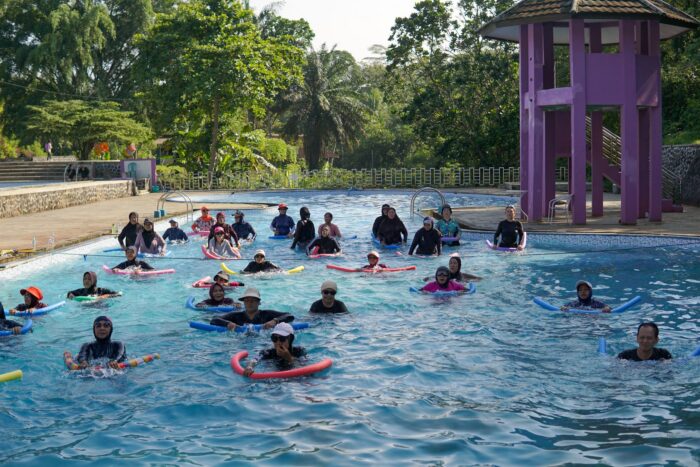
A class usually starts with a warm-up, where the body gets used to the water and the movements grow bigger. Next come aerobic exercises, strength exercises and finally a calmer part. The trainer demonstrates the movements at the poolside or in the water, and everyone can adjust the training load through range of motion and tempo.
Classes often use equipment. Gloves increase the load on the arms and shoulder girdle. Belts keep the body afloat in deep water. Noodles test your muscles, your balance and sometimes your ability to keep a straight face, because some exercises look funny at first. Resistance bands and light and heavy dumbbells are also used, and these can help build muscle strength.
Athletes around the world have also used water training during recovery. When an injury doesn’t allow running or jumping, water can offer a way to move without the same impact. It doesn’t replace the advice of a doctor or physiotherapist, but it can be a good part of a smart return.
Water aerobics isn’t only a women’s workout, nor is it only gentle gymnastics. In the original text it was said outright: FOR MEN!!!, for women, for young people, for older people, for children. When the training load is chosen correctly, you can get a really solid workout in the water.
Water aerobics in Estonia and around the world
In Estonia, the tradition of moving in water has long been tied mainly to swimming and bathing. Water gymnastics and water aerobics have only gradually reached the public. The opening of new swimming pools will certainly help, because a good class needs a suitable pool, a trainer and a regular time slot.
Compared with the Scandinavian countries and America, we still have plenty of room to grow. Liina Raska described her experience at the annual conference of the AEA (Aquatic Exercise Association), the largest and most popular water aerobics organization in the USA. The program was extremely packed: over six days, 130 different classes were on the schedule.
The heat of Las Vegas put the instructors to the test. Temperatures that at times reached 47°C drove quite a few people indoors in search of coolness. Fortunately, some classes took place in the indoor pool of the University of Nevada, Las Vegas, where the focus could be on the nuances of muscle training in water.
One exciting direction was hydrorider classes: cyclists were brought into the water on special bicycles. Spinning in water, which used to be done with belts or noodles, took on a new form with real bikes. There were also more polished kickboxing classes, and FUN classes appeared alongside the seriousness of everyday life. Who said training always has to be serious?
What to keep in mind before your first class?
For your first class, it’s worth bringing swimwear, a towel, flip-flops and a water bottle. Arrive a little early so you can get to know the pool, the changing room and the trainer without rushing. If you have a health concern, pain, or are recovering from an injury, tell the trainer before the class.
Don’t compare yourself with the person next to you. Water makes movement more private, because most of the body stays below the surface. That gives many people the courage to try even when working out in a gym feels uncomfortable.
A good sign is a trainer who offers easier and harder variations of the exercises. That way, people with different levels of condition and experience can move together in one class. Maintaining and increasing muscle strength among women over 40 is an important task in the fitness world, but the same principle actually applies to everyone: muscles need to be used.
Not everyone likes water. That’s perfectly normal. But if water appeals to you at all, water aerobics may be exactly the kind of movement that gets you back to working out, even when regular aerobics or the gym don’t appeal.
FAQ: water aerobics
Is water aerobics suitable for beginners?
Yes, it is. You can adjust the training load through the speed and range of your movements and through the equipment you use. Start gently, and ask the instructor for an easier variation if an exercise feels too hard.
Do you need to know how to swim?
In many classes, no. Exercises in shallow water don’t require swimming. In deep water, a belt that keeps your body afloat is usually used.
Does water aerobics help improve your fitness?
It does, if you attend regularly and put in enough effort. Water supports your body while also providing resistance, which works both your heart and your muscles.
FISAF, AEA water aerobics instructor, personal trainer
liina.r@online.ee
Tel. 05134811
Author: Liina Raska
Source: WHO – physical activity.
Come and work out! ArtGym