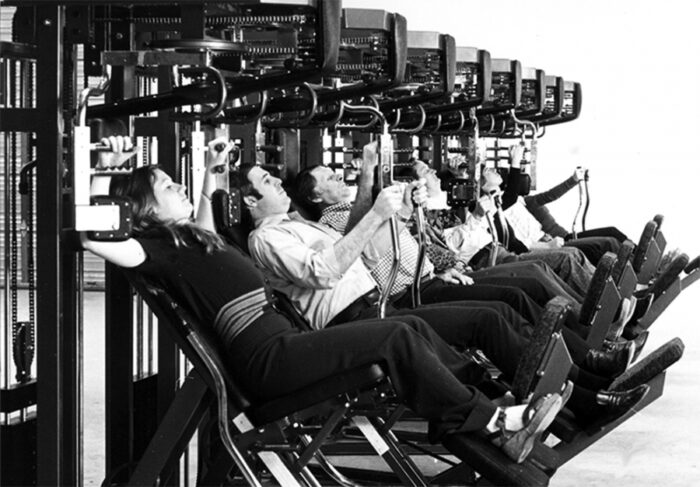
Arthur Jones and the basics of strength training
Arthur Jones didn’t beat around the bush: training had to be short, precise and heavy enough. If you want to waste less time in the gym and better understand why one proper set can be worth more than five sloppy ones, these basics will help you get back on track.
Why Arthur Jones still matters today
It’s easy to do too much in the gym. One more exercise for the chest. Two more sets for the arms. Then a little abs work too, because otherwise the workout feels unfinished. Arthur Jones’s idea was the opposite: do less, but do it so properly that your body has a real reason to get stronger.
Jones became known for Nautilus machines and high-intensity training. His principles don’t mean everyone should train only on machines or follow one specific program. What matters is the mindset. The exercise has to be controlled, the movement clean and the effort honest.
A simple truth: if you drag yourself from one set to the next, but your reps are half-done and your rests stretch out on your phone, it’s no longer effective training. Jones wanted every minute to count.
How Arthur Jones built a workout
Training starts with choosing exercises. According to Jones, a full-body workout should include about 4-6 exercises for the lower body and 6-8 exercises for the upper body. In total, it should stay at 12 exercises at most. That isn’t a random number but a way to keep the training short enough while still covering the whole body.
For each exercise, choose a weight you can lift for 8-12 slow, proper reps. If the eighth rep falls apart, the weight is too heavy. If the twelfth comes easily, the weight is too light. Next time, add load, for example about 5%, but only if your technique stays clean.
A set ends when you can no longer complete a rep with the same technique. Not when it becomes uncomfortable. Not when the thought pops into your head that it’s enough. Honestly, this is where many people leave the work unfinished.
Tempo was important to Jones. Lift the weight in about two seconds, pause briefly and lower it under control in about four seconds. It’s the lowering phase that tends to get away from people. If the weight just drops, the muscle is no longer doing the work you started the exercise for.
In your exercise order, move from larger muscle groups to smaller ones. For example: glutes and lower back, thighs, back, shoulders, chest, arms and neck. This helps you spend your energy where the training load is greater, instead of wearing yourself out on small muscles first.
Practical tips for the gym
When training on a machine, make sure the axis of your joint and the machine’s axis of rotation line up. For example, in a knee extension your knee has to be in the right place relative to the machine’s movement. If your position is wrong, you feel the exercise in the wrong place and the load may end up on the joints.
Keep your body still. Don’t sway, jerk or use momentum. Your grip should be firm but not desperate. Squeezing the handle too hard can raise tension throughout your body and make the exercise harder for the wrong reasons.
Breathe normally. If you hold your breath, the whole set becomes stiffer and more uncomfortable. If you’re not sure about the tempo, choose the slower option. A slow, controlled rep teaches you more than a fast rep you don’t fully control.
Keep your rests short. Jones wanted the move from one exercise to the next to happen quickly. That doesn’t mean rushing the exercise itself. On the contrary: move between machines quickly, but perform the reps calmly.
Move on to the next exercise and come back later. The point of the training disappears if an intense rhythm turns into waiting.
The whole program should fit within 20-30 minutes, including the warm-up. The working part itself can be 6-15 minutes if the effort is truly hard. After such a workout, rest for at least 48 hours. In some cases a break of up to 96 hours is appropriate, especially if the load was new or very heavy.
Keep a training log. Write down your exercises, weights, reps and time. Without notes, you just think you’re progressing. The numbers show whether that’s really the case.
Arthur Jones and recovery
Training alone doesn’t build muscle. It gives your body a reason to adapt. Recovery, sleep and food do the rest. If you eat too little or sleep badly, even the smartest training program won’t save you.
Protein intake has to be adequate, especially if your goal is muscle mass or strength gains. There’s no need to overcomplicate it. Every meal could include a reasonable amount of protein-rich food. Supplements can be convenient, but they don’t replace regular meals.
Alcohol works against your results. It interferes with recovery and makes consistency harder. Likewise, banned substances such as anabolic steroids or growth hormone are not part of Jones’s principles. These guidelines are meant for people who train on regular food and permitted supplements.
FAQ: Arthur Jones and training
Is one set per exercise really enough?
It can be enough if the set is performed with very good technique and sufficient effort. A beginner doesn’t need to go to the max right away, but should first learn to control the movement.
Can this be done with free weights?
Yes, but on machines it’s easier to keep the movement consistent and safe. With free weights, such as squats or deadlifts, your technique has to be especially solid.
How often should you do this kind of program?
Usually 2-3 times per week is enough, as long as every workout is hard and your whole body gets worked. If your strength drops or your muscles don’t recover, the break is too short.
Author: Arthur Jones, summarized by Timo Maju, edited by Arnold Tokko
Come and train! ArtGym