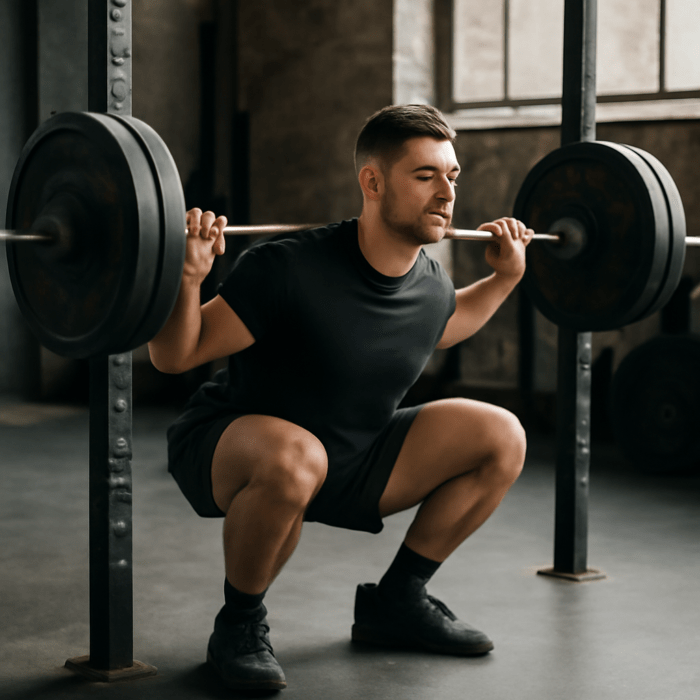
Squats for muscle mass or strength
Squats may look much the same from the outside, but your goal changes how you approach the exercise. If you want to build muscle mass, you train one way; if you want to lift more weight on the barbell, you need to shift your priorities.
The simple truth is this: before choosing your reps, weight and barbell position, ask yourself why you are squatting in the first place. That answer keeps your training true to its purpose.
Why do squats differ depending on your goal?
The squat is an exercise for both muscle building and strength development. The difference lies in what you want to achieve in each set. When training for bodybuilding, you want your thigh, glute and core muscles to do more work and stay under tension for longer. When training for powerlifting, you want to move as powerfully as possible, with solid technique and heavy weights.
This does not mean that one approach is right and the other is wrong. Both work when used appropriately. Problems arise when you talk about muscle building but perform every squat like a competition attempt. Or the reverse: you want a higher one-rep max but exhaust yourself with long, slow sets.
So what is actually happening? The same exercise sends your body a different signal. That signal depends on your reps, rest periods, tempo, body position and how deliberately you keep the muscle working.
How do squats work for muscle building?
When your goal is muscle mass, the squat is more about working your muscles than simply moving weight. You do not need to set a record every time. You need to create enough tension, maintain control of your technique and feel which muscles are working.
- 1. Reps. For hypertrophy, use a broad rep range: from sets of 8-12 reps up to 25 and even 50 reps. This gives the muscle more training volume and teaches you to maintain tension.
- 2. Weight (intensity). Getting stronger should always be a goal, but when training for muscle mass, this applies to both long and short sets. The weight needs to be heavy enough, but not so heavy that your technique breaks down.
- 3. Tempo. Slow squats with an emphasized eccentric phase stimulate greater muscle growth. When you lower yourself under control instead of simply dropping into the bottom position, your legs do more actual work.
- 4. Time under tension. If your goal is muscle mass, longer time under tension is more effective and often necessary. A longer set means the muscle has to work for longer.
- 5. Barbell position. Bodybuilders generally favor a high barbell position on the upper traps. This helps keep the torso more upright and shifts more of the work to the thigh muscles.
- 6. Body position during squats. When training for muscle mass, you generally keep your torso more upright. This places more tension on the thigh muscles and relies less on hip drive.
- 7. Rest between sets. Both long and short rest periods between sets are used when training for muscle mass. Shorter rest can make a workout feel harder, while longer rest allows you to maintain the weight you are lifting more effectively.
- 8. Squat depth (range of motion). For both goals, you should generally squat as deep as possible while keeping the risk of injury to a minimum. If your joints do not allow you to reach adequate depth, you need to work on mobility.
- 9. Foot placement (stance width). Bodybuilders often squat with a medium or narrow stance. However, the right stance depends heavily on your body type and individual anatomy.
- 10. Muscle contraction during squats. For muscle building, focus more on the mind-muscle connection and on feeling the muscle contract. As you rise from the squat, feel the peak contraction.
How do squats work for strength development?
When developing strength, the squat has a simpler primary purpose: to lift more weight with solid technique. The goal here is not a burning sensation in your thighs or the longest possible set. The focus is on the nervous system, technique and force production.
When squatting for strength, you generally stay in the 1-5 rep range. The load is heavy enough for your body to learn to handle high levels of effort, but the set does not last so long that fatigue starts to dictate your technique.
The tempo changes too. Slow squats with an emphasized eccentric phase generally have no place in powerlifting. The movement should be controlled, but not deliberately slowed down. The heavier the weight, the more a precise barbell path, a stable core and a strong drive out of the bottom position matter.
In strength training, the barbell is often positioned lower, sitting farther down across the traps or back. This allows many lifters to lift more weight and make greater use of their hips. A wide stance and a forward torso lean are also common in powerlifting squats. This is not lazy technique, but a position chosen to serve the goal.
Rest periods are also longer. When training for strength, rest periods between squat sets are usually 3 minutes or more. The reason is practical: you need to recover almost fully from the previous heavy squat set.
Squats in practice: what should you pay attention to?
If you’re unsure which approach to choose, look at your training log. Do you want bigger thighs and a better mind-muscle connection? Then keep some of your work in higher-rep sets, control the descent and give yourself enough rest between sets. Do you want more weight on the barbell? Then prioritize low-rep sets, longer rest periods and regular technique practice.
Honestly, you don’t have to commit to one approach forever. Many people need both. You can focus on muscle mass during one phase and strength during another. What matters is keeping the training stimulus consistent within a single training block.
Squat depth remains important for both goals. If you can squat deep without your lower back losing position, your knees hurting or your heel lifting off the floor, you have a solid foundation. If you can’t, don’t let your ego dictate your depth. Work on your mobility and, in the meantime, find a range of motion you can control with good form.
Stance width is individual, too. Some people feel their thigh muscles working more with a narrower stance. Others need a wider stance because it lets their hips move more freely. A good squat doesn’t have to look the same for everyone, but it does need to be repeatable, pain-free and aligned with your goal.
FAQ: squats and training goals
Do you always have to squat slowly to build muscle mass?
Not always, but a controlled eccentric phase helps keep the muscle engaged. Lowering too quickly often makes the squat easier at precisely the point where the muscle could be doing more work.
Are high-rep squat sets useful for strength?
They can help build training volume, but heavier, lower-rep sets matter more for developing foundational strength. That’s why the 1-5 rep range is often used when training for strength.
Should you always squat as deep as possible?
Generally, you should aim to squat as deep as possible, but only with good technique and to a depth your body can tolerate. If mobility is limiting you, work on it patiently.
Source: www.t-nation.com
Translated by Janar Rückenberg
Come work out! ArtGym