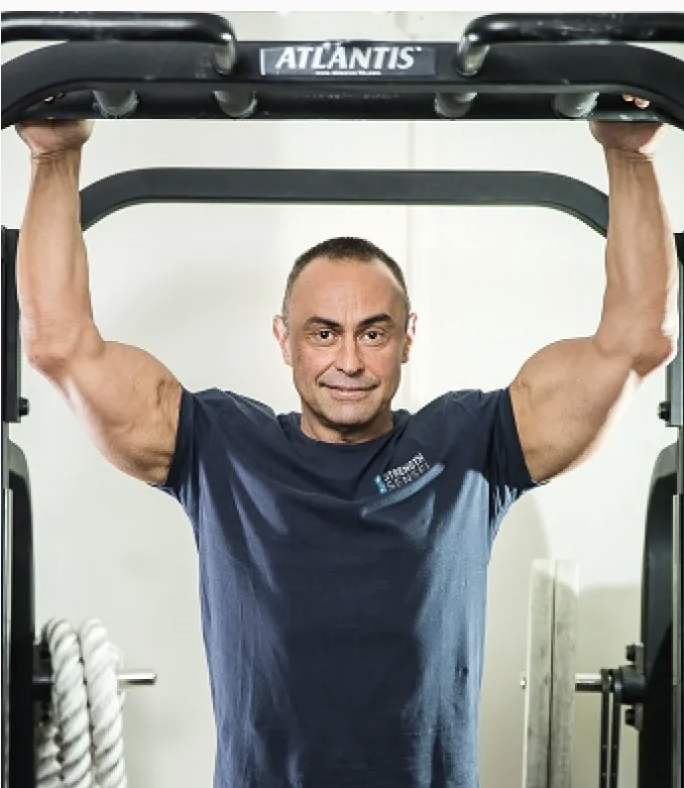
Charles Poliquin: rules of strength training
Many coaches remember Charles Poliquin for his straightforward approach to strength training. Here is part II of his rules, covering exercise selection, set length, reps, rest and when to reduce volume.
Charles Poliquin on exercise selection
35. If your goal is functional strength and better athletic performance, closed kinetic chain exercises often offer greater benefits than open kinetic chain exercises. A simple example: for an athlete, a squat is usually a better choice than a machine leg extension.
36. When choosing an exercise, you also need to consider the training load from your main sport. If a speed skater or gymnast already does a lot of jumps in sport-specific training, adding excessive depth jumps in the gym is unwise. It can lead to injury.
37. The greater the proportion of your muscle mass involved in an exercise, the greater the energy expenditure. That is why a heavy squat fatigues your body differently from a small isolation exercise.
38. The muscles that do most of the work in your main sport should also take priority in strength training. Train them at angles, in directions and through planes of movement that match those of your sport as closely as possible.
Charles Poliquin on reps and intensity
39. Set length influences the structure of your entire workout. It determines the number of sets, tempo, rest periods and sometimes even exercise selection.
40. Set length also determines intensity: the weight you can use for a set. You generally cannot perform a long set with the same weight you use for short sets.
41. The weakness of percentage-based programs is that they do not always account for how ready you actually are to perform that day. A weight may look appropriate on paper, but your body may tell a different story.
42. The weight you lift determines how much tension your muscles experience. The direction and magnitude of that tension help determine how your muscles develop.
43. When planning your training, first ask yourself what effect you want to achieve. Only then can you choose the right rep range.
44. Short sets do more to develop maximal strength. Longer sets are better suited to building strength endurance.
45. To develop maximal strength, use an intensity of 70-100% of your 1RM. This does not mean every workout has to push you to your limits; it means the goal requires a sufficiently heavy weight.
46. Fast-twitch muscle fibers respond better to heavy weights and short sets. Slow-twitch muscle fibers receive more stimulation from longer sets and lighter weights.
47. As you get stronger, your nervous system also becomes more efficient. To keep progressing, you then need to use intensities closer to your 1RM more frequently.
48. For eccentric sets, or negative reps, stay within a range of 1-6 reps. Doing more may not produce better results, because the training load is already high.
49. With technically demanding exercises, such as the Olympic lifts, long sets can cause technique to break down. When a movement requires precision, you need to monitor fatigue particularly carefully.
50. To develop relative strength, athletes generally use a range of 1-5 reps per set. This keeps the focus on strength rather than simply tolerating fatigue.
Strength training volume, sets and rest
51. Adding chains increases the time a muscle spends under tension. Using chains may therefore allow you to reduce the optimal total rep count for your training goal.
52. The number of sets is inversely related to the rep count. If you do short sets, do more of them. If you do long sets, do fewer.
53. The principle of diminishing returns applies to the number of sets you perform. Beyond a certain point, each additional set contributes less to your progress than the one before it.
54. For beginners, 1-2 sets per exercise may provide enough stimulus. However, you adapt to this within just 6-12 workouts, after which you need to increase the volume of work.
55. Sometimes, doing more sets than usual is justified. It must still serve a purpose, though, rather than simply making the workout feel harder.
56. One way to fit in more exercises without spending extra time is a tri-set. This means performing three different exercises for the same body part or muscle in succession, with minimal rest between them.
57. If your goal is to bring up a lagging body part, it may be appropriate to use as many as four exercises for it during certain periods. This is a temporary focus, not a permanent rule for every workout.
58. If you feel you have not recovered from your previous workout, you should reduce volume rather than intensity in your next workout. Frankly, many people struggle with this because doing less work feels like a step backward.
59. Rest intervals depend on the goal of your training: relative strength, functional hypertrophy, muscle mass or strength endurance.
60. The more muscle mass an exercise involves, the longer your rest intervals between sets should be.
61. The greater an exercise’s range of motion, the longer your rest intervals should be.
62. The bigger and stronger you are, the more recovery time you need between sets.
63. Exercises that demand more coordination, such as the barbell snatch, require longer rest intervals between sets.
64. Supersets for opposing muscle groups allow you to double the training load on your body in essentially the same amount of time, without sacrificing much intensity.
65. Some exercises must be performed with speed and explosiveness. The Olympic lifts fall into this category.
66. With consistent training, a talented athlete can triple their strength in about seven years. However, progress is not linear. Both the potential for improvement and the rate of progress decrease each year.
67. Even during periods of recovery, such as after surgery, you can tolerate a training frequency of 5-6 workouts per week very well. It is a matter of managing your training load, not just counting days on the calendar.
Charles Poliquin: a practical summary
So what really matters? Your exercise selection must suit your goal and your primary sport. Your reps must match the desired effect. Resting is not laziness; it is part of your training plan.
If your training progress stalls, adding weight straight away is not always the answer. Sometimes you need to change the number of sets, the duration of each rep, the angle of the exercise or the amount of recovery. The simple truth: good strength training is not random hard work, but purposeful hard work.
Read part I here: http://www.fitness.ee/artikkel/1723/charles-poliquini-reeglid-joutreeninguks–i-osa
FAQ: Charles Poliquin and strength training
Do beginners need to do lots of sets?
No. If you are a beginner, 1-2 sets per exercise may work initially, but your body adapts within 6-12 workouts. You then need to increase your training load intelligently.
When should you use low-rep sets?
Low-rep sets are better suited to developing maximal and relative strength. For example, training for relative strength often involves 1-5 reps per set.
Can rest intervals be long?
Yes. Big, complex exercises with a large range of motion require longer recovery. The stronger you are, the more rest you may need.
Translated by Janar Rückenberg
Come train with us! ArtGym