Training during pregnancy
Two lines on a test strip or a tiny flickering dot already smiling at you from the screen at your doctor’s office are a clear sign that you’re no longer working out alone.
Your training now has just one goal: to bring a healthy, strong baby into the world. Until fairly recently, pregnant women who exercised were met with disapproving looks, but awareness has grown considerably in recent years, and exercising with a baby on board is no longer such an unusual sight.
To dispel common myths and offer valuable advice on exercising with a baby on board, we turned to Valeri Tsobanu, who has worked in this field for years, and Egle Eller-Nabi, who is continuing to work as a trainer during her pregnancy.
Training during pregnancy doesn’t just keep your body toned; it also improves circulation, helps fight fat and prepares your body for the
physical demands of childbirth. As an expectant mother, you need to keep a few precautions in mind and adjust your training routine to accommodate your growing bump and keep your baby safe.
“If you train at a gym, it’s best to consult an experienced trainer who can make the appropriate changes to your training program as your pregnancy progresses,” says Valeri. He stresses that training during weeks 10-12 and 20 of pregnancy needs particular attention, as these are fairly critical periods and any problems that arise can have serious consequences. After giving birth, return to training after your first menstrual cycle, or after three months if you’ve had a cesarean section. The only exception here is therapeutic exercise. Breastfeeding places no restrictions on exercise, but you do need to pay closer attention to hygiene.
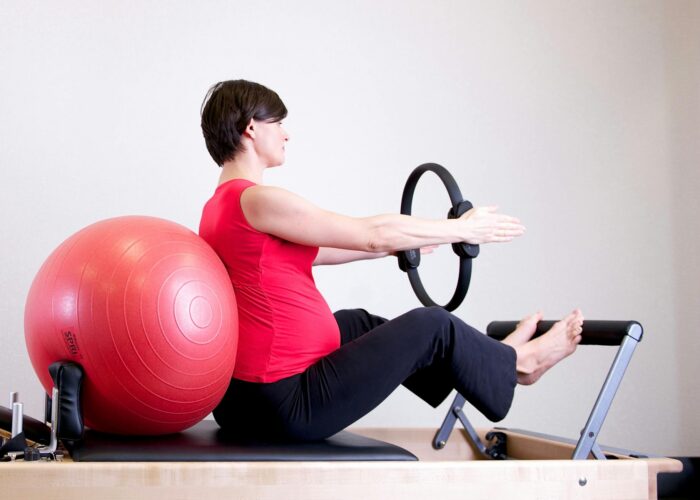
“There’s a wide range of activities I would definitely recommend during pregnancy: Pilates, yoga, tai chi. Exercise ball exercises are also very suitable, but they should always be done under a trainer’s supervision. Movements should be smooth and slow, without causing pain or discomfort,” Valeri advises. And remember that movement and sport are just one part of a successful transition to motherhood, good health and a body in great shape.
Training during pregnancy
“Staying active during pregnancy is important for both you and your baby. Moderate training, whether strength training, aerobic training or stretching, improves blood flow throughout your body and, in turn, the blood supply to your baby,” says Egle. “If you exercised regularly before pregnancy, you can certainly continue your active lifestyle by adjusting your training load. I recommend consulting your midwife and trainer first—our bodies are unique and respond to pregnancy very differently,” she adds. Egle emphasizes that during pregnancy you need to learn to listen to your body and pay attention to how you feel at every moment.
Here are her key principles:
– Remember that there are always two of you, and your baby can’t yet clearly let you know what feels most comfortable.
– Pushing yourself too hard can harm your baby. If an exercise causes too much discomfort, skip it.
– During aerobic training, make sure your heart rate doesn’t rise too high, and avoid exercising in rooms with poor ventilation or high humidity. It’s up to you to find the type of training that suits you best and that you enjoy.
“For example, I enjoy walking outdoors, going to aqua aerobics and practicing yoga. I’m also continuing to teach classes at a reduced training load, avoiding jumps or excessive muscle strain. I also try to do stretching and strengthening exercises regularly to help prepare my body for childbirth. I’m currently in my seventh month of pregnancy and feel very well—largely thanks to staying active regularly,” Egle says of her experience.
Here are some recommended exercises that Egle does regularly at home. She adds that, as well as helping her stay in shape during pregnancy, they also prepare her mentally for childbirth.
Stretches to open up the pelvic floor muscles
1. Sit on the floor with your back straight and the soles of your feet together in a butterfly position. Hold your feet with both hands and draw them as close to you as you can without causing discomfort. Begin moving your knees up and down. Continue for a few minutes, then extend your legs in front of you and relax. If your back gets tired, do the exercise with your back supported against a wall or a ball.
2. Stand upright with your feet wider than shoulder-width apart, firmly on the floor and parallel to each other. Slowly lower into a squat. Keep your back straight and your heels on the floor. Press your palms together and rest your elbows against your knees. Hold the position for a couple of minutes, then relax your legs. You can also do the exercise with support by squatting down onto a low bench or a stack of books.
An exercise to strengthen your thigh muscles and glutes
3. Stand with your feet wide apart, your back straight and your toes pointing outward. Slowly lower into a squat, keeping your back straight. Aim to lower until the angle between your thigh and lower leg is 90 degrees, but never push yourself too hard. If you feel discomfort, don’t go any lower. Slowly return to the starting position. Avoid locking your knees. Repeat the exercise 10–12 times.
4. Stand with your feet shoulder-width apart and parallel. Bend your knees and slowly lower into a squat until your thighs are parallel to the floor, then return to the starting position. Repeat the exercise 10–12 times.
Exercises for the abdominal and core muscles
5. Sit with your back straight and your arms extended in front of you. Slowly lean back toward the floor, going no more than halfway down and keeping your back straight, then return to a seated position.
6. Sit on the floor with your back straight and your legs apart. Keeping your back straight, move into forward flexion, resting your hands on the floor. Return upright, then repeat the movement toward one leg and then the other. This exercise also stretches the muscles of your back and the sides of your torso.
7. Get into a plank position. If you feel excessive strain on your abdominal muscles, lower your knees to the floor. Keep your core muscles engaged and hold the position for as long as feels comfortable. Then sit back onto your heels with your torso bent forward and rest.
8. Stand upright, leaning against a wall. As you exhale, perform a crunching motion, contracting your abdominal muscles. Repeat the exercise 10–12 times.
9. Lie on your side with your knees bent and your legs drawn forward, resting your head on your outstretched lower arm. Place your other hand behind your head and, contracting your abdominal muscles, slowly move your elbow toward the floor. Keep the movement smooth and do not lower too far.
Exercises to strengthen and relax the back muscles
10. Get onto your hands and knees, making sure your back is not rounded and your hands are in line with your shoulders. Slowly raise one arm and the opposite leg, keeping both straight and in line with your body. Hold for 10–15 seconds, then return your legs to the starting position. Repeat the exercise with the other leg. Perform the exercise 8–12 times with each leg.
11. Get onto your hands and knees. Round your back upward, bringing your head toward your chest into the cat position. Return to the starting position, then arch your back in the opposite direction and lift your head. Repeat the exercise 12–16 times. You can also make circles with your torso in this position.
12. Sit cross-legged with your back straight and begin slowly circling your torso. Make circles in one direction for a couple of minutes, then in the other direction. This exercise is also good for relaxing the back muscles and stretching the pelvic floor muscles.
These are 12 different exercises recommended for women who are pregnant to do at a fitness center. I want to emphasize that you should consult a trainer beforehand and let them know you are no longer training alone.
Read the full article in the Spring 2011 issue of Hers.
Author: Egle Eller-Nabi
Source: Turg.Fitness.ee
Come and train! ArtGym