
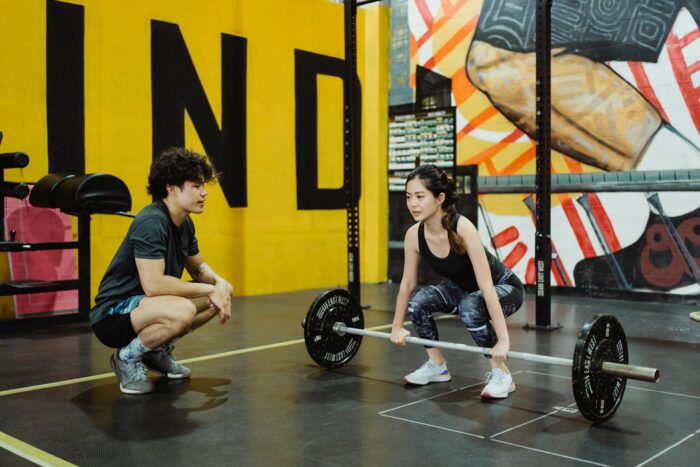
Deadlift: correct hip position and setup
A deadlift is not a squat, even though the two exercises have similar starting positions. If your hips drop too low, the barbell drifts out in front of your body and your shins take an unnecessary beating.
The simple truth is that a good deadlift starts from a position that allows the barbell to travel as straight upward as possible. To achieve this, the barbell, your shins, shoulder blades and hips need to be positioned correctly in relation to one another.
Why is a deadlift not a squat?
The aim of a squat is to lower yourself and stand back up. Your hips drop low, your knees move forward and your body has to balance differently than it does during a deadlift. In a deadlift, the aim is to lift the barbell off the floor while keeping the weight close to your body and directing force into the floor, rather than losing it forward.
If you start a deadlift with your hips below your knees, you are essentially in a squat position. It might look strong at first, but the initial movement quickly exposes the mistake. Your hips shoot up, the barbell loses contact with your shins and it rolls away from your body.
What is actually happening? You are no longer lifting straight up. The weight travels farther, your lower back has to work harder and the barbell feels heavier than it should.
A deadlift starts with the right hip height
The right hip height is not the same for everyone. Body proportions vary: some people have longer legs, others have longer arms or a shorter torso. That is why you cannot expect every lifter to start at exactly the same angle.
The general principle is clear, though: in a conventional deadlift setup, your hips are higher than your knees. That does not mean your legs are straight. It means the position resembles a half squat rather than a deep squat.
If your hips are too high, the exercise starts to resemble a stiff-legged deadlift. This places more of the training load on your hip extensors and lower back. If your hips are too low, your knees get in the way of the barbell and it scrapes your shins. Either way, you lose a strong start to the lift.
How to get your deadlift technique right
Start with the barbell. It should be touching your shins or very close to them. If the barbell is already far from your body at the start, it will move even farther away during the lift. This is one of the most common reasons a deadlift feels awkward and heavy.
Next, check the position of your shoulder blades. Viewed from the side, your shoulder blades should be directly over the barbell. Your shoulder blades, not your shoulders. With your shoulder blades in position, your shoulders will naturally sit slightly in front of the barbell. This is normal and necessary.
Then find the right hip height. Do not sit too low. Do not lift with completely straight legs when performing a conventional deadlift, either. A good starting position lets you feel tension in your legs, hips and back at the same time. Your chest does not need to be upright as it would in a squat, but your back must stay firm and under control.
Frankly, scraped shins often say more about your technique than your bravery. If the barbell tears up your shins, check your hip height and knee position first. The barbell should travel close to your body, but it does not need to take skin off with every rep.
Practical signs that your setup is better
- The barbell travels up from the floor in an almost straight line.
- Your hips do not shoot up at the start of the lift.
- Your shins stay close to the barbell without being scraped bloody every set.
- Your shoulders are slightly in front of the barbell, with your shoulder blades directly above it.
- You feel your legs, hips and back working, rather than just your lower back.
A trap bar, also known as a hex bar, can offer a useful middle ground for some lifters. It combines some of the benefits of the squat and deadlift: your body can stay more upright, and it is easier to keep the weight aligned with your body’s midline. This does not make the conventional deadlift wrong, but it offers a way to learn a stronger deadlift movement pattern.
If your coach tells you to keep your hips very low, it is worth asking exactly what they want to see. Sometimes they simply mean that your hips should not be too high. That makes sense. But hips below your knees are no longer a good starting position for a conventional deadlift.
FAQ: deadlifts and hip position
Should the barbell touch your shins during a deadlift?
Yes, the barbell should be close to or touching your shins. However, the lift does not have to leave your legs scraped. If your shins keep taking hard knocks, your knees are probably too far forward or your hips are too low.
Does a lower hip position make your deadlift stronger?
Usually not. Starting with your hips too low forces them to rise at the beginning of the lift anyway. This disrupts the barbell’s path and makes the lift less efficient.
Do long legs change your deadlift setup?
Yes. A lifter with longer legs may naturally have a higher hip position than a lifter with shorter legs. That is why you need to consider your body proportions rather than blindly copying someone else’s starting position.
Author: Janar Rückenberg (translation)
Source:Turg.Fitness.ee
Come train with us! ArtGym




