Why muscles aren’t all equal in training
Muscles don’t all develop the same way, even if a training program looks solid on paper. The idea behind Todd Wilson’s article “Functional Hypertrophy” is simple: for an athlete, what matters is not just a bigger muscle, but the kind of muscle growth that genuinely supports their strength, speed and explosiveness.
If your goal is a stronger pull, a better jump or a sharper acceleration, you need to look deeper than the mirror. Hypertrophy is not one and the same thing in every situation.
Why aren’t muscles equal?
In the gym, people often talk about muscle mass as if it were one big unit. In reality, what matters a great deal is which muscle fibers develop and what kind of work makes them grow. One workout may build more endurance and pump, while another mainly improves strength and explosive effort.
The original text distinguishes two important directions: sarcoplasmic hypertrophy and myofibrillar hypertrophy. The first is associated more with volume inside the muscle and longer time under tension. The second concerns more the structures that make the muscle contract. This second side matters especially for an athlete whose performance depends on strength, power and speed.
Honestly, this distinction is blurry in many programs. People simply do more sets and more exercises and hope the result is both a bigger muscle and better performance. Sometimes that works out. But not always.
How do muscles grow for strength?
In myofibrillar hypertrophy, the main focus is on adding contractile capacity to the muscle. As the myofibrils develop, the muscle’s ability to produce force grows. You can see this in elite powerlifters and weightlifters, especially in the legs and traps. They don’t just look strong. They are strong.
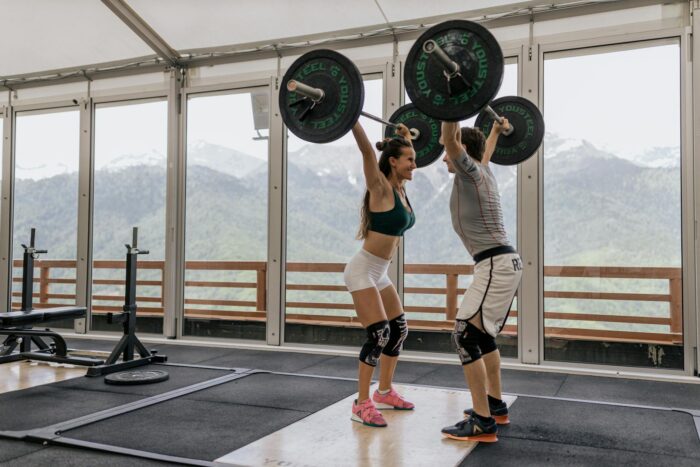
Exercise selection alone isn’t behind this kind of development. Squats, rows, snatches and presses all matter, but how you perform them matters just as much. Traditionally, this means heavy loads, short sets and plenty of quality working sets. Sets are rarely longer than 6 repetitions, and sets of three are often used.
Explosive execution creates high tension in the muscle. It recruits many fast muscle fibers, which often don’t work to their full extent during slow repetitions and very long sets. A simple truth: if you want to train fast strength, your training also has to include fast, forceful effort.
That doesn’t mean every repetition should be careless or technically falling apart. Explosive doesn’t mean uncontrolled. It means moving the weight with the intent to be fast while keeping your position and bar path in check.
Fast and slow muscles in training
Slow muscle fibers, and also type IIA fibers, need a longer time under tension to trigger hypertrophy. That suits work where the goal is endurance, volume and repeated effort. But if an athlete needs a jump, acceleration or a heavy single lift, putting too much emphasis on growing slow fibers may not be the best choice.
The original text points out that fast muscle fibers contract up to 10 times faster than slow muscle fibers (Siff, 2000). If slow fibers are too heavily hypertrophied, it can, figuratively speaking, make movement inside the muscle harder. Friction between the fibers increases, and the work of the fast fibers can lose its sharpness.
This doesn’t mean slow muscle fibers are bad. They aren’t. The body needs them. The problem arises when an athlete in a speed-strength sport spends much of their time training in a way that develops the qualities their sport demands least.
A powerlifter, weightlifter, soccer player, basketball player, volleyball player, hockey player, baseball player, strongman and track and field athlete don’t need exactly the same muscle profile. A bodybuilder doesn’t have to choose just one path either. A smart bodybuilder uses both types of hypertrophy, because appearance and strength can support each other.
Muscles in practice and choosing a program
So what actually happens if your whole workout consists of nothing but long, burning work? The muscle gets plenty of volume and the time under tension is long, but developing fast strength may take a back seat. If, on the other hand, your whole workout consists only of heavy singles and short sets, you may lack the volume that some athletes or bodybuilders need.
That’s why it makes sense to include both in your program. For example, you can start the workout with heavy basic exercises, where the goal is strength and technical quality. The 5 x 5 mentioned in the original fits well here as an example. Later you can add longer sets, for example 8–12 repetitions, or timed sets lasting 45–60 seconds.
This structure helps keep the focus clear. Heavy exercises demand a fresh nervous system and good technique. Longer sets fit better into the second half of the workout, where the aim is to give the muscle extra work rather than push for a record.
Your sport matters too. If your goal is explosiveness, don’t let every workout turn into a pump-only marathon. If your goal is muscle mass, don’t forget that a bigger muscle can be stronger when you also give it heavy work.
FAQ
Is sarcoplasmic hypertrophy bad?
No, it isn’t. It can be useful for bodybuilders and athletes alike, as long as it’s used at the right time and in the right volume. It’s a question of balance, not of avoiding one way of training entirely.
Do short sets build muscle?
Yes, especially when the weights are heavy and the quality of work is high. Short sets favor myofibrillar development, which is closely linked to strength and power.
Should a bodybuilder only do long sets?
No. The point of the original is exactly the opposite: a smart bodybuilder uses both heavy basic exercises and longer sets. That way you can develop both strength and muscle size.
References
Siff M.C. (2000) Supertraining 5th edition. Supertraining Institute, Denver, CO.
Translated and compiled by Janar Rückenberg
Source:Turg.Fitness.ee
Come and train! ArtGym