
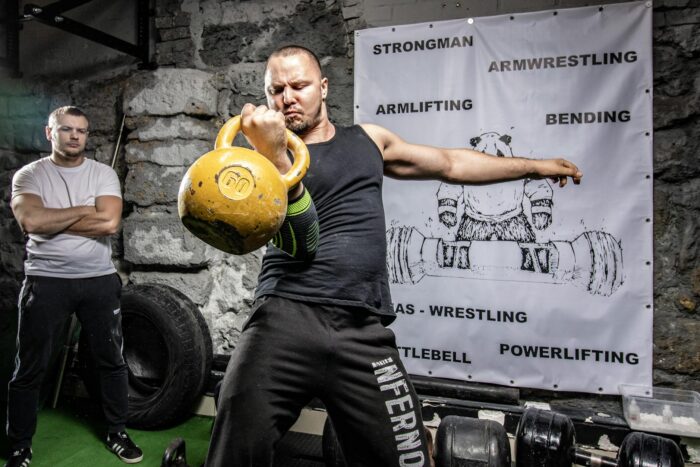
Practice makes a strongman a champion
A short truth every strongman should know: practicing the specific competition events is what makes you a successful strongman. Not just the squat, deadlift and press in the gym. The stones, the Yoke and the suitcases themselves, too.
Why practice is the foundation of a strongman’s success
The men who reach the final share one thing. They have tried the events beforehand and worked through them, rather than only building base strength in the gym.
There have been callers who ask only a month before a competition whether they should practice the events separately. These are often men with strong base strength. But their performance at the competition speaks for itself: they finish in the back half, and it’s obvious the events have barely been touched.
Take the example of a soccer player. You can squat 300 kg with a barbell in the gym, but if you rarely step onto the field, you won’t become a world-class soccer player. Logical, right? So why do so many strength athletes believe that a strong squat, deadlift and press will take care of everything else on its own?
Becoming a strongman at a high level requires constant training on the competition events. Period.
Equipment costs and commitment
Many complain that buying dedicated strongman equipment is expensive and time-consuming. That’s true. But reaching world level in any sport is not cheap. If you take your child to tennis training hoping they’ll become a champion, private sessions await there too, with an hourly rate that can reach 200 dollars. Costs and sacrifices come with everything.
How practicing with stones paid off for Jouko Ahola
Jouko Ahola had not touched the specific competition stones before the contest, yet he lifted all six, and in a staggering 22 seconds. Besides him, only Phil Pfister managed stone no. 6. While stones no. 4 and 5 proved insurmountable for most, Ahola seemed to be playing with them.
There’s no magic here. He has his own stones at home, and he has spent years honing his technique on them. They aren’t exactly the same as the competition stones, but an event is an event. On top of that came a 400 kg deadlift, his own staircase with weights, the Hercules Hold and more. At 27, he had decided to stay at the top for a few more years, and practice is precisely the foundation of that.
To beat someone in competition who is stronger than you in base strength, you have to master the technique of the specific event. Every man has different muscle attachment points, bone lengths and movement patterns. The only way to learn to perform an event efficiently in time and space is direct practice.
Super Yoke — where practice is downright mandatory
A good example is the Super Yoke, also known as the Yoke walk. One competition stuck in my memory: the finalists’ squat records were around 360-370 kg, but the Yoke times were dreadful. The event was won by a wide margin by Phil Pfister, who has said publicly that he has never squatted more than 270 kg.
That doesn’t mean Pfister is weak. Core and overall strength have to be well above average in this event. But it’s telling that a base number alone doesn’t work miracles. The competitors who recorded any Yoke time at that competition had a homemade Yoke in their gym and used it regularly.
Walking with a 300 kg barbell on your shoulders is not a natural movement pattern for the body. No matter how strong you are, the first time you go under the Yoke, your body has no idea what to do with it. The more you do it, the better you get. At first it’s hard and unpleasant, a bit like a backhand in tennis. Theoretical knowledge doesn’t help much; you have to go and do it.
How to prepare for changing events
The obvious question: events are run differently at different competitions, so how do you prepare?
The simple answer: stay informed. Look at which events are planned for upcoming competitions, and get or build as much practice equipment as you can. Events vary, but the core events recur, and practicing them is never wasted.
- suitcase carries
- standing presses (barbell, big dumbbell, log, Apollon)
- stones
- staircase
- Yoke walk
- car pull
- deadlift variations
Translator’s note: some people claim that you can already succeed in strongman on the strength of big base lifts. This article argues the opposite. You can squat 300 kg and still struggle with the Yoke walk and lifting stones. The competition events have to be practiced separately and continuously. Naturally, base strength must also be at a good level alongside that.
FAQ on practice
Is base strength alone enough for a strongman competition?
No, it isn’t. A strong squat, deadlift and press are a necessary foundation, but without practicing the events, that strength doesn’t show up in your performances. The Yoke, stones and suitcases each demand their own technique.
How often should you train the competition events separately?
At least one of them once a week, and 2-3 times a week when preparing for a competition. Rotating them keeps your technique fresh without letting your body burn out.
What should you do if you have no room for equipment at home?
Find a gym that has strongman equipment, or find a community that trains together. In Estonia there are few such places, but they exist. If necessary, you can also build the Yoke and the stones yourself.
Translated by: Janar Rückenberg
Come and train! ArtGym




