
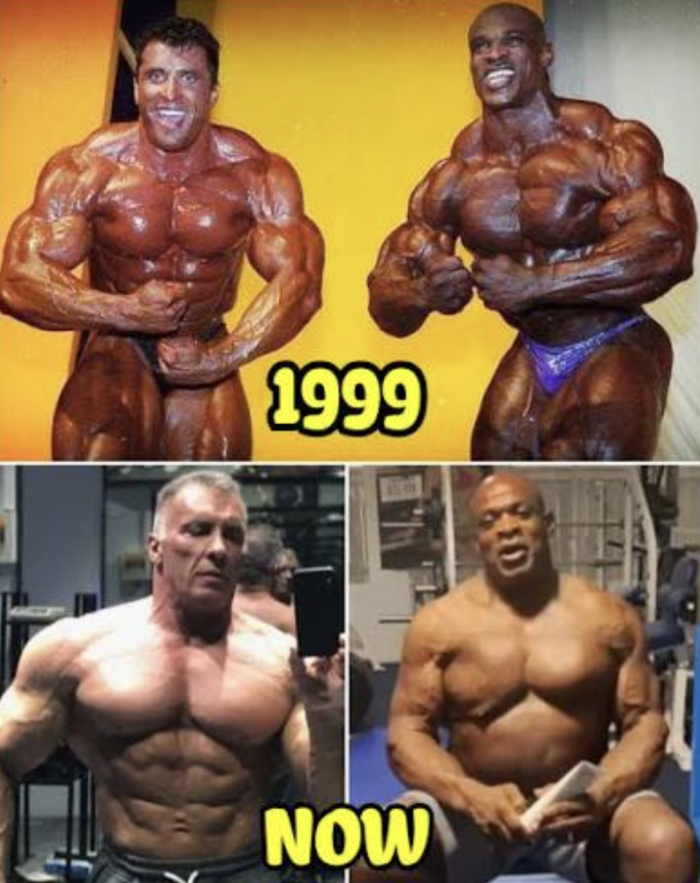
Back training with Ronnie: intensity
Back training with Ronnie wasn’t just another workout for Milos Sarcev. It was a reminder that hard core doesn’t only mean free weights; it means how far you can push every set.
The original question was an honest one: why did Milos train so much on exercise machines in the “Road To Olympia” videos, when champions have been built over the years by squats, deadlifts, barbell biceps curls and military presses? The answer gets straight to the point.
Does back training depend only on the barbell?
Milos admitted that 1999 was a special year. Back then, training was almost entirely on machines. The reason wasn’t laziness or fear of heavy weights. Filming often had to be done after the workouts themselves, at the end of a long, tiring day, and the machines were simply at hand.
At the same time, Milos reminded us where the journey began: Yugoslavia. There weren’t many options there. There were free weights, and the foundation was built with them. The first 10 years of Milos’s training rested on exactly the exercises the critic named: squats, deadlifts, barbell lifts and strong basic exercises.
Had anyone walked into Gold’s gym in Fullerton, California, they would have seen Milos and Shawn Ray doing mostly free-weight work. Milos described having trained for years six days a week, twice a day, alongside many pro bodybuilders. So the question wasn’t whether the work was hard. The question was how to measure toughness.
Back training with Ronnie: what did Milos see?
Before the 2000 Mr. Olympia, Ronnie trained a few days a week at Milos’s gym. One day Ronnie called out in that familiar voice: “Man, are we training?” Milos had already taken 3 months off from training and had been quietly “ticking over”. But curiosity won.
Ronnie’s answer to the day’s plan was simple: back. And this was not a fresh start to the day. Ronnie had already done one strength training session in the morning, an hour of cardio and a 3-hour photo shoot with Chris Lund. Over the whole day, Ronnie had eaten only 50g of carbohydrates.
The first exercise was rows with the end of a barbell, also known as T-bar rows. Milos put on two 20 kg plates, but Ronnie cut in, laughing, and suggested starting with 6 plates. That meant 121.5 kg, and they did 15 repetitions with it as a warm-up.
Next came 12 repetitions with 9 plates, which was 182.5 kg. Ronnie did the serious work sets with 12 plates: 243 kg. That weight was moved for 3 sets of 10 repetitions each. And here is the simple truth: the numbers were big, but even more important was how controlled and consistent the movement was.
How does intensity actually work?
The next exercise was bent-over barbell rows. For the warm-up it was 15 repetitions with 182.5 kg. Milos stressed that the execution was controlled and almost perfect. Then came 3 work sets with 223 kg, 10 repetitions in each set.
The third exercise was one-arm bent-over dumbbell rows. By then Milos was completely spent. Ronnie’s skin was only slightly damp, and Ronnie asked, disappointed, whether the 90 kg dumbbells really were the biggest dumbbells in the gym.
In Texas, Ronnie usually used 135 kg dumbbells, so 90 kg felt like a joke. Still, Ronnie did 4 sets of 15 repetitions with the 90 kg dumbbells. It shows well that intensity isn’t only maximum weight. Intensity is also tempo, control, rep count, shorter rest times and the readiness to keep the muscle under tension.
The last exercise was supposed to be the deadlift. Ronnie was a former powerlifter, and 360 kg or even more was no miracle for Ronnie. Luckily for Milos, the deadlift was skipped that day. Ronnie said that the evening would bring a return for calves and another hour of cardio. Ronnie spends about an hour training calves.
A practical lesson for back training
If there is one thing to take away from this story, it’s this: back training needs more than a list of exercises. Yes, free weights are important in bodybuilding. Yes, deadlifts, bent-over rows and T-bar rows build a strong back. But an exercise alone doesn’t make a workout hard.
What makes it hard is the intention you bring into the set. Do you add repetitions? Do you raise the weight? Do you cut the rest breaks? Do you choose a method that forces the muscle to work from a new angle? According to Milos, hard core training means constantly raising intensity and playing with it.
The same went for Shawn Ray, whom Milos called Mr. Intensity. Shawn wasn’t as powerful as Ronnie, but the focus was another world. From the moment Shawn walked into the gym, every set was a war. Not a show, but work.
Honestly, this is a good reminder for the average lifter too. You don’t need to pull 243 kg to train smart. But you do need to know why you’re doing your next set, what you’re improving, and whether the effort is really there.
FAQ: back training
Is back training with machines worse than free weights?
It doesn’t have to be. Free weights give you a strong foundation, but machines help you keep the movement under control and load the muscle in a targeted way. The result depends on effort, technique and the plan.
What can you learn most from Ronnie’s training?
The most important lesson is intensity. Ronnie didn’t just lift heavy weights. He kept control, piled up plenty of repetitions and pushed every set to the end.
Should a beginner copy Ronnie’s numbers?
Definitely not. A beginner’s goal is to learn technique, keep the back working safely and progress step by step. Ronnie’s numbers were the work of an elite-level bodybuilder and powerlifter, not an ordinary training plan.
Milos Sarcev „Back Training With Ronnie!!!“
Translated by Janar Rückenberg
Come and train! ArtGym




