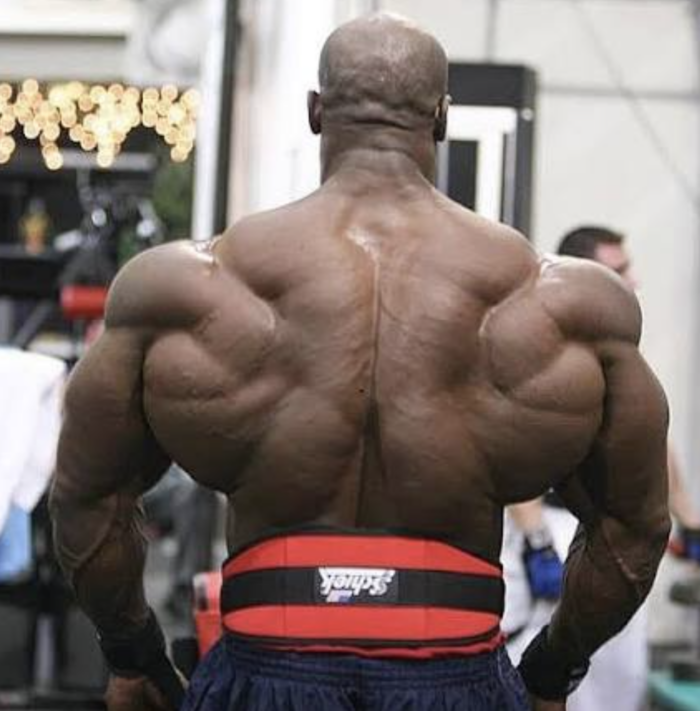
Joel Stubbs and bodybuilding’s mighty back
Joel Stubbs is a name that doesn’t come up in gym talk as quickly as Ronnie Coleman, Dorian Yates or Lee Haney. But when the subject is one of the widest and most detailed backs in bodybuilding, his name deserves a place at the table.
This story looks at why the Bahamasair pilot and bodybuilder drew so much attention, how he trained his back, and what the average lifter can learn from it without blindly copying a pro’s program.
Why Joel Stubbs stood out in bodybuilding
If you made a short list of the best and most powerful backs of all time, it would usually start with Ronnie Coleman, Dorian Yates and Lee Haney. Between the three of them, they have 22 Mr. Olympia titles. The fourth name on that list may surprise some people: Joel Stubbs.
Stubbs wasn’t a man every bodybuilding fan knew in their sleep. He never qualified for the Mr. Olympia and never stood center stage there. Still, something happened on the stage at the 2005 Europa Super Show that made critical viewers raise their eyebrows. The width, thickness and detail of his back, from the neck down to the glutes, were at a level usually associated only with the biggest names in the sport.
The next morning, Flex photographer Kevin Horton shot him at the MetroFlex gym. It showed that this back was no accident. Stubbs used a fairly classic toolbox: pull-ups, deadlifts, barbell rows, dumbbell rows and cable exercises. What set him apart wasn’t an exotic exercise but how he felt every movement.
A simple truth: a pro-level back isn’t built from heavy barbell work alone. It’s built from heavy barbell work, repetitions, technique and the ability to tell which muscle is actually doing the work.
Joel Stubbs and his background before the big back
Joel Stubbs was a big man even before bodybuilding magazines started talking about him more. He stood 187.5 cm (6´3´´) tall and weighed 137.5 kg in the off-season and 126 kg at his pro debut. An athlete with a frame like that stood out on stage from a long way off.
His day job is even more interesting. Stubbs was a Bahamasair pilot. Much of his time went on flying from Nassau to Miami, Florida, Atlanta and Georgia. The gym wasn’t his only world. He had to fit his training around a job where the schedule, fatigue and travel don’t ask whether today is a heavy back day.
He played basketball during his time at Florida Technical College. Stubbs started bodybuilding in 1996, after tearing the patellar tendons in both knees. When basketball took a back seat, his focus shifted to building his body. As early as 2000, he won the Southern States super heavyweight class, while Marcus Haley took the overall title.
In 2003, Stubbs won the Central American and Caribbean Championships and secured his pro status. By his own account, that was an important line to cross: once that goal was done, it made sense to see what would happen in the big boys’ league.
At the 2005 Europa Super Show, he placed twelfth. The downside that was pointed out was an overly powerful, or overdeveloped, waist. Still, that didn’t take away from the main impression: his back was huge, dense and easy to recognize on stage.
Stubbs, who turns 38 in December, also spoke at the time about wanting to promote bodybuilding in the Caribbean. He did not build his entire life around a single competition venue. His main workplace remained the sky.
How Joel Stubbs trained his back
So what actually happens when a back this big gets built? Stubbs didn’t describe it as some mystical secret. He talked more about feel. The back is a complex muscle group, and his approach was to split it into regions: the upper, middle and lower back, the outer and inner lats, the traps, the rhomboids and the lower back.
He didn’t do endless sets just to tick a box. He wanted to feel where an exercise was working. That matters for the average lifter too. If the barbell is moving but your back isn’t working, momentum, your arms or a poor lower-back position are often doing much of the work.
Stubbs used two different back workouts. The first was a heavy day with strong compound exercises, where the rep count dropped as low as 6 reps. The second was a lighter day, where reps stayed mostly in the 10–15 range. For most of the time he alternated them week by week: a heavy day one week, a lighter day the next. In the last month before competitions, he did two back workouts a week.
Both days included pull-ups. In total he did 6 sets of pull-ups, using three different grips. This wasn’t a casual warm-up but a way to get the back working while hitting different angles.
Pull-ups
Stubbs liked to start his back workout with pull-ups. A wide overhand grip worked more on the upper lats and the rear delts. A close neutral grip, with the palms facing each other, gave him a better feel in the inner lats and lower traps. A close underhand grip shifted the emphasis to the lower parts of the lats and the rhomboids.
Here’s a good lesson: grip changes the feel of the movement. Not all pull-ups are the same exercise. If you train your back, watch whether you pull up with your chest, keep your shoulders under control and let your back stretch, rather than jerking out reps as fast as you can.
Deadlift and heavy rows
Stubbs called the deadlift one of the best exercises for adding thickness to the mid and lower back, feeling its effect from the lower back all the way up to the traps. The weight was pyramided up over 5 6 sets: starting easy at 60 kg and finishing at 300 305 kg for six reps.
Stubbs did the barbell bent-over row as a pyramid too, starting at 60 kg for 15 reps and working up to about 140 kg for 8 10 reps. One set was done with an underhand grip, the next with an overhand grip. Sometimes it was 3 working sets with each grip, 6 sets of barbell bent-over rows in total.
The underhand grip gave Stubbs a better contraction, while the overhand grip produced a stronger stretch in the lats. The idea was simple: the weight has to be heavy enough for the back to really work, but not so heavy that you can no longer feel the muscle.
Dumbbell, T-bar and cables
On one-arm dumbbell rows, Stubbs went up to an 80-kilo dumbbell and did 10 12 solid reps with it. In this exercise he felt the work in the lower lats, right where the lat connects toward the lower back.
On back extensions, he held a 20 kg plate. This was primarily lower-back work, not a place to push through with the whole body’s momentum. On T-bar or barbell-end rows, he went up to 185 kg. By his feel, this hit the area where the lat attaches under the rhomboid.
On the seated machine row, he went up to 135 140 kg, focusing on the stretch so that the lower lats took the load on every rep. On pulldowns, he varied the grip: a wide overhand grip put more work on the upper lats, while a narrower underhand grip shifted the tension to the inner and lower lats and brought in the rhomboids and traps too.
Back training: practical tips
Stubbs was a professional bodybuilder, so his weights shouldn’t and needn’t be copied one to one. For the average lifter, the principle behind the plan matters more than the plan itself: every exercise must have a job. Some movements give width, some thickness, some teach the stretch and some strengthen the lower back.
If you train your back, start by choosing one vertical pull and one horizontal pull. For example, a pull-up or lat pulldown, and a barbell, dumbbell or cable row. Then add a lower-back exercise if needed. Once all three directions are covered, there’s no need to run through ten random machines.
The second important thing is tempo. In back training, ego tends to jump ahead quickly. The weight moves, but the shoulder blade doesn’t, the elbow doesn’t lead the pull and the lat doesn’t realize it’s supposed to be doing the work. Reduce the weight, pause at the contraction and let the muscle stretch at the bottom.
The third point is recovery. Before a contest, Stubbs could do two back workouts a week, but that doesn’t mean every recreational lifter should do the same. If your lower back is constantly tired, your grip is weak and the next workout goes worse, the problem isn’t willpower. The training load may simply be too high.
Honestly, the best part of Stubbs’s story is that there’s no fancy trick. It’s the basic lifts, different grips, hard work and the ability to tell real feel from jerking. That’s exactly what keeps Stubbs’s back training interesting even years later.
FAQ: Joel Stubbs and back training
Is Joel Stubbs a good role model for a beginner?
Yes, but only in terms of principles. A beginner shouldn’t copy the weights or the volume. What is worth learning is how Stubbs used different grips, controlled the stretch and thought about the different regions of the back.
Why were pull-ups included on both back days?
Pull-ups warmed up the back and gave the lats a strong dose of work right at the start of the workout. The three grips shifted the emphasis: the upper part, the inner part and the lower region each got their share.
Is a heavy and light back day split sensible?
It can be sensible if recovery is in order. The heavy day builds strength and thickness, while the lighter day allows more reps and a focus on feel. If fatigue accumulates, the volume needs to come down.
Joel Stubbs’s back workouts
HEAVY DAY:
- Pull-ups (wide overhand grip) 2 x 10
- Pull-ups (palms facing, narrow grip) 2 x 10
- Chin-ups (medium-width underhand grip) 2 x 10
- Deadlift 5 6 x 15 6
- Barbell bent-over row 4 6 x 15 8
- One-arm dumbbell bent-over row 4 x 10 12
- Back extensions 4 x 15
LIGHT DAY:
- Pull-ups (wide overhand grip) 2 x 10
- Pull-ups (palms facing each other, narrow grip) 2 x 10
- Pull-ups (medium-width underhand grip) 2 x 10
- T-bar rows 4 5 x 12 15
- Seated machine row 4 5 x 15
- Lat pulldowns (wide overhand grip) 4 x 15
- Lat pulldowns (medium underhand grip) 4 x 15
- Back extensions 4 x 15
Translator’s note: I believe and hope that we’ll hear more from this man!!!
„BEST BACK EVER – HOW JOEL STUBBS EARNED HIS WINGS, BUILDING ONE OF THE MOST AMAZING BACKS IN BODYBUILDING HISTORY. GREG MERRITT
Author: Translated by Janar Rückenberg
Come and train! ArtGym