Pre-contest nutrition in bodybuilding
Pre-contest nutrition is the part of bodybuilding preparation where every meal starts to affect your condition. The goal is not simply to lose weight, but to reveal the shape of your muscles, hold on to as much muscle mass as possible and reach the stage with a drier, sharper physique.
PREPARED BY JANAR AND SILVAR RÜCKENBERG
Why does pre-contest nutrition matter so much?
Bodybuilding training is broadly divided into two phases: the off-season and the pre-contest period. During the mass phase, you build muscle mass. As a contest approaches, that mass has to be refined into better quality. A simple truth: on stage, it is not only size that gets judged, but also how well the muscle shows.
The length of a pre-contest training regimen is highly individual. It depends mainly on two things: the bodybuilder’s condition before the diet starts and how important the upcoming contest is. Peak form is usually timed for the more important contest.
The contest period can last 2-5 months. 4-5 months of preparation is mostly used by professionals competing at Mr. Olympia level. For a lower-level bodybuilder, preparation often lasts about 3 months. Flex magazine has suggested the following starting points for switching to a pre-contest regimen:
- 8 weeks – your condition is good and well defined, body fat percentage is low, and your muscles show clearly.
- 13 weeks – body fat percentage is higher and definition is lower, but your condition is still acceptable.
- 16 weeks – the body is soft, and dryness and definition have almost disappeared.
- 20 weeks – body fat percentage is high and there is no definition at all.
The goal of pre-contest training is to bring out the details in a massive physique. A defined physique means that muscle groups, their separate parts, blood vessels and muscle fibers become visible. That isn’t built in the gym alone. The kitchen decides just as much.
Pre-contest nutrition and carbohydrates
In the pre-contest period, the importance of nutrition rises sharply. Aerobic work is added alongside your gym training. While many bodybuilders do almost no cardio when building mass, in contest prep it becomes just as important as strength training.
The main change in the diet concerns carbohydrates. They are restricted for two reasons. First, too many carbohydrates can be stored as fat tissue. Second, carbohydrates are the body’s primary source of energy. When their level is low, the body starts to use more fat.
There are many ways to manipulate carbohydrates. One of the most common is to use depletion and loading cycles, also known as carbohydrate cycling. For example, you start the diet with a 10 % carbohydrate deficit and gradually move to smaller amounts, until you reach about 2-2.5 grams of carbohydrates per one kilogram of body weight.
For a 90 – 100 kg bodybuilder, that means roughly 180 – 250 grams of carbohydrates per day. Once you reach that limit, you start doing depletion cycles. These are often four days long, although 3- and 5-day variations are also used.
A simple example might look like this:
- Day 1: 225 g
- Day 2: 200 g
- Day 3: 160 – 180 g
- Day 4: 250 – 300 g
The number and length of depletion and loading cycles depend on the individual. You often start them as early as 4 – 6 weeks before the contest, in order to gradually reduce the amount of carbohydrates in the body. Another reason is preserving muscle mass. If you only reduce carbohydrates in a linear fashion, the energy deficit deepens and the body may start to use its own muscles as well.
Honestly, there is no single recipe here that suits everyone. In some people, heavy calorie restriction causes too great a loss of quality muscle mass. They may need a longer diet period and a smaller deficit. Another person has to be stricter than 30%. Current condition, metabolism and body type all come into play.
How does pre-contest nutrition work in practice?
For a bodybuilder with an average body type, the common view is that during the pre-contest period carbohydrate intake could be about 2 – 2.5 grams per 1 kilogram of body weight. Protein is also set at 2 – 2.5 grams, less often up to 3 g. Fat is kept in the range of 0.5 – 1 gram.
A classic daily split for a ninety-kilogram bodybuilder preparing for a contest could look like this:
- Protein: 200 – 230 g
- Carbohydrates: 200 – 230g
- Fat: 45 – 90 g, the less the better
You don’t get there overnight. The changes are made gradually. If the baseline ration fluctuates around, say, 200 g, you can eat 300-350 g of carbohydrates on a loading day every 3-5 days. Over the course of the whole diet, though, total carbohydrate intake keeps moving downward.
The last week before the contest is usually the strictest. In practice, the final depletion is made longer, about 5 – 6 days, but smoother. In the final days, carbohydrates get close to zero. The carbohydrate concentration doesn’t fall all the way to zero, though, because the human brain needs carbohydrates.
Depletion makes the muscles more sensitive to carbohydrates. Loading afterward helps store glycogen more effectively. The original source states that after thorough depletion, a person with an average metabolism can experience 150% supercompensation within the first 24 hours and an almost maximal 160-170% overcompensation. That is why the final loading doesn’t necessarily have to be long.
Metabolic type makes a big difference. Endomorphs with a slower metabolism may need 2-3 days to load, because glycogen builds up more slowly. Amounts should be smaller and spread more evenly across the day. Ectomorphs with a faster metabolism often tolerate a shorter period and a larger amount at once.
One to three days before the contest, the muscles are loaded with carbohydrates to the maximum. If the contest is on Saturday, a bodybuilder with a faster metabolism can diet until Thursday and start loading on Friday morning, about 36 hours before stepping on stage. The main risk is overloading. If the excess carbohydrates don’t fit into the muscles, they can bind water under the skin and spoil your look.
Menu, protein and practical choices
When carbohydrates are low, many bodybuilders increase their protein intake. There are two reasons for this. First, muscle needs enough protein during hard training. Second, part of the remaining protein can be converted into carbohydrates, which helps ease the energy deficit slightly. While protein may make up 20% of the menu during the mass phase, before contests it can rise to 25-30 and even 40 percent.
How much weight a bodybuilder puts on between contests is also individual. Most keep it within 5-12 kilograms. Lighter-weight competitors often lose more than heavyweights, but what matters most is how much body fat accumulated during the mass phase.
A good transition into contest mode is a smooth one. Sudden changes in training and nutrition can send the body the opposite signal. The optimal weight loss per week would be 0.5-1 kg. This pace helps preserve muscle mass better while fat decreases.
A classic pre-contest menu can be simple, dry and repetitive, but that is often exactly the point.
- Meal 1: egg whites, oat flakes, fruit, protein shake (whey protein).
- Meal 2: fillet cut, meat or fish, potatoes and wheat bread.
- Meal 3: egg whites, brown rice and a protein shake (whey protein).
- Meal 4: grilled fish, raw salad and braised vegetables.
- Meal 5: egg whites, oat flakes, buckwheat or braised root vegetables, and a protein shake (whey protein).
- Meal 6: boiled chicken breast and/or egg whites and raw salad.
The entire pre-contest menu is built on two things: high-quality, high-biological-value protein and fiber-rich complex carbohydrates with a low glycemic index. Before contests, bodybuilders often eat at roughly a 10-30% calorie deficit to create the energy deficit needed for fat burning.
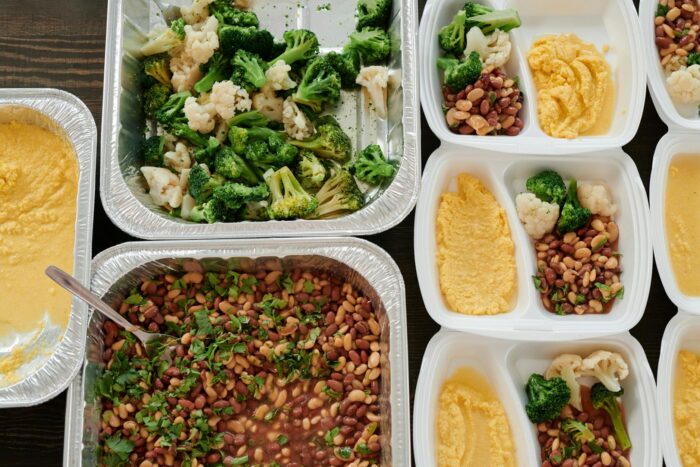
The main carbohydrate sources are brown rice, potatoes, oat flakes, buckwheat, bran, coarse rye bread (sepik), fruit and vegetables. Suitable vegetables include cabbage, rutabaga, carrots, leeks, broccoli, radishes and lettuce. The main protein sources are chicken and turkey breast, fish, egg whites, tuna, fat-free cottage cheese, quark and protein shakes made from whey protein.
So what actually happens? Pre-contest condition comes from training, aerobic work, carbohydrate cycling, adequate protein and controlled weight loss all moving in the same direction. If one part becomes too extreme, muscle mass or stage condition usually suffers.
FAQ: pre-contest nutrition
How long should a pre-contest diet last?
It depends on your starting condition. If you’re in good shape, 8 weeks may be enough; if you’re softer, you may need 13 weeks, 16 weeks or even 20 weeks. Many lower-level bodybuilders start about 3 months before a contest.
Do carbohydrates need to be cut to absolutely zero before a contest?
Carbohydrate concentration never falls all the way to zero. In practice, the amount is brought very low and the muscles are loaded again later, but the exact timing depends on metabolism and condition.
What is the biggest mistake in loading?
The biggest mistake is overloading. If too many carbohydrates come in too quickly, the body may start holding water under the skin. That makes your look softer just when your physique should be dry and sharply defined on stage.
Author: Janar Rückenberg
Come train with us! ArtGym