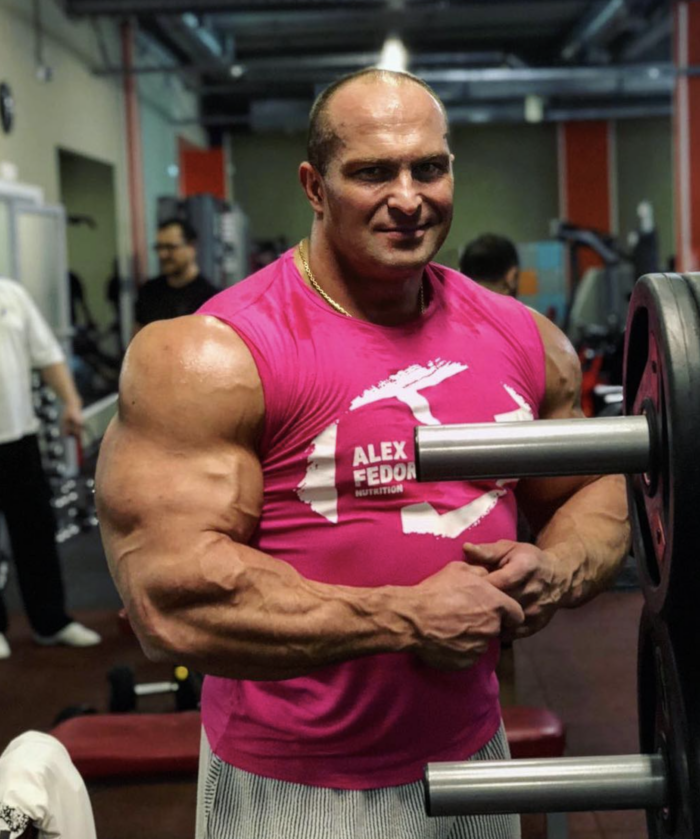
Fedorov and clean exercise technique in the gym
Fedorov puts it plainly: bodybuilding isn’t just about moving weight, it’s about how you build your body. Here is his training philosophy in simple terms: clean technique, constant tension, sensible experimenting, and enough food and recovery.
Translated by Silvar Rückenberg
Why does Fedorov talk about technique, not ego?
It’s easy to let the numbers mess with your head in the gym. There are more plates on the barbell, the mirror shows a strong pose, and it all feels right. But in bodybuilding, the winner isn’t the person who heaves up the heaviest weight in every exercise. A bodybuilder’s goal is to shape the muscle, not simply to move weight from point A to point B.
Fedorov’s point here is quite practical. If you’re training biceps, the biceps should be doing the work. If you do a barbell biceps curl with 70 kg, but your shoulders and back do much of the work, the biceps doesn’t get the training load you did the exercise for in the first place. The weight may look impressive, but the result is mediocre.
Honestly, you see this in every gym. Someone picks up a dumbbell that’s too heavy, the body starts swinging along, and the exercise turns into something that wasn’t written in the training program. That doesn’t make someone a bad lifter. It just shows that ego sometimes wants to run ahead of the muscle.
Fedorov: muscle grows from clean work
Good technique doesn’t mean slow, boring training. It means choosing a weight you truly control. The movement is clean, the repetition is felt, and the muscle does the work it was chosen for. A lighter weight with perfect technique can give you far more than a heavy weight that is simply forced through with sheer strength.
Alongside technique, Fedorov stresses breathing. During an exercise, breathing isn’t a side issue. Breathing in and out correctly helps you maintain performance, supports recovery between sets, and helps your body cope better with the training load. If you hold your breath and the movement falls apart, it’s a sign that the weight or tempo needs another look.
A simple truth: a controlled repetition teaches the muscle better than random flailing. This applies to chest presses, squats, pulling movements and smaller isolation exercises alike. The more precisely you feel the working muscle, the less energy you waste on extraneous movement.
How do you keep constant tension in a set?
One clear recommendation from Fedorov: rest between sets, not between repetitions. Once the set has begun, focus on making each repetition flow smoothly into the next. Don’t pause for long at the start or end of the movement if it takes the tension off the muscle.
So what actually happens when you stop for too long between repetitions? The muscle gets to rest. That may feel comfortable, but the training effect of the set diminishes. At the same time, active blood flow in the working muscle drops and the body starts redistributing the load. According to Fedorov, that’s not good if the goal is to make the muscle work as hard as possible.
This doesn’t mean every repetition has to be agonizing, or that you should push technique until it completely breaks down. Quite the opposite. Constant tension demands control. If you can’t do the repetitions without pauses and without cheating with your body, it makes sense to reduce the weight or cut the set shorter.
Experiment, but listen to your body
No single training program works the same way for everyone. In terms of build, some people suit higher volume, while others progress better with shorter but very precise work. Fedorov recommends experimenting with new methods and exercises, but not blindly.
Sometimes you don’t need to turn the whole program upside down. A small change is enough. Changing your grip width by a few centimeters can give an exercise a completely different feel. The same goes for tempo, range of motion and exercise order. If your body responds well, remember it. If something causes pain or you don’t feel it working, don’t hold on to it just because someone else does it.
Progress needs variety, but variety mustn’t turn into random scrambling. A good lifter knows how to track what really works. Notice which exercises give you a clear feeling of the muscle working, which weights keep your technique clean, and when recovery starts to drag.
Fedorov and bodybuilding as a lifestyle
Bodybuilding doesn’t end at the gym door. Training matters, but the body doesn’t develop from lifting weights alone. Nutrition and recovery are just as important. If those two are out of order, even the most beautiful training plan stays incomplete.
Fedorov’s point isn’t that life should become a strict punishment. Quite the opposite. If bodybuilding is a lifestyle, it has to be natural and enjoyable. You don’t have to prove to yourself at every moment that you’re a bodybuilder. Training, eating and rest should become part of a rhythm you can truly sustain.
Here’s a good yardstick: if the whole process creates only stress, fear and guilt, it won’t last long. But if training gives you a clear direction, food supports the goal and there is room for recovery, progress becomes much calmer. That is exactly the bigger picture Fedorov emphasizes.
FAQ: Fedorov and training
Does a heavier weight grow muscle faster?
Not if your technique falls apart. Muscle grows better when the targeted muscle does the work. A heavy weight is useful only if you can control it.
Why shouldn’t you rest between repetitions in a set?
Because a long pause takes the constant tension off the muscle. According to Fedorov, you should rest between sets, not after every repetition, if the goal is to keep the muscle working.
Should you change your training program often?
Change it when the change has a purpose. Experiment with exercises, grip and tempo, but watch how your body responds. Variety should support progress, not just create confusion.
Translation of the article “Fedorov on Training”.
Author: Silvar Rückenberg
Source: WHO – physical activity.
Come and train! ArtGym