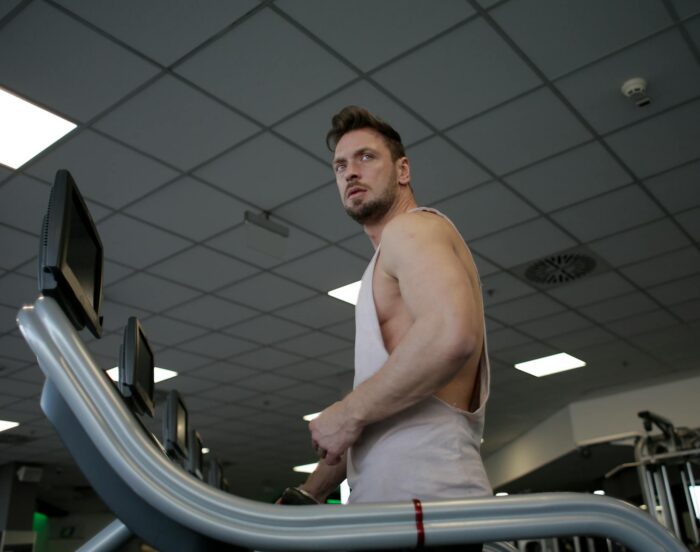
Aerobic training and maintaining muscle mass
Aerobic training and maintaining muscle mass seem like contradictory goals to many people. In reality, they complement each other — especially if you add regular aerobic work to the off-season as well. It keeps your metabolism active, lets you eat more calories and helps you reach contest day in better condition, without having to put yourself through the wringer in the final weeks.
Why aerobic training helps maintain muscle mass
A common myth says that aerobic training eats away your muscles. There is a grain of truth in it — but only when the volume is too high and your nutrition doesn’t support recovery. Moderate, regular cardio works quite differently: it keeps your metabolism fast, improves oxygen delivery to the muscles and speeds up recovery from heavy lifting.
An important detail that is often forgotten: active burning of body fat begins only after 30 minutes of active aerobic training. During the first half hour, the body works mainly from its glycogen stores. So shorter sessions are useful for your cardiovascular system, but their fat-burning effect stays minimal. It’s worth planning your sessions long enough to cross that threshold.
When cardio is part of your regular routine, you can allow yourself more calories in the off-season. That means you don’t have to go on a strict diet or sacrifice muscle — your metabolism is fast, your body burns more even at rest, and you can build muscle mass with less fat coming along with it.
So what actually happens if you skip aerobic work in the off-season? Your metabolism adapts to the lower training load and slows down, and preparing for the diet phase becomes much more painful. This is easier to avoid than to fix later.
Aerobic training during contest prep — how to use it
Most bodybuilders skip aerobic work in the off-season. They hope that a couple of months of strict dieting before the contest will do the job. The problem is that the body adapts: metabolism slows down, mood drops and muscles suffer under intense calorie restriction.
A smarter approach is to keep your body weight about 10 pounds above contest weight until four weeks remain before the contest. Then you can focus on the final fine-tuning with a strict diet. Four weeks is enough time to reach contest condition — provided you’ve included aerobic training throughout the entire off-season and your metabolism is still fast.
This strategy demands discipline in the off-season, but the benefit is clear: muscle mass loss is minimal, your body is better conditioned and you handle the stress of the final phase better. The last four weeks become about fine-tuning, not survival.
Practical tips for adding aerobic training
How do you add aerobic training without overtraining? Here are a few recommendations that help you keep your strength training results while still getting the benefits of aerobic work.
Choose low- to moderate-intensity aerobic work — walking, cycling, the elliptical trainer, swimming. High-intensity interval training is too draining an addition to heavy lifting, especially when your goal is maintaining muscle mass. Your heart rate should stay in a conversational zone, where you can talk but your breathing is still noticeable.
The ideal frequency is 3–4 sessions a week, 35–45 minutes at a time. Under 30 minutes, fat burning stays minimal. Beyond an hour, the risk of elevated cortisol rises and, because of the stress response, the body starts breaking down muscle protein — which is exactly what we want to avoid.
If possible, do your aerobic training separately from your strength training session — preferably in the morning, or in the afternoon after your gym session. That way your energy and recovery are optimal for both. If your schedule forces you to do both in the same workout, put the strength exercises first and the aerobic work at the end.
The nutrition side is just as important. It makes sense to eat at least 2 g of protein per kilogram of body weight per day — it protects your muscles even when calorie expenditure is higher. Don’t let your total calories drop so low that your body starts using muscle as an energy source.
FAQ — frequently asked questions about aerobic training
Does aerobic training slow muscle mass growth?
Moderate volume does not slow muscle mass growth. The problem arises when aerobic volume is too high and calorie expenditure exceeds intake for a long time. Adjusting your nutrition solves this — calories up, protein high.
How long should one aerobic session last?
The optimal duration is 35–45 minutes. That way you pass the 30-minute threshold from which active fat burning takes place, but stay under an hour, where the risk of elevated cortisol rises.
Does it increase the risk of overtraining?
No — provided the intensity is low to moderate and your total volume is balanced. Overtraining usually results from too much volume at too high an intensity, not from moderate, regular aerobic work.
Author: Lou Ferringo/Flex
Source: WHO – physical activity.
PS Come and train! ArtGym