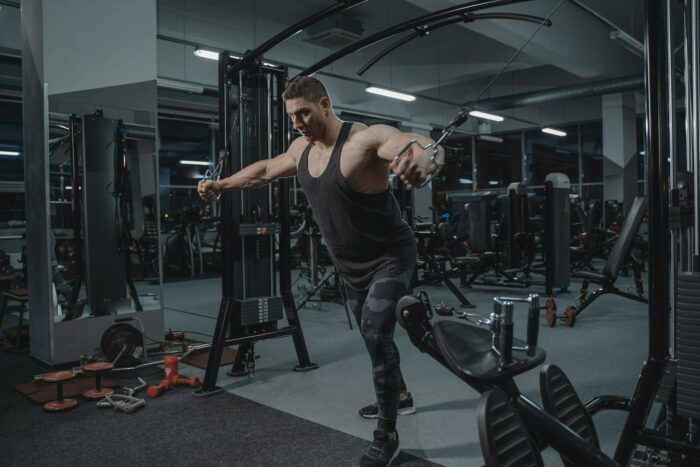
Cable exercises: Ronnie’s tips for building muscle
Cable machines are something many gym-goers underestimate. I’m a 6x Mr. Olympia precisely because I combine heavy weights in compound exercises with isolation cable exercises. Below I share the exercises that have delivered results for me over the years — and explain why the cable isn’t just a warm-up but real work.
Why cable machines work in the first place
With free weights, the tension in the muscle is uneven. In one part of the movement you work purely against gravity, in another you rest for a moment. A cable behaves differently: it keeps the muscle under tension through the entire range of motion. It’s exactly this constant tension that gives you the detail and separation you rarely get from a barbell alone.
People often notice the shape of my biceps and triceps. A large part of that shape has come from cable work — not the other way around.
Chest: cable crossovers
You can be the best at the bench press and have an impressive amount of chest mass. But if the middle of your chest is underdeveloped, the rest doesn’t show as well as it could. In my experience, the only way to fix that is crossovers between two cables.
In the bench press, you can only involve the middle part with a very narrow grip. In a cable crossover, the training load on the middle of the chest is at its maximum. The tension is consistent from the start of the exercise to the end. On top of that, at the end of every repetition I squeeze the muscles deliberately for a second or two — that “burns” the chest all the way through. To hit the upper part separately, I use an incline bench.
Biceps: two cable exercises
Two-arm cable curls
Done with strict technique, this is in my opinion the best biceps exercise, because the tension stays on both the way up and the way down. Sometimes I use it as the last exercise of biceps day, sometimes as the very first — I feel the contact much better in a warm muscle.
One-arm cable curl
If anyone wonders why my biceps are high, wide and really stand out, the answer is largely here. Working one arm at a time forces the other muscles out of the movement — no help from the shoulders or the back, only the biceps works.
Triceps: three cable variations
Cable triceps pushdown
Use the full range of motion so the peak contraction falls at the bottom of the movement. That part is what has given mass to the upper part of my triceps. I don’t use momentum — control from start to finish.
Overhead cable triceps extension
This variation works the lower part of the triceps, near the elbow. I press with force and get a very strong peak contraction midway through the movement.
One-arm pushdown with rotation
By turning the thumb inward or outward, I can isolate different parts of the triceps separately. This is detail work that stands out in posing.
Practical tips for using cable machines
These exercises are not mainly for building mass — they are for shape and separation. With that in mind:
- Keep your repetitions at around 12.
- Perform the movements strictly and deliberately, without momentum.
- Squeezing for a second or two at the end of each repetition makes a big difference.
- Don’t use the cable only at the end of your training session — sometimes try it as the first exercise when you want to feel a specific muscle better.
Don’t be afraid to add cable work to your program. I wouldn’t be where I am today without these exercises.
FAQ
Do cable machines replace free weights?
No. Free weights remain the foundation of mass training. The cable complements them — it brings the detail, shape and separation that a barbell alone can’t give.
How many cable exercises should you add for one muscle group?
One to two is usually enough. If your whole training session is on the cable, your base strength stays undeveloped. Balance is important.
Are cable machines suitable for beginners?
Yes, even very well — the tension is more controlled and the risk of injury is lower than with free weights. A beginner should also use it to learn to feel how a specific muscle works.
Author: joker, Flex
PS Come train with us! ArtGym