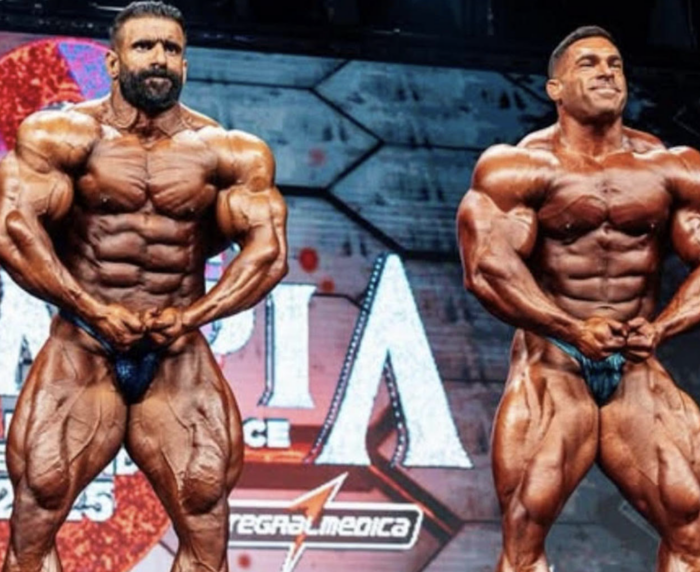
Top athletes on their training: honest lessons
Top athletes often talk about training more simply than a beginner would expect: heavy weights, focus, honest reps and a consistent plan. Their thoughts aren’t magic. They’re a reminder that in the gym, what counts is what you actually do, not what you plan to do.
Why top athletes talk about training so bluntly
Nasser El Sonbaty put it bluntly: he tries to get stronger every day, because gaining strength gives the muscles a reason to grow. It’s a simple idea, but it’s quickly forgotten in the gym. If your weights, repetitions or technique don’t improve for months, your body has little reason to change either.
Fauzi Hanst described the gym as a place where he faces the weights and his pride won’t let him back down. You don’t have to take that as theater. It’s more that every workout needs a clear focus. You don’t just wander between the machines to pass the time. You go to do work that has a measurable result.
Kevin Levrone stressed focusing on your repetitions through thick and thin. In today’s terms: phone aside, conversations shorter, and your mind in the muscle during the set. One proper set is often worth more than three scattered sets during which your eyes wander around the room.
How top athletes think about hard work
Gunter Schlierkamp talked about training until you’re fully pumped, until the muscle is full of blood and burning. That feeling isn’t a goal in itself, but it gives you feedback. If you’re working your shoulders but only feel your lower back, something is wrong. If you’re doing a chest press but the training load disappears into your triceps and shoulders, it’s worth reviewing the movement.
Patrick Lynn put the emphasis on steady pressing in every set. His point is harsh but fair: proper musculature doesn’t come when you cheat yourself while performing the movements. Partial repetitions, swinging your body for momentum and too much ego in choosing the weight can feel good for a moment. Still, when you’re building muscle, clean work pays off.
Chris Cormier said it even more briefly: if you train badly, you look bad. Honestly, that’s a good line to keep in mind. Training doesn’t have to look pretty for Instagram, but it does have to be done properly. Your back stays under control, the movement is controlled all the way through, and at the end of the set you know why you did it.
Practical lessons for your own training
Leo Ingram called every repetition a step that develops his physical ability. That sounds almost too simple, but that’s exactly the point. Good training isn’t born from a single heroic day. It builds up repetition by repetition, week after week. If today’s set is better than the last one, you’re moving in the right direction.
Mike Matarazzo didn’t want to simply accept a setback during a set. His wording was rough, but the message is clear: a hard moment doesn’t automatically mean the end. Sometimes you have to fight for the last repetition. At the same time, fighting doesn’t mean your technique falls completely apart. There’s a big difference.
Vince Taylor talked about moving forward, raising the level and pumping yourself up one more notch. That suits recreational lifters well too. Write down what you did. Review it next time. Add a small step if your body is ready. If it isn’t, hold on to quality and come back stronger.
Flex Wheeler summed it up in terms of work and pay: if the work is good, the pay is good. In the gym, the pay is better shape, a stronger body and a more confident feeling. Dennis James added the importance of a plan: think up a plan, write it down and follow it. Aaron Maddron said bluntly that there is no substitute for hard work when building muscle mass.
Top athletes and your next workout
So what actually happens when you put these thoughts together? You get a fairly down-to-earth training rule: go to the gym with a plan, choose a weight you can control, really push yourself and write down the result. If you do this for long enough, the changes start to add up.
A beginner doesn’t have to train like Nasser El Sonbaty, Kevin Levrone or Flex Wheeler. But there’s one thing you can take from their attitude: don’t waste a set. If you’re already in the gym, do the work as well as you can that day.
FAQ: top athletes on their training
Does every workout have to be maximally hard?
No. Hard work matters, but your body also needs recovery and good technique. The best progress comes when effort, sleep, food and your plan all fit together.
Does a pump in the muscle always mean a good workout?
A pump can be a good sign, but it isn’t the only measure. Also look at your progress in weights, the quality of your movement and whether you feel the training load in the right muscle.
How do you use these ideas in your plan?
Pick a couple of core rules: write down your training, do your repetitions cleanly and focus during the set. These three things make your plan more honest right away.
Author: joker: From Flex magazine
Source: WHO – physical activity.
Come and work out! ArtGym