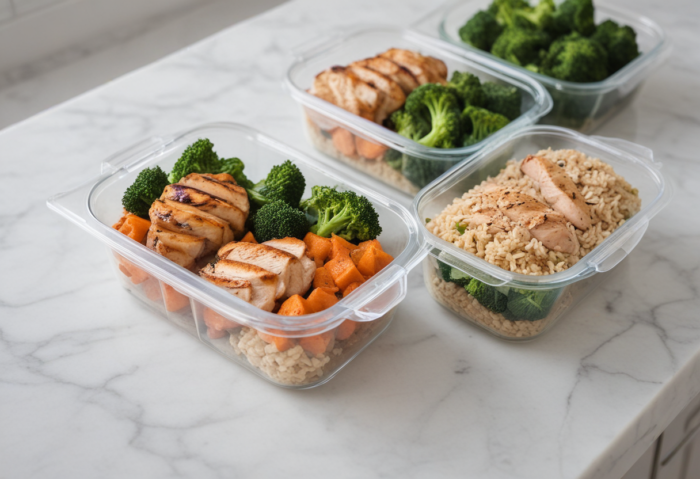
Lose fat, keep muscle: a smarter diet
Fat doesn’t disappear on command, especially when you also want to keep the muscle mass you’ve built in the gym. If your goal is to lose 5-10 kilos of fat in 3-4 months, your plan needs to be steady, measurable and realistic.
The simple truth is that an overly aggressive diet often costs you muscle, too. A more sensible approach is to set your starting calorie intake, keep protein high, reduce carbohydrates gradually and add cardio only when you need it.
Why fat builds up faster than muscle
A surplus of around 500 kcal/day is enough for muscle growth. That means eating 500 calories more than you burn each day gives your body the building blocks it needs for recovery and growth.
But this is where things get out of hand for many people. If most of those extra calories come from foods high in fat and sugar, your weight rises quickly, but you may not like what you see in the mirror any better. You may gain muscle mass, but you also accumulate fat that will take a long diet to lose later.
Eating cleaner can feel like a slower approach at first. Your weight doesn’t shoot up as quickly. Yet the changes in the mirror are often better: your waistline stays in check, your muscle definition becomes clearer and your motivation to train doesn’t drop.
You can see this clearly in competitive bodybuilders. Those who step onstage in exceptionally lean condition usually start their diet already in good shape. Your body weight during the training phase should therefore be no more than 10-15 % above your target competition weight or fat-free mass.
This isn’t quite a guide to a contest prep diet. It’s more suited to you if you train with a goal in mind, want to improve your physique or are considering competing in the future. The same principles apply if you simply want to get in better shape for summer without letting your hard work in the gym go to waste.
Fat loss works better when the deficit isn’t too large
Dieting gets difficult when you try to do too much at once. If you cut calories very low, your body becomes more energy-efficient. You lack strength during workouts, your sleep may suffer and your muscle mass starts to decline.
At the start of a diet, eating around 500 calories below your total daily energy expenditure is often enough. For example, if your basal metabolic rate is 2000 kcal/day, office work burns 500 calories a day and training burns another 500 calories a day, your total expenditure is 3000 calories a day. In that case, you could start your diet at 2500 kcal/day.
A common mistake is to drop your daily intake straight to 1500-2000 calories. This doesn’t magically speed up fat burning. Often, the opposite happens: your metabolism slows, workouts feel sluggish and your body starts using muscle instead of preserving it.
Protein intake is another area where people go wrong. If you eat too little protein, your muscle mass is more vulnerable during a diet. A good starting point is 2.5 – 3 g per kilogram of fat-free mass. If your measured fat-free mass is 70 kg, then 70 kg x 3 g = 210 g of protein a day.
At the same time, there’s no point in adding more and more protein indefinitely. Excessive amounts can put a strain on your body. The goal is to eat enough protein to support recovery and maintain muscle mass, rather than as much as possible.
Fats aren’t the enemy either. A very low-fat diet can negatively affect your hormonal system. Your body needs 30 60 g of healthy fats to support hormone production, recovery and overall well-being.
How to maintain muscle mass while losing fat
Cardio helps, but only in the right amount. You can start with 30 minutes three times a week. Later, if your physique stops improving and your diet is already in order, you can increase this to a maximum of 60 minutes five times a week.
Fasted cardio in the morning is often the best option. If you’re worried about muscle loss or feel depleted, you can have a small protein shake beforehand. A long cardio session after a tough strength training workout isn’t always the best idea, because strength training already places considerable stress on your body.
If you follow strength training immediately with a long cardio session, you stay in a catabolic state for longer. Yes, you’re burning fat, but your muscles may suffer at the same time. That’s why it’s worth timing your recovery drink or a proper post-workout meal so your body can recover quickly.
The quality of your training needs to stay high while you diet. Dieting quickly reveals whether your technique is sound or whether everything relies on lifting heavy weights. Powerlifting and bodybuilding use the same equipment, but their goals differ. In bodybuilding training, the muscle needs to do the work; it isn’t enough simply to move a weight from point A to point B.
Muscles respond to fatigue and tension, not just the amount of weight on the bar. If your strength drops, don’t let your technique fall apart. Keep your reps controlled, feel the muscle working and leave your ego at the gym door.
Recovery is just as important. Muscles grow after your workout, not in the gym. If you can train a lot, you also need to be able to rest a lot. Typical signs of overtraining include fatigue, declining motivation, loss of appetite, a lack of muscle pump during workouts, insomnia and irritability. If you have at least two of these signs, take an extra rest day or make your training lighter than usual for a week.
A practical example: quantities and meals
Take an 80-kilogram man who does light work or studies and trains at the gym 3 – 4 times a week. His basal metabolic rate is 1900 kcal/day, while his workouts and work duties burn 300–500 kcal/day. His total energy expenditure on a training day is therefore around 2400 kcal/day.
To support progress and recovery, he could start by eating around 3000 kcal/day. That puts him in a surplus of 600 kcal/day. When his goal changes and he starts dieting, he should avoid cutting out the entire surplus at once.
His protein requirement is around 2–3 g of protein per kilogram, or 80 kg x 2.5 = 200 g of protein per day. Fat intake could be around 50 g per day, or 450 kcal/day. With a daily energy intake of 3000 kcal, subtracting the 450 kcal from fat and 800 kcal from protein leaves 1750 calories for carbohydrates. Since one gram of carbohydrate contains 4 calories, daily carbohydrate intake comes to 437.5 grams.
For the first week, he could stick to these quantities: 5-6 meals a day, eating regularly and keeping unplanned snacks to a minimum. This helps the body settle into a routine.
The diet begins after a week. Carbohydrate intake is reduced by 25 % from the starting amount: 437.5 g of carbohydrates − 25 % = 328 g. Breakfast and the post-workout meal should together provide 50 % of the carbohydrates, or 164 g / 2 = 82 g. That means 82 g per meal at both breakfast and after training. The rest is divided between the other meals: 328 g − 164 g = 164/4 meals = 41 g per meal.
- Set your starting calorie intake.
- Reduce carbohydrates by 25 %.
- Add cardio, including intervals if needed.
- Reduce carbohydrates by another 25 %.
- Train properly 3–4 times a week.
- Use supplements for support.
Start with 30 minutes of cardio 3 times a week, preferably in the morning. If mornings are not an option, do your cardio after your workout, when energy stores are low. You can increase this to a maximum of 5–6 sessions a week and a maximum of 45 minutes per session. Increase the volume approximately every 2–4 weeks, keeping your calorie intake the same throughout.
Everyday life often determines whether the plan works. Prepare your food in the morning or the day before and take it to work or school. If you know you have a trip coming up, calculate how much food you will need. If you are going to a party, eat your meal as close to the event as possible and choose higher-protein dishes there if you are unsure exactly what is in them.
Once the diet is over and you have lost the fat you wanted to lose, you can increase your calorie intake to 3000–3500 kcal/day. Your food choices should stay largely the same, but you can add more carbohydrates: bars, fruit, bread, muesli and porridge. Aim to gain 300 700 g a week. You can even train 5–6 times a week if your recovery remains good.
Supplements and nutrient distribution for fat loss
- Protein powder, specifically whey, at breakfast and after training.
- Creatine after training: 5–10 g.
- Glutamine in the morning and after your workout: 10 g.
- Fish oil: 2–4 in the morning and evening.
- A fat-burning supplement.
- A recovery drink.
Distributing protein evenly: 200 g / 6 meals = 33 g per meal.
Meals - protein - carbohydrates
Meal 1 - 33 g - 82 g
Meal 2 - 33 g - 41 g
Meal 3 - 33 g - 41 g
Meal 4 - 33 g - 41 g
Workout
Meal 5 or recovery drink - 33 g - 82 g
Meal 6 - 33 g - 41 g
At this stage, you are not doing any cardio yet. Stick with this eating plan as long as your weight is dropping and you can see your physique improving in the mirror. This usually lasts around 3-6 weeks.
When progress stalls, repeat the initial step: reduce carbohydrates by another 25 %.
Meals - protein  - carbohydrates (initial) - carbohydrates (now)
Meal 1 - 33 g - 82 g - 61.5 g
Meal 2 - 33 g - 41 g - 30.75 g
Meal 3 - 33 g - 41 g - 30.75 g
Meal 4 - 33 g - 41 g - 30.75 g
Workout
Meal 5 or recovery drink - 33 g - 82 g - 61.5 g
Meal 6 - 33 g - 41 g - 30.75 g
By the time you reach this point, 8-12 weeks will have passed. You may be 5-10 kilograms lighter and your physique visibly improved. This is not down to a miracle trick, but to changing one thing at a time and keeping your muscles working.
FAQ: fat, dieting and muscle mass
Do you need to check your weight every day?
You can weigh yourself every day, but base your decisions on your weekly average and what you see in the mirror. A good rate of weight loss is 700–1000 g a week. If you adjust the plan, change only one thing at a time: either your calorie intake or the amount of cardio, not both at once.
Do you need to start cardio as soon as you begin dieting?
No. If your eating plan is bringing your weight down and improving your physique, there is no need to increase your training load straight away. Cardio is a tool, not a punishment.
What is the biggest dieting mistake?
Starting too aggressively. A very low calorie intake, too little fat, too little protein and too much cardio can all lead to losing muscle mass along with fat.
Translated from Body magazine; Author: Marko Heikkinen
Translator: Greta Reisalu
Source:Turg.Fitness.ee
Come train with us! ArtGym