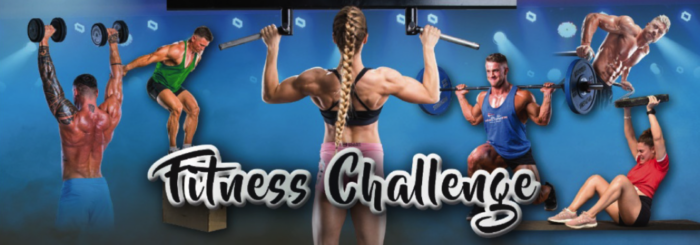
Fitness Challenge held its first full-fledged cup competition in Estonia on 29 April 2023. In this sport, two minutes of work and two minutes of rest quickly reveal how well your strength, endurance and technique work together.
Saturday’s competitors were a varied bunch: gym-goers, calisthenics enthusiasts, CrossFit athletes, basketball players, wrestlers, stair runners, and middle- and long-distance runners. That is precisely what makes the sport interesting. Fitness Challenge does more than ask how strong you are. It also asks how long you can maintain good form.
Why does Fitness Challenge appeal to people in Estonia?
The first Estonian Cup competition clearly showed that this format has a place in Estonia’s sporting scene. There is also the desire to put yourself to the test. Fitness Challenge offers a simple, straightforward way to do that.
The competition consists of six exercises. You perform each exercise for two minutes, with two minutes of rest between exercises. It adds up to a tough day’s work, involving almost every major muscle group. At first, two minutes sounds like a short time. Honestly, by the end of the second or third event, it no longer feels that way.
Ott Kiivikas has played a major role in developing the sport. A format like this needs someone to lead the way, because the rules, judging and competitors’ understanding need to come into alignment over time. The first competitions inevitably reveal points that need clarification later. That is normal for a new sport.
How does a Fitness Challenge competition work?
To make the sport accessible to more people, the exercises were divided into two levels: silver and gold. Silver is easier and suits those who want to get a feel for the competition. Gold is harder, requiring more strength, mobility and a good pace.
Silver-level events
The silver-level exercises were inverted barbell rows, bringing your chest to the barbell while holding your body in a plank position with your feet elevated on a box; Jefferson squats, with 40 kg for women and 60 kg for men; dips with your feet on a box in front of you; forward lunges holding dumbbells, with 10 kg dumbbells for women and 15 kg dumbbells for men; abdominal exercises with a 10 kg weight plate; and kettlebell snatches, with 8 kg for women and 12 kg for men.
That list looks fairly straightforward on paper, but the training load can catch you off guard. Rows in a plank position fatigue your core muscles, lunges wear out your legs, and you still have kettlebell snatches to finish. The simple truth is that if you set off too fast, your body will make you pay for it later.
Gold-level events
The gold-level events were even more demanding: pull-ups; box jumps, with a 50 cm box for women and a 60 cm box for men; dips; lunges with a barbell across your upper back, with 30 kg for women and 50 kg for men; abdominal exercises holding a 10 kg weight plate with your arms straight; and burpees with an overhead press, using 10 kg dumbbells for women and 15 kg dumbbells for men.
The author had previously only attempted the gold level. Half a year before the competition, the result was 185 repetitions; this time it was 207 repetitions. That is a clear sign that knowing the exercises matters just as much as overall fitness in this sport. Knowing where to ease off and where to push can make a substantial difference to your final result.
Fitness Challenge results and winners
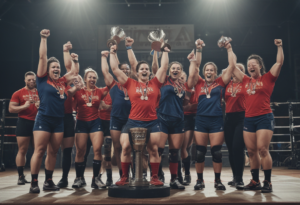
Christin-Amani Kiivikas won the silver-level junior category with 257 repetitions. Cätlyn Toomere topped the women’s category with 289 repetitions. Maigi Käige won the women’s Masters category with 294 repetitions and was also the overall silver-level winner.
Egert Oiov won the men’s silver level with 301 repetitions. That result also earned him the overall title. The number speaks volumes: silver level is more than just an “easy” competition; it still demands a high work capacity.
Mari Oks won the women’s gold level with 247 repetitions. Liia Oks topped the women’s Masters category with 237 repetitions. Mari Oks was also the overall gold-level winner. In the men’s gold level, Kaspar Kallas won the junior category with 167 repetitions, Miko Lilleorg won the men’s category with 293 repetitions, and Rene Laane won the men’s Masters category with 275 repetitions. Miko Lilleorg was also crowned the overall gold-level Estonian Cup winner.
Sparta Spordiklubi took the club title, followed by Tartu Kulturismi ja Fitnessi klubi and Arigato Spordiklubi. Sparta’s success is no surprise, given its longstanding competitive culture within Estonia’s gym scene.
What should you keep in mind when trying Fitness Challenge?
If you want to try the sport yourself, do not start by simply chasing repetitions. Get your technique right first. Landing matters in box jumps, range of motion in dips, and control in pull-ups. If a judge starts disallowing your repetitions, that good feeling quickly disappears.
It is worth practicing two-minute intervals in training. Start a timer and see what happens after the first 40 seconds. Most people start too aggressively. It is better to choose a pace you can maintain even when your arms and legs begin to feel heavy.
The next competition was scheduled for May 27 in Pärnu as part of the Kevad Battles festival, with only the gold level planned. This was to be the Pärnu County Open Championships, with international calisthenics events on the program alongside the challenge. Registration information was available here: www.kevadbattles.com.
FAQ
Is Fitness Challenge suitable for beginners?
The silver level is a better starting point if you are familiar with the basic exercises and can handle the pace. If you are starting from scratch, it is worth spending a couple of months gradually building a foundation first.
What makes the gold level difficult?
The gold level involves more technically demanding exercises and a higher training load. Pull-ups, box jumps, barbell lunges and burpees with an overhead press test both strength and endurance.
How should you train for Fitness Challenge?
Practice the competition format: two minutes of work, two minutes of rest. Start at a moderate pace and only increase the training load once you can maintain good technique under fatigue.
Come and train! ArtGym