At a glance:
- For a healthy older adult, a practical target is often around 1.0–1.2 g of protein per kilogram of body weight per day (Deutz, 2014).
- During illness or recovery, or if you are at risk of malnutrition, your needs may be around 1.2–1.5 g/kg per day, but if you have kidney disease, you must discuss the amount with your doctor (Deutz, 2014).
- A suitable target per meal is around 0.4 g/kg of high-quality protein, because older muscle needs a relatively higher dose than younger muscle to stimulate protein synthesis (Moore, 2015).
As you age, what matters is not just how much muscle you have, but whether it allows you to stand up, climb stairs and manage independently. That makes protein for older adults a practical concern, rather than a niche bodybuilding topic. WHO describes healthy aging in terms of maintaining functional ability; by the same logic, protein intake needs to be considered alongside strength, movement and disease risks WHO healthy ageing.
How much protein do older adults need each day?
The short answer: a target of 1.0–1.2 g/kg per day is often suitable for a healthy older adult (Deutz, 2014). If you weigh 70 kg, that means approximately 70–84 g of protein per day (Deutz, 2014). This is not a magic threshold, but a practical range intended to support muscle mass and function alongside adequate energy intake and strength training.
Why not simply 0.8 g/kg per day? This is a longstanding recommendation close to the minimum requirement for healthy adults, but in older age it may not be the best target for maintaining muscle, especially if your appetite is poor, your physical activity is low or you are still recovering from an illness (Bauer, 2015). Reviews of protein recommendations for older adults conclude that it makes sense to consider a higher range to support functional outcomes, rather than focusing solely on avoiding deficiency (Bauer, 2015).
If you have a chronic illness, are at risk of malnutrition or are recovering from an injury or surgery, the range often suggested in the literature is 1.2–1.5 g/kg per day (Deutz, 2014). This does not mean that every older adult should automatically use more protein powder. First, your diet needs to be assessed as a whole: are you getting enough energy each day, can you tolerate the foods you eat, do you have kidney disease and is your body weight changing unintentionally?
For background on protein in general, you can also read How much protein should you eat per day?, but for older adults, the key emphasis is on function: strength, walking speed, balance and the ability to carry out everyday activities.
How does protein help maintain muscle mass in older age?
Muscle is constantly being renewed: some proteins are broken down and others are rebuilt. Older adults often develop anabolic resistance, which means that muscle responds less strongly to the same amount of protein than it did at a younger age (Moore, 2015). Moore and colleagues found that the myofibrillar protein synthesis response plateaued at a dose of approximately 0.40 g/kg in older men, compared with approximately 0.24 g/kg in younger men (Moore, 2015).
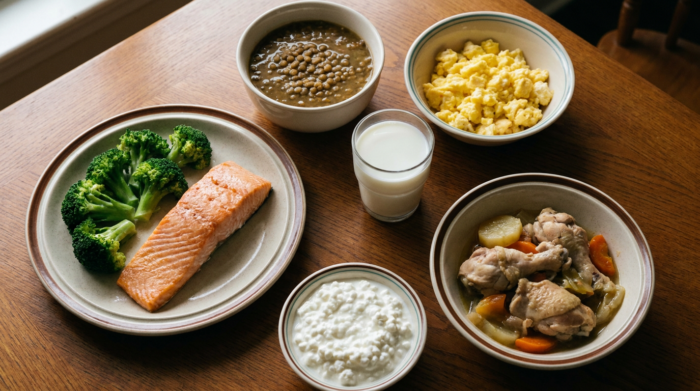
In practice, this means that eating a large amount of protein only in the evening may not be the best strategy. It makes more sense to spread your protein intake throughout the day so that each main meal includes a substantial serving: for example, meat, fish, eggs, dairy products, legumes, tofu or, if needed, a protein supplement. For someone weighing 70 kg, 0.40 g/kg per meal provides approximately 28 g of protein (Moore, 2015). You do not need to weigh everything to the gram to hit this figure, but it helps illustrate why a breakfast of white bread with jam and coffee gives your muscles little building material.
Protein alone does not resolve sarcopenia. EWGSOP2 emphasizes that low muscle strength is the central feature of sarcopenia, while muscle mass and physical performance help confirm the condition and assess its severity (Cruz-Jentoft, 2019). This matters because you may eat enough protein, but if your muscles are not being challenged, the signal to maintain them is weak.
Which matters more for older adults: protein or strength training?
The strongest practical answer is a combination of the two. ACSM’s position stand emphasizes that an older adult’s physical activity plan should include aerobic activity, muscle-strengthening exercises and flexibility work (Chodzko-Zajko, 2009). Strength training gives your muscles a stimulus; protein supplies the material and amino acids needed to respond to it.
Meta-analyses have found that protein supplementation combined with strength training provides modest additional support for gains in fat-free mass and strength in older adults, although results vary between studies (Cermak, 2012; Liao, 2019). In the meta-analysis by Liao and colleagues, the combination of protein supplementation and strength training increased fat-free mass by 0.23 kg and appendicular skeletal muscle mass by 0.39 kg more than in the control condition (Liao, 2019). These are not dramatic figures, but a small change can matter for an older adult if it helps maintain mobility.
If your goal is to make more structured progress in the gym, the article How much protein should you eat if you train at the gym? offers a useful point of comparison from a broader sports perspective. For older adults, however, the priority remains consistency and safe progression: exercises you can do regularly, a training load you can gradually increase and a protein intake you can achieve through regular food.
How should you spread your protein intake throughout the day?
Start with three questions: how many times a day do you eat, does each meal include a protein source and does your daily intake at least reach the target range? If your appetite is small, it is often easier to add protein to breakfast and lunch than to try to make up the entire shortfall in the evening.
For example, a daily target of 1.0–1.2 g/kg for an older adult weighing 70 kg works out to 70–84 g of protein per day (Deutz, 2014). You can spread this across three main meals, each containing around 25–30 g of protein, in line with older muscle’s greater protein needs per meal (Moore, 2015). If you eat four times a day, the portions can be smaller, but each meal should include a clear protein source.
A balanced plate contains more than protein. Maintaining muscle mass also requires enough energy, carbohydrates to meet the demands of training, fats, dietary fiber and micronutrients. If you are losing weight unintentionally, the problem may be a shortfall in total energy intake as well as protein. The principles of muscle building are covered more broadly in How can I gain as much muscle mass as possible in three months?, but in older age, monitoring strength, balance and recovery should take priority over aggressive bulking.
Can older adults have too much protein?
Yes, context matters. If you have a known diagnosis of chronic kidney disease, a higher protein intake must be agreed with your doctor or a clinical nutrition specialist (Deutz, 2014). If you are a healthy older adult, there is no point in increasing protein indefinitely, as focusing too heavily on protein can leave less room for vegetables, whole grains, fruit and other essential foods.
It is also worth being wary of slogans claiming that protein is either always a miracle cure or always a problem. Fitness.ee’s earlier provocative article Don’t eat protein serves as a reminder: a single nutrient cannot replace a well-rounded training program, sleep, energy availability or disease management.
What is a practical action plan?
Weigh yourself and assess what you eat on a typical day. Calculate an initial target of 1.0–1.2 g/kg per day and, if needed, discuss the 1.2–1.5 g/kg range with a healthcare professional, particularly during illness or recovery (Deutz, 2014). Spread your protein intake across your main meals and include a clearly identifiable protein source in each meal.
Add strength training, at least in a form that is safe for your condition: chair stands, band rows, squat variations, hip thrusts, light dumbbell exercises or supervised gym workouts. If your strength, walking speed or body weight declines, consider asking your family doctor or physiotherapist for a sarcopenia assessment, as EWGSOP2 identifies low muscle strength as an important early sign (Cruz-Jentoft, 2019).
References
- Bauer (2015). Protein Requirements and Recommendations for Older People: A Review. Nutrients. PMID: 26287239. DOI: 10.3390/nu7085311
- Cermak (2012). Protein supplementation augments the adaptive response of skeletal muscle to resistance-type exercise training: a meta-analysis. American Journal of Clinical Nutrition. PMID: 23134885. DOI: 10.3945/ajcn.112.037556
- Chodzko-Zajko (2009). American College of Sports Medicine position stand. Exercise and physical activity for older adults. Medicine and Science in Sports and Exercise. PMID: 19516148. DOI: 10.1249/MSS.0b013e3181a0c95c
- Cruz-Jentoft (2019). Sarcopenia: revised European consensus on definition and diagnosis. Age and Ageing. PMID: 30312372. DOI: 10.1093/ageing/afy169
- Deutz (2014). Protein intake and exercise for optimal muscle function with aging: recommendations from the ESPEN Expert Group. Clinical Nutrition. PMID: 24814383. DOI: 10.1016/j.clnu.2014.04.007
- Houston (2008). Dietary protein intake is associated with lean mass change in older, community-dwelling adults: the Health ABC Study. American Journal of Clinical Nutrition. PMID: 18175749. DOI: 10.1093/ajcn/87.1.150
- Liao (2019). Effect of Protein Supplementation Combined with Resistance Training on Muscle Mass, Strength and Function in the Elderly: A Systematic Review and Meta-Analysis. Journal of Nutrition, Health and Aging. PMID: 31021362. DOI: 10.1007/s12603-019-1181-2
- Moore (2015). Protein ingestion to stimulate myofibrillar protein synthesis requires greater relative protein intakes in healthy older versus younger men. Journals of Gerontology Series A. PMID: 25056502. DOI: 10.1093/gerona/glu103
- Yaegashi (2021). Association of dietary protein intake with skeletal muscle mass in older adults: A systematic review. Geriatrics and Gerontology International. PMID: 34643981. DOI: 10.1111/ggi.14291
Frequently asked questions
Do older adults need to take protein powder every day?
No. Aim to meet your daily target through regular food first; protein powder is a convenient supplement if you repeatedly fall short of 1.0–1.2 g/kg per day through food alone (Deutz, 2014).
How much protein should each meal contain?
A good practical target is around 0.4 g/kg per main meal, as older muscle needs a larger relative dose to strongly stimulate protein synthesis (Moore, 2015).
Does more protein automatically build muscle in older adults?
No. Protein works best alongside strength training; ACSM emphasizes that an older adult’s physical activity plan should include muscle-strengthening exercises (Chodzko-Zajko, 2009).
Can older adults with kidney disease eat 1.2–1.5 g/kg of protein?
If you have kidney disease, you should not adopt this range on your own; a higher protein intake must be agreed with your doctor (Deutz, 2014).
Come and train! ArtGym