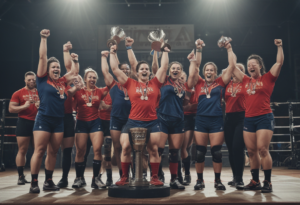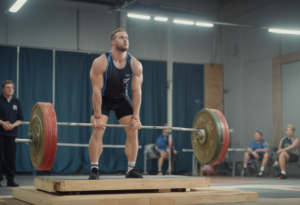
Bench press at Rocca al Mare School
The bench press brought young people, teachers and powerlifting enthusiasts to the Rocca al Mare School sports center on 24 May 2016. This archive notice brings together the key competition details: who the event was for, how the weigh-in worked and which rules competitors had to follow on the platform.
Why the bench press mattered at a school competition
Rocca al Mare School’s open spring competition was more than just another event on the sports day program. The aim was to introduce young people to the bench press and make their first experience straightforward, fair and safe.
You see people bench pressing in the gym almost every day. In competition, though, things are different. It is not just the weight of the barbell that counts. Technique, following commands and whether the attempt meets the rules all matter too.
That made a school competition a good way to introduce more people to the sport. Students could see that powerlifting is about more than chasing heavy weights. It involves discipline, measurable progress and the ability to control your body. Frankly, that is a useful lesson even if you have no plans to compete.
How the bench press competition was run
The competition took place on 24 May 2016 at the Rocca al Mare School sports center at Vabaõhumuuseumi tee 8. The weigh-in was scheduled for 15.00-15.45, with the competition starting at 16.00.
The organizers were Rocca al Mare School, the Estonian Powerlifting Federation and Haabersti Sport SK. Ants Rosenbaum was listed as the head referee. This combination gave the event a stronger foundation than a school competition alone could provide, bringing together the experience of the school, a sports club and the sport’s governing body.
Participants and competition standings
Students from all upper secondary schools were eligible to compete. An identification document, such as a student card, had to be presented at the weigh-in. Students from universities, technical colleges and vocational schools, as well as teachers, could also take part outside the main competition standings.
Weight classes were set according to IPF rules. This meant athletes were not simply grouped by age or school: their body weight was also taken into account. This makes competition fairer, especially among young people, whose physical development can vary considerably.
Awards and scoring
The top three competitors in each weight class received certificates. The overall winner was determined using the WILKS table and received a trophy. The principle is simple: overall scoring helps compare athletes of different body weights, rather than just the weight loaded onto the barbell.
What competitors needed to know before an attempt
To a spectator, a bench press attempt looks simple: the athlete lies on a bench, lowers the barbell to their chest and presses it up. In reality, several small details determine the result. The barbell must touch the chest, the buttocks must stay on the bench and the arms must be straight, or locked out, at the end of the press.
These requirements are no small matter. If the buttocks lift off the bench or the barbell does not reach the chest, the attempt is no longer comparable with the others. Competition rules keep the sport fair and help prevent one athlete from winning simply by using a shorter range of motion.
Clothing also played a part. Competitors had to wear a short-sleeved shirt and close-fitting bottoms. This makes it easier for the referee to assess whether body position meets the rules. It may seem strict, but being able to see an athlete’s technique clearly is very important in powerlifting.
Each athlete was responsible for their own health. This is a standard statement in competition regulations, but you should not treat it as a formality. If your shoulder, wrists or chest are already causing discomfort during the warm-up, you need to reconsider the weight. A spring competition is no reason to get under a barbell when you are in pain.
Bench press: practical advice for participants
If you are a school student preparing for a similar competition, start with technique rather than your maximum weight. A good attempt is one you can repeat under a referee’s watchful eye. In training, practice pausing the barbell on your chest, keeping your feet stable and finishing with your arms fully locked out.
On competition day, it makes sense to arrive with time to spare. Weighing in, getting changed and warming up all take time. Leaving everything until the last minute adds to your nerves, and your first attempt can go wrong simply because you are rushing.
Registration for this competition was open until 22.05.2016 via sport@ramkool.edu.ee. Participants were asked to send their first and last names, date of birth and school name. The entry fee was 5 €; participation was free for Rocca al Mare School students and teachers.
The event regulations stated that any problems arising during the competition would be resolved on site and that later complaints would not be considered. This is a practical approach for a small competition. If anything is unclear, you need to ask straight away, rather than after the results have been announced.
FAQ: bench press at a school competition
Who could take part in the Rocca al Mare competition?
Upper secondary school students could compete in the main standings. Students from higher education institutions, technical colleges and vocational schools, as well as teachers, could also participate outside the standings.
What made an attempt valid?
The barbell had to touch the chest, the buttocks had to stay on the bench and the arms had to be straight at the finish. If any of these conditions were not met, the attempt might not count.
Why was the WILKS table used?
The WILKS table allowed results to be compared across athletes of different body weights. This made it possible to determine the overall winner more fairly than by the weight lifted alone.
Author: Estonian Powerlifting Federation
Come work out! ArtGym