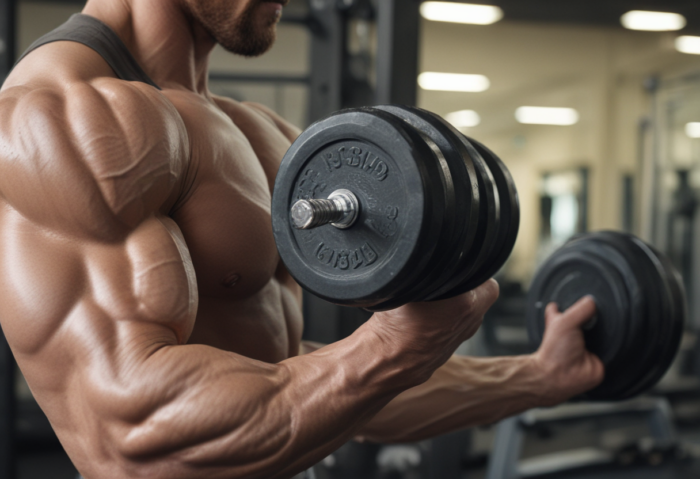
Arms: why train them separately in the gym
Arms are a surprisingly heated topic in the gym. Some say rows and presses are enough, while others want to add a couple of sets for biceps and triceps after a heavy workout. In my view, there’s nothing to be ashamed of here, as long as you go about it sensibly.
Why train arms separately at all?
Many coaches and plenty of “functional training” advocates are fairly harsh on direct arm training. The main argument sounds familiar: in real life or on the sports field, the biceps and triceps don’t work in isolation, so there’s no need to train them in isolation either.
Honestly, I’ve partly come to understand that view. A beginner really does need to learn the squat, row, press, pull-up and other big movements first. If an entire workout consists of nothing but biceps curls in front of the mirror, the picture is lopsided.
But the other extreme is no better. Claiming that training arms is vain, pointless or somehow shameful is simply overdoing it. People care about how they look. That doesn’t make anyone a worse athlete or a less serious lifter.
If a person eats well, shaves, buys clothes they like or gets a tattoo, it’s clear that their appearance matters to them. The same logic applies in the gym. If you like your arms to look strong, that’s a perfectly normal goal.
Arms, strength and looks don’t have to be at odds
You often hear the line: “I only train for strength, I don’t care how I look.” Nonsense. Most of the time, people do care. Even a very strong powerlifter with a 115 cm waist probably enjoys being seen as a big, powerful man.
That doesn’t mean every workout has to be a chase for aesthetics. Strength, health and performance really do matter. But the simple truth is that aesthetics and strength can go hand in hand. You can do heavy foundational training and add a few sets for the arms at the end without the world falling apart.
For an athlete, a well-developed upper body can even be an advantage. Big, trained arms give the body a more powerful overall impression. It’s not a primary performance indicator, but psychology plays a role in sport. Your opponent sees you before they feel your strength.
Balance is even more important. If you do a lot of presses, your triceps already get training load. If you do pull-ups and rows, your biceps work as well. Direct work doesn’t have to replace that. It can complement it.
How to add arm work to your training sensibly
The first rule: don’t build your whole program around the arms if you lack a general strength base. Start with the big exercises. Get your squats, rows, presses and pull-ups done. Only then add direct work for the biceps and triceps if needed.
The second rule: keep the volume under control. A few sets of biceps curls a week won’t take anyone’s athletic ability away. The problem starts when your elbows hurt, recovery falls short and every workout turns into nothing but an arm pump.
The third rule: choose exercises you feel in the right places. Biceps curls with dumbbells, a barbell or a cable are all fine as long as your technique stays clean. For the triceps, cable pressdowns, French presses or close-grip press variations all work. The name of the exercise matters less than controlled movement.
So what actually happens? When you add a couple of well-thought-out sets at the end of your basic exercises, your arms get a more targeted stimulus. You don’t have to apologize for that. You just have to make sure the small extra work doesn’t eat into your main goal.
Practical tips for training arms
Don’t chase weight alone. In arm exercises, feel is often more important than ego. If your shoulders swing along, your lower back jerks and the rep looks like a whole-body heave, your biceps are no longer doing the work the exercise was meant for.
Keep your wrists neutral, your elbows under control and your tempo calm. If in a triceps exercise you feel your shoulder or elbow more than the back of your upper arm, change your grip, the weight or the exercise. Pain is not a sign of a good workout.
If your goal is a better look, say so honestly. There’s nothing odd about it. It’s just as honest to say you want to be stronger, move better or stay in shape. A workout can have several reasons at once.
The moral of the story is simple: once the heavy work is done, don’t be afraid to pick up the dumbbells and do a few solid sets afterward. Training your arms doesn’t make you a less functional person. A poorly built program does.
FAQ: arms and direct training
Should a beginner train arms separately?
Yes, but in small volume. A beginner’s main focus should be on the basic exercises, but a couple of extra sets for the biceps and triceps can be perfectly reasonable.
Does training arms get in the way of strength gains?
Usually not. It starts to interfere when the volume is too high, recovery is poor or your arms are constantly tired before important push and pull days.
Is training for looks a bad reason?
No. Looks can be a perfectly normal reason to train, as long as you don’t forget about health, technique and overall physical capacity.
Original article HERE.
Author: Janar Rückenberg (translation)
Come and work out! ArtGym