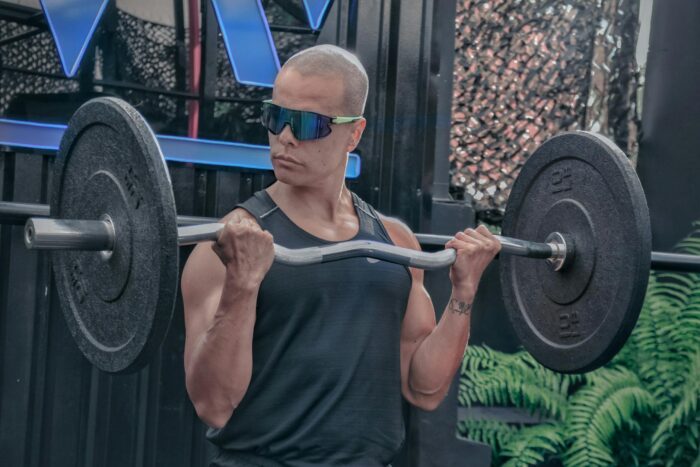
Dream arms: an 8-week program
Arms are a body part that’s easy to check in the mirror but harder to actually grow. This 8-week program gives you a clear rhythm: when to increase volume, when to increase weight, and when to use supersets or drop sets.
The original note was simple: Flex. We’re making that old plan more readable, but keeping its principle: controlled reps, short rest and honest effort.
Why arms need a separate plan
Biceps and triceps also get worked in back, chest and shoulder workouts. That is exactly why more isn’t always better. If you train arms too often, recovery stays incomplete. If you train too lightly, you don’t create enough stimulus.
A simple truth: arm growth comes from the quality of your reps, not just from the plates added to the barbell. Every repetition should move through a full range of motion. Don’t swing the weight up or let it drop down. If the movement falls apart, the weight is too heavy.
Before you start, measure your arm circumference. Do it at the same time of day and in the same position, for example in the morning before your workout. Then after week eight you’ll see whether the program worked or whether you need to adjust your training load, sleep or diet.
Arms: the 8-week training logic
Week one: preparation
The first week is the opening round. Train arms 2x a week and leave a two- or three-day rest break between sessions. Keep the tempo light and quick, but not sloppy. Rest between sets should not be longer than 30 seconds.
Do 8 working sets for biceps and 9 sets for triceps. Each set is 15 reps. Finish with a 3-exercise tri-set for the wrists. Choose a weight so that the last rep is hard but your technique stays clean.
Week two: increase the volume
The first training day may leave your muscles sore. The second day should already give you a better feel. After your third arm workout, move on to week two.
Now train arms 1x a week. The reason is simple: these muscles also work along with other upper-body exercises. Rest between sets stays at around 30 seconds. Do 8 working sets for triceps, 8 sets for biceps and 8 sets for the wrists with underhand and overhand grips. Each set is 15 reps.
Week three: fast-slow-fast
Week three brings some variety. You could call it the 15-set week. Do the first 5 reps slowly and hold the peak contraction for one second. Do the next 5 reps explosively, but control the movement. Do the last five more slowly again.
Rest about 1 minute between sets. Do 9 working sets for biceps and triceps and 4 working sets for the wrists. Each set is 15 reps. So what actually happens? The muscle gets a different stimulus with the same weight, and you don’t just sleepwalk through your reps.
Week four: heavier and heavier
In week four, add weight to the barbell and cut the reps. Rest about 60 seconds between sets. Each repetition should move up and down with similar control. If you want more of a burn, you can do the lifting phase a little faster, but don’t rush so much that your form breaks down.
Do 9 working sets for triceps, 10 working sets for biceps and 4 sets for the wrists. Each set is 10 reps.
Week five and week six: going heavy
Week five means more resistance. Lower the reps to 8 per set. Choose a weight you can do 8 controlled reps with. Bodybuilding isn’t simply moving weight. It’s feeling the muscle and working it so that the right spot does the work.
Think of it this way: do one proper rep 8 times, not just 8 reps. If you lose control, stop the set. Adjust the weight and try again in the next set. Do the same in week six, but add a little more resistance if you can.
The goal of this block is 8 working sets for biceps and triceps, with 8 reps per set. Add 5 sets for the wrists.
Week seven: supersets
Week seven uses supersets at maximum intensity. After several weeks, your arms have adapted to the training load and need a new push. Do the biceps and triceps exercises back to back. Move quickly between the two exercises, then rest only as long as it takes for your breathing to recover. That should take 90 seconds at most.
Do 9 supersets for triceps and biceps, with 10 reps for each. Add 8 working sets for the wrists with underhand and overhand grips.
Week eight: drop sets
Week eight is a test. Start with a weight you can do 8 good reps with. Then reduce the weight and do the next 8 reps. Keep going with lighter weights until you reach your limit. Within the set, make four weight reductions.
In total, do 1 working set each for biceps, triceps and wrists, with underhand and overhand grips. Do all of them as drop sets, taken to the limit of what you can do. Honestly, this is the hardest part of the plan, so don’t choose your weight at the start based on ego.
Your arms grow when your technique stays honest
Keep your wrists neutral, your shoulders down and your elbows under control. When training biceps, don’t push your elbows forward every time. When training triceps, don’t let your shoulder take over all the work. If you feel strain in the joint rather than the muscle, change your grip or the weight.
Recovery counts as much as the set. Eat enough, sleep properly and don’t also add a separate arm finisher to every upper-body workout at the same time. This program is already dense. More doesn’t necessarily give you more.
Arms and FAQ
Can a beginner do this plan?
Yes, as long as your technique is solid and the weights stay manageable. A complete beginner should start with lower volume and first learn the feel of the exercises.
Can I train arms more than the plan says?
You can, but it isn’t always sensible. Your arms also get training load from other upper-body exercises. If your performance drops or your elbows start to hurt, reduce the volume.
When will I notice results?
A pump and a better feel for the muscle can come quickly. You’ll see real change more clearly if you take a circumference measurement at the start and compare it after the eighth week.
Author: joker
Source: WHO – physical activity and recovery.
Come and train! ArtGym