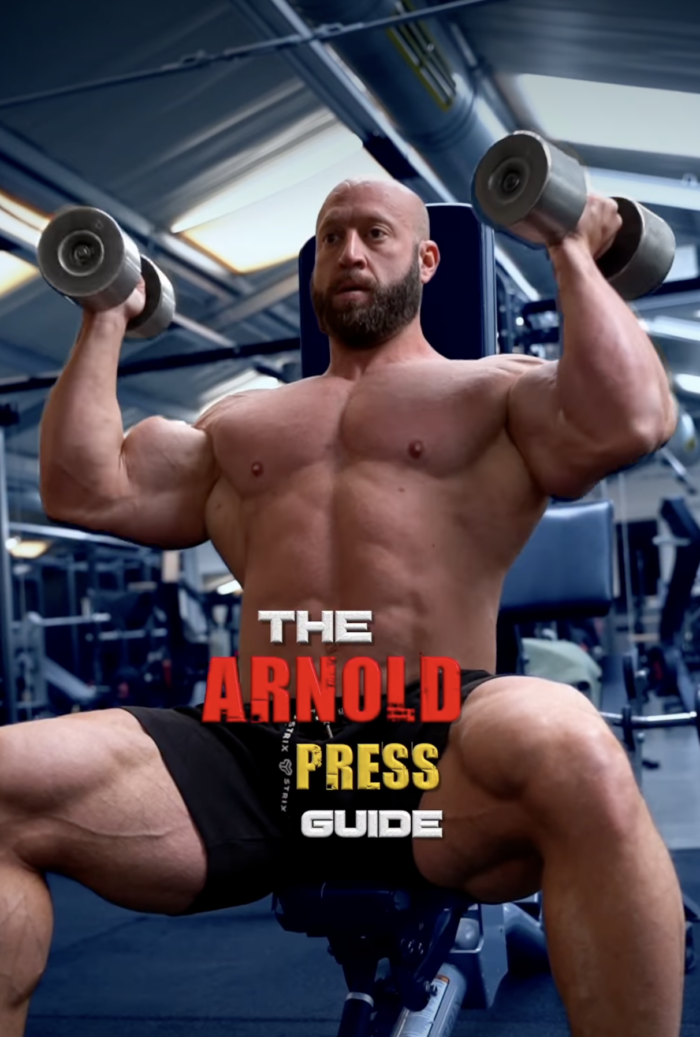
Arnold and bodybuilding training tips
For many bodybuilders, Arnold is still the benchmark, because his advice isn’t only about heavy weights. Here are his thoughts on training body parts, in plain English: how to feel the muscle, when to reduce the weight and why ego must never ruin your technique.
Why Arnold stressed feeling the muscle
Back training brings out an old truth right away: your back doesn’t work well just because the barbell or cable is moving. The biceps and shoulders take over the work very easily. The same happens when the weight is too heavy and the body starts using momentum.
Arnold’s idea was simple. An exercise has to go where it’s meant to go. If you’re training your back, you should feel your back. If you’re training your triceps, the work shouldn’t all sink into the shoulders or elbow joints. When you no longer feel the muscle, the weight is usually too heavy or the technique too sloppy.
That doesn’t mean training has to be easy. Quite the opposite. A good set is hard but controlled. The difference is big.
Arnold and upper-body training
Shoulders and traps
Shoulders show in almost every pose. Weak shoulders are hard to hide, especially in bodybuilding. On presses, Arnold advised not locking the elbows out completely, because locking out takes the tension off the shoulders and shifts it more onto the triceps.
During a press, keep your elbows rather wide. As you lower the weight, the elbows don’t travel straight down but slightly back. When doing dumbbell lateral raises, the arm should be slightly bent at the elbow. That way you can control the movement better and put less load on the elbow joint.
For the traps, a simple mental image works: when doing shrugs, try to touch your ears with your shoulders, as it were. It helps guide the movement in the right direction.
Arms and controlled cheating
In biceps training, Arnold talked a lot about visualization. Think about what shape of muscle you’re building. He described the biceps as mountains with peaks. That may sound old school, but the point is practical: focus on the muscle, not just on heaving the weight up.
When you do biceps curls, do them with your biceps. Your back, legs and shoulders rush in to help quickly if the weight is too much. Be stronger than your ego and choose a weight you can really handle.
Arnold also used deliberate cheating. He took a weight he could do 3–4 proper repetitions with, then added 3–4 cheat reps, using his body to help. But there’s an important limit here: if you can’t feel the biceps even during those last 3–4 reps, the weight is too heavy.
The same principle applies to the triceps. Choose a weight that lets you isolate the work of the triceps. Your program should include exercises for all three heads, not just one convenient movement that you always repeat.
Arnold on lower-body and back training
Your back needs both thickness and width. In addition, muscle density, separation and detail matter. The latissimus dorsi is the largest muscle of the back, and you can think of it as an upper, a lower and a middle part.
When training your back, you can’t watch the muscle work in the mirror very well. That’s why feel has to be your guide. If your shoulders get pumped instead during rows, reduce the weight or fix your technique. Honestly, for many people that’s harder than just putting more plates on the barbell.
On legs, Arnold was blunt: you have to learn to love leg workouts. They’re the most draining workouts for the body, but also the most necessary. Calves shouldn’t always be left until the end, when your energy is gone. If calves are a weak point, you can train them at the start of the workout, while you’re still fresh.
Translator’s note: In my opinion this is a bit debatable, because if you do calves first, your legs will shake through the whole workout and the training of the other body parts suffers badly!
VERY SIMPLE: YOU JUST HAVE TO SQUAT!
Squats aren’t good only for the legs. They also raise your general endurance and improve the strength of your whole body. If you pick a weight for your first working set that you could squat for 6–8 reps, try to pull yourself together and do 12 reps. The point isn’t to flail around carelessly, but to understand that the effort often gets stuck in your head before it does in your body.
When doing leg flexions and extensions, use the strength of the hamstrings and the quadriceps respectively. Control the movement, because with these exercises it’s easy to start swinging the weight with your body.
Practical Arnold tips for chest and abs
On chest presses, Arnold didn’t recommend locking the elbows out completely. On bench presses at different angles, stop the barbell 1–2 inches before lockout. That keeps tension in the chest muscles and puts less unnecessary load on the joints.
Don’t move the barbell only straight up and down. As you lower it, bring the barbell to your chest; as you press up, it travels slightly toward your neck or face. During flyes, keep your elbows in line with your shoulders, not too far in front.
In bodybuilding, the midsection is the center of the physique. At competitions, the eyes of the judges and the audience often go there first. Abdominal muscle training supports your posture and helps your body move with more strength and stability.
The final conclusion is old-fashioned, but it works: Rome wasn’t built in one day. The same goes for your body. You have to believe in the program, but not blindly. If you can’t feel the muscle working, your technique is falling apart or your ego is running the set, take a step back and fix the foundations.
FAQ: Arnold and training tips
Did Arnold always recommend heavy weights?
No. Heavy weight mattered only as long as you kept the feel of the muscle and your technique. If the work shifted to the wrong place, the weight had to come down.
Why is feeling the muscle so important?
Because your body can move a weight using assisting muscles and momentum as well. In bodybuilding, the goal is to make the right muscle do the work, not just to get a repetition done somehow.
Is controlled cheating suitable for beginners?
A beginner should learn clean technique first. Controlled cheating is a tool for more experienced lifters who can tell when the muscle is still working and when the set is simply falling apart.
Translated by: Janar Rückenberg
Source: WHO – physical activity.
Come and train! ArtGym