
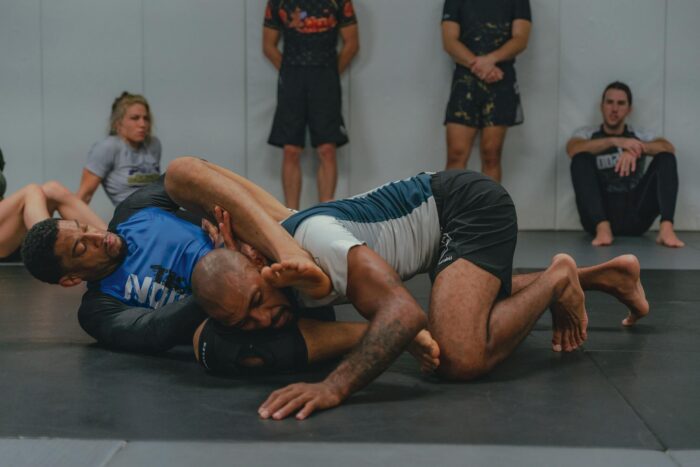
Body combat: energetic combat training
Body Combat is a group training class where moves from boxing, karate, kickboxing, tai chi and taekwondo are set to music. You don’t need a martial arts background. The class is more of an energetic aerobic workout that works your body from head to toe.
If you like training with music driving you along and an instructor setting a clear rhythm, this style could suit you well. Punches, kicks, elbow strikes and loud shouts make the class emotional. Honestly, that’s part of the appeal.
Why does body combat work?
Combat fitness is not a contact sport. You don’t hit a partner or learn to spar for competition. The moves are borrowed from the world of self-defense and martial arts, but the aim of the training is to improve endurance, coordination, speed and muscular endurance.
During the class, your arms, shoulders, back, abs, glutes and legs all work. The upper body takes the training load from punches and arm and elbow strikes. The lower body works through kicks, steps and stance changes. Because the tempo is lively, your heart rate rises too. That’s exactly why it’s often described as a fat-burning workout.
A simple truth: the best workout is the one you actually go back to. Body Combat may work precisely because, for many people, it doesn’t feel like a dry list of exercises. Music, choreography and a strong rhythm give you the sense of being part of the class rather than just filling minutes.
What does a body combat class look like?
A standard class lasts 60 minutes and is divided into ten different parts. The structure stays generally familiar: a warm-up first, then separate upper-body and lower-body blocks, followed by a more intense combat section and finally a calmer finish.
The music is changed about every 3 months. This keeps the class fresh, yet the moves don’t become completely new every week. After you’ve attended a couple of times, you start to anticipate the order of the strikes. Then you can focus more on technique and power.
The warm-up walks you through the basic strikes. This matters because a badly executed strike can injure the wrist, shoulder or lower back. The following parts use the same moves with more energy. Kicks are done to the front, back and side. In the combat section, punches, kicks and loud shouts all come together.
The original description even mentioned playing with an imaginary sword in the final part of the class. That sounds a bit theatrical, but it fits the nature of this workout: Body Combat doesn’t try to be quiet and polite. It tries to get you moving.
Body combat for beginners: what to watch for
As a beginner, you don’t have to do everything at maximum effort. The first time, keep your strikes under control and see how your body responds. A punch doesn’t need to be wild. It’s better to make a shorter, more precise and more stable movement than to fling your arm carelessly out from the shoulder.
With kicks, watch the position of your knee and hip. If you lose your balance, lower the height. A low kick can be just as effective if you do it with good control. Your abdominal muscles should work along during strikes, because the core holds the body steady.
Music is a topic of its own. The original described it as rock ‘n’ roll, which may not be to everyone’s taste. Then again, that very energy may get you singing along to Queen’s song We Will Rock You. If you don’t like the song, focus on the rhythm. The class goes faster when you move with the music.
- a great fat-burning workout
- improves cardiovascular endurance
- improves muscle strength and speed, increases muscle mass
- better flexibility
- an exciting, motivating experience set to great music
- better joint mobility
- better coordination and balance
- potential weight loss through burning calories
Who can try it? In principle, both women and men and people training at different levels. If you have a knee, hip, shoulder or back problem, choose a calmer pace and ask the instructor for an easier variation. The same applies if you’ve been away from training for a long time.
FAQ: body combat
Is Body Combat suitable for complete beginners?
Yes, if you take the first class easy. You don’t need to master karate, kickboxing, tai chi or taekwondo techniques. The instructor demonstrates the moves and you get to choose your own pace.
Is Body Combat real self-defense training?
No. It uses moves from self-defense disciplines, but the goal is getting in shape, building endurance and enjoying movement. If you actually want to learn self-defense, choose a separate martial arts or self-defense class.
What should you bring to your first class?
Bring comfortable footwear, clothes you can move freely in, and a water bottle. The most important thing is not to overdo it. The first time is for learning, not for proving yourself.
Source
Sources used in the original article: https://www.lesmills.com/us/workouts/bodycombat
Author: Mo
Come and train! ArtGym




