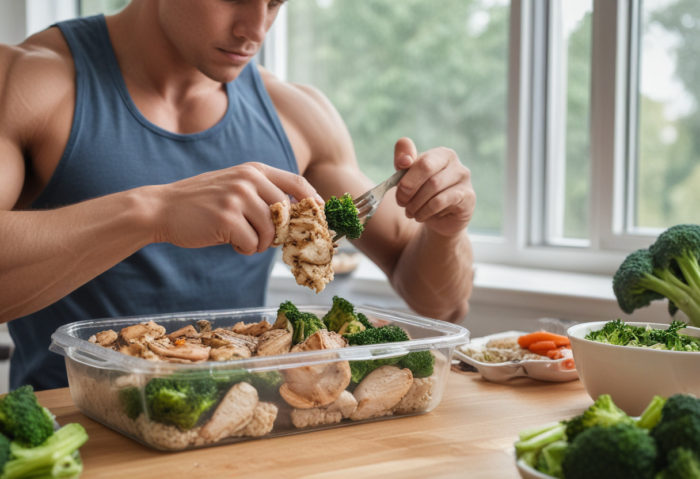
Bodybuilder protein intake: The pre-contest diet
A bodybuilder’s protein intake during contest preparation reaches levels that seem pointless to the average person. In the third part, we look at why men competing at the highest level eat 4–4.5 g of protein per kg, how their diet changes from phase to phase, and what science says about the health effects of it all. Our starting point: 17 years of practical experience and studies that actually have something to say.
Translated by Janar Rückenberg
Why a bodybuilder’s protein intake differs from standard recommendations
General dietary recommendations say that adults need only a modest amount of protein. Recent studies discussed in earlier parts of this series recommend 2.2 g of protein per kg of body weight for bodybuilders as well. But what happens in practice? In the off-season, a competitive bodybuilder typically consumes 2.75–3.3 g of protein per kg of body weight. During contest preparation, that amount often rises to 3.5–4.5 g per kg.
Nearly 100% of the world’s top bodybuilders eat almost twice as much protein as science recommends. Do they know something that laboratory research has yet to uncover? Few scientific studies demonstrate that protein intakes above 1.75–2.2 g per kg directly increase muscle mass. But muscle building is not the only reason top competitors eat so much protein.
The real reason lies elsewhere. A low-carbohydrate pre-contest diet leads to muscle loss unless protein intake is extremely high. When carbohydrates are in short supply, the body starts processing amino acids for energy through gluconeogenesis. This process is metabolically costly — but that is precisely what allows a bodybuilder to achieve a \”dry\”, fat-free stage physique without their muscles wasting away. Protein also speeds up metabolism.
Mainstream nutrition scientists condemn these diets. Their argument: excess protein is converted to glucose and used for energy, with the surplus stored as fat. Technically, they are right. But an athlete’s goal is not to live by a healthy eating textbook — it is to achieve results. And every elite sport involves extremes that fall outside health recommendations: whether that means 6–8-hour training days, running 40–50 km a day, or a wrestler losing 10 kg of water weight in a week to make their weight class.
Besides, who decides what is healthy? Elite sport is not good for your health. That is a simple truth. Elite athletes’ habits cannot be judged against general guidelines. The extreme protein intake in competitive bodybuilding is part of that picture, not an exception. And an important clarification: the competition period is short. After stepping off stage, bodybuilders return to a more manageable diet, with a higher proportion of carbohydrates and a lower proportion of protein. Just like training, diet needs to be periodized.
A bodybuilder’s off-season protein intake
Take a male bodybuilder weighing 87–88 kg, for example. His minimum intake would be 195 g of protein a day (2.2 g per kg). But that is just the minimum. Based on years of practical experience, I prefer to stay above that threshold rather than below it — I trust both my own experience and that of my colleagues.
An off-season diet needs to be high in both total calories and carbohydrates. A typical breakdown for an 87–88 kg bodybuilder looks like this:
- Calories: 3800 kcal
- Protein per 1 kg of body weight: 3.25 grams
- 55% carbohydrates = 2090 kcal = 522 grams
- 30% protein = 1140 kcal = 285 grams
- 15% fat = 570 kcal = 63 grams
These figures provide the baseline for the pre-contest cycle. Each bodybuilder adjusts them according to their metabolism, growth and recovery — the daily diets of two athletes of the same weight can differ by 10–15% and both be appropriate.
The pre-contest diet in three phases
Contest preparation begins by reducing total calorie intake and increasing the volume of aerobic training. The percentage split between nutrients initially stays the same — only the total intake changes. This approach increases fat burning while preserving muscle mass.
First phase: Fewer calories, the same proportions
- Body weight: 87–88 kg
- Calories: 3200 kcal
- Protein per 1 kg of body weight: 2.73 grams
- 55% carbohydrates = 1760 kcal = 440 grams
- 30% protein = 960 kcal = 240 grams
- 15% fat = 480 kcal = 53 grams
For some people, this change alone is enough to reach contest condition. Most, however, move on to the second phase, where carbohydrates are cut drastically and protein intake is increased.
Second phase: fewer carbohydrates, more protein
The second phase is the toughest and most restrictive part of the diet. But this is also when fat burning is at its most efficient and greatest.
- Body weight after the first phase has dropped to approximately 85.5 kg
- Calories: 3000 kcal
- Protein intake per 1 kg of body weight: approximately 3.5 grams
- 40% carbohydrates = 1200 kcal = 300 grams
- 40% protein = 1200 kcal = 300 grams
- 20% fat = 600 kcal = 66 grams
Third phase: the final couple of weeks
The third phase is the final stage — roughly a couple of weeks before the competition. By this point, the bodybuilder already has a dry physique and a low body fat percentage. Carbohydrates are reduced further, but must not be eliminated from the diet entirely. Carbohydrate loading also begins during this phase: the classic approach follows a four-day cycle — three days of low carbohydrate intake (to prevent muscle mass loss), followed by a loading day on the fourth day.
- Body weight has dropped to approximately 81.5 kg
- Calories: 2700 kcal
- Protein intake per 1 kg of body weight: 4.1–4.5
- 25% carbohydrates = 675 kcal = 169 grams
- 50–55% protein = 1350–1485 kcal = 337–371 grams
- 20–25% fat = 540–675 kcal = 60–75 grams
It bears repeating: contest preparation is highly individual, and the figures above should be treated as generalizations. Some bodybuilders do push their protein intake to unnecessarily high levels — if that suits their metabolism, then why not. For larger bodybuilders, a higher protein intake is justified during both cutting and bulking phases.
By the end of the third phase, the athlete is practically ready to step on stage. All that remains is the final week’s \”water manipulation\”. And yes, 4.1–4.5 g of protein per kg really is a large amount. I can imagine what you might think of that.
Translator’s note: the protein intakes in this example are indeed extremely high. Some readers may find 4.1–4.5 g of protein per kg alarming. But these are exactly the figures given in the original text. I would focus instead on how the nutrient ratios change across the phases — how carbohydrates are reduced while protein intake increases.
Does a high protein intake harm your health?
This tiresome question never goes away. The standard criticism goes like this: a high-protein diet damages the kidneys, causes dehydration and promotes osteoporosis. Let’s look at these one by one.
Kidneys
Medical fact: if you have no pre-existing kidney disease or damage, there is no documented evidence that a high protein intake could damage completely healthy kidneys. No study in adults has demonstrated kidney dysfunction caused by excess protein.
Victor Herbert and Genell Shubak-Sharpe write in \”Total Nutrition: the Only Guide You’ll Ever Need\” that high-protein diets have not been shown to pose a risk to healthy people. Naturally, processing excess protein places a strain on the kidneys and liver if they are already diseased — which is precisely why people with liver or kidney disease are put on a low-protein diet. The same warning applies to young children and infants, whose kidney function is not yet fully developed.
Some nephrologists speculate that eating a very high-protein diet for a very long time — years or decades — may cause kidney function to decline faster than it normally would with age. However, this claim is still being investigated and has not been officially confirmed.
Osteoporosis
Some studies in sedentary participants have shown that a high-protein diet increases calcium excretion. The reasoning is that a high-protein diet increases blood acidity, and the body needs calcium to buffer it. This led to the conclusion that calcium loss from bones accelerates osteoporosis, particularly in women.
However, this observation was made in sedentary people. A clear link between a high-protein diet and osteoporosis has yet to be demonstrated in physically active people who participate in sports. Women are particularly at risk of osteoporosis, but regular physical activity — whether strength exercises or aerobics — significantly reduces that risk.
Herbert and Shubak-Sharpe add that the widespread claim that a high-protein diet containing meat promotes osteoporosis is based on a misinterpretation of some scientific studies. Studies have shown that mixtures of pure protein and amino acids from which phosphate groups have been removed do indeed increase calcium excretion through the kidneys — in both animals and humans. However, long-term controlled studies in humans led by Herta Spencer have shown that high protein intakes from natural sources (such as meat) do not significantly increase calcium excretion because the phosphate groups remain intact.
A high-protein diet is not recommended for a sedentary woman of menopausal age. But if you are a bodybuilder who regularly trains with weights, your bone density is higher than the average person’s, and a slightly higher protein intake is not a problem.
Dehydration
This is one of the few legitimate concerns. Metabolizing protein — breaking it down and processing it — requires considerably more water than metabolizing fat or carbohydrates. That is why you must also drink more fluids when you increase your protein intake.
The standard recommendation is 8–10 250 ml cups of water a day, totaling 2–2.5 l. But the higher the proportion of protein in your diet, the more you need to drink — the usual guidelines no longer apply here. A bodybuilder preparing for a contest usually needs to drink 4–5 l of water a day. Of course, it also depends on body weight: a 70 kg bodybuilder and a 105 kg bodybuilder do not drink the same amount.
Bodybuilder protein intake FAQ
Does every bodybuilder need 4.5 g of protein per kg?
No. This is the upper end of the range and applies mainly to the final phase of a pre-contest diet, when carbohydrates have been drastically reduced. During the off-season, the 2.75–3.3 g/kg range works very well for most bodybuilders.
How much water should you drink on a high-protein diet?
The average person can get by on 2–2.5 l a day. A bodybuilder preparing for a contest needs 4–5 l. Tip: if your urine is dark yellow, you are not drinking enough.
Does a high protein intake damage healthy kidneys?
No study in adults has demonstrated that a high-protein diet damages previously healthy kidneys. However, if you have pre-existing kidney disease, your situation is different and you need medical advice.
I hope this series of articles has cleared up some of the myths surrounding protein. In closing: never do anything that causes irreversible damage to your health. But there are also situations where some extreme measures are necessary to achieve a better end result. The pre-contest dieting period is one such phase, and all the measures put into practice are essential to achieving ideal contest condition.
If a particular diet works for you, that is a good thing. Forget what the critics and traditionalists say. If your goal is a big, lean physique with rock-hard muscles, increase your protein intake and feel free to use the figures in this article to calculate your own dietary intake. If it works, you have found a way to get into contest shape and can keep using it in the future. If it does not, try a different approach. But if you never experiment with a high-protein diet, you will never know whether it can help you get lean while preserving muscle mass.
Author: Janar Rückenberg
Source: Protein source
Come work out! ArtGym