
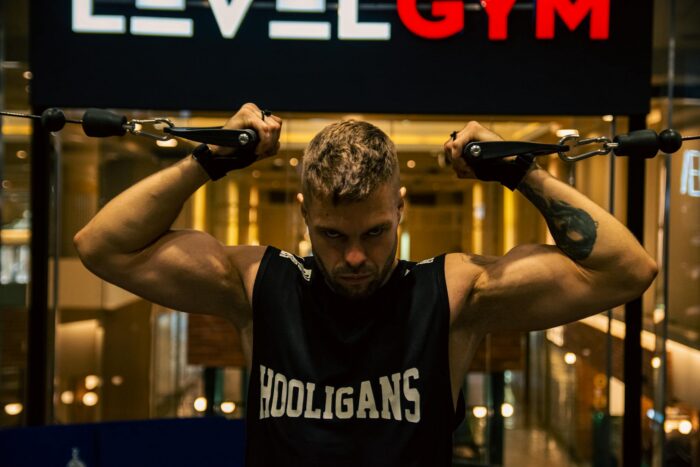
Build bigger arms: 20 honest training tips
Growing your arms isn’t just about endless biceps curls in front of the mirror. If you want your biceps and triceps to really develop, you need to play with repetitions, weights, volume and exercise order.
Why do arms so often fail to grow?
It’s an easy sight to spot in the gym: someone does the same arm exercises every week, with the same weight and the same feel, yet the reflection in the mirror never changes. It’s not always a lack of willpower. Often, what’s missing is a plan.
When training your arms, keep in mind that your biceps and triceps also get worked during back, chest and shoulder training. If you add direct work on top of that, progress can come quickly. But if the whole workout is random, the result will be random too.
How can you make your arms work better in training?
A simple truth: your arms need both heavy basic exercises and a more precise mind-muscle feel. One doesn’t replace the other. Dips, close-grip pull-ups and presses give your mass a strong foundation, while isolation exercises help you work the muscle fully.
- Dips and close-grip pull-ups are very good exercises for building arms. The arms of male gymnasts are no accident. Their training includes a lot of heavy bodyweight work.
- For maximum hypertrophy, use a wide repetition range. Do sets of 6-10 repetitions, 11-15 repetitions and occasionally 16-20 repetitions. Variety keeps the muscle working.
- If your biceps aren’t developing, train your forearms directly from time to time as well. A stronger grip and stronger forearms can help your biceps progress better.
- Triceps often respond well to heavy weights in the 5-8 repetition range. Start with, for example, a medium-grip or close-grip bench press, a barbell floor press, a board press, or lockouts from the safety pins of a power rack. Cable pushdowns with a rope or a standard handle work well at the end.
- Sometimes do exercises in which the muscle is in a stretched position at the end of the eccentric phase. Overhead extensions behind the head suit the triceps, and seated incline curls suit the biceps.
- Try the close-grip or medium-grip bench press and triceps extensions with a thick-handled barbell. A thick handle can be friendlier on the wrists than a standard barbell.
- For a short period, for example 1-2 months, you can train your biceps and triceps at the start of an upper-body day. In that case, reduce the volume for the larger muscles in the same workout. Translator’s note: ?!?, that’s exactly the reaction you get when reading this recommendation.
- If straight-bar barbell curls make your wrists hurt, use dumbbells. That’s not giving up. For many people, dumbbells are just as effective and more natural for the body.
- A curl doesn’t always have to be rock-solid and perfectly still. A little body movement may feel more natural for some lifters and be more comfortable on the shoulders and elbows.
- If you care about the health of your shoulders, be careful with added weight on dips. A good exercise doesn’t justify bad technique.
- If you want to increase the training load on dips, try rings for a change. Once you reach the level where you do 3-4 sets of 12/15 repetitions on rings, that is already serious work for the triceps.
- Arms are a small body part and can tolerate more volume and frequency than the lats, thigh muscles or other larger muscle groups. Translator’s note: this is a position that gives me something to think about, and a relatively new one.
- The first Mr. Olympia, Larry Scott, recommended doing curls with a wrist rotation. He felt that this allowed him to use heavier weights than with fully supinated hands. Looking at his biceps, it’s hard to argue.
- Do an equal amount of work for your biceps and triceps. Translator’s note: another new position!
- Try a superset of standing barbell curls or seated incline dumbbell curls, followed by close underhand-grip pull-ups. In exactly that order.
- For triceps, you can use the same logic: do cable pushdowns or triceps extensions, followed by a medium-grip or close-grip bench press.
- If you aren’t squatting and deadlifting properly, don’t worry too much about a separate high-volume arm workout. First build strength throughout your whole body.
- During the eccentric phase of a curl, try to feel tension in the triceps, as if you were doing a cable pushdown. During the negative phase of a triceps exercise, do the opposite and feel the biceps.
- Arm exercises need progression too. Add weight, repetitions or sets sensibly. If the training load doesn’t change, your body has no reason to change.
- For a beginner and a very skinny lifter, going overboard with direct arm training is often a waste of time. First focus on basic exercises, progression and an overall increase in body weight. Once that’s in place, add more direct work for your arms.
Practical tips to give your arms the training load they need
Don’t choose an exercise just because someone calls it the best mass builder. If your wrists hurt, your shoulders pinch or your elbows start complaining, change your grip, use dumbbells or swap the exercise.
Honestly, arms grow best when your training is both consistent and flexible. Keep the basic exercises in, track your repetitions and don’t be afraid to change the order for a few weeks. But don’t turn every workout into an experiment.
Source
FAQ: arms and arm training
Can you train arms several times a week?
Yes, but the volume has to fit with the rest of your training. If you do a lot of back and chest work, your biceps and triceps already get extra training load as it is.
Are pull-ups enough for the biceps?
For some beginners, they may be enough at first. Later on, though, direct biceps curls are a good way to target the training load more precisely.
Why is the triceps so important for arm size?
The triceps makes up a large part of the upper arm. If you train only the biceps, you leave much of your arm’s volume untapped.
Author: Janar Rückenberg (translation)
Source:Turg.Fitness.ee
Come work out! ArtGym




