
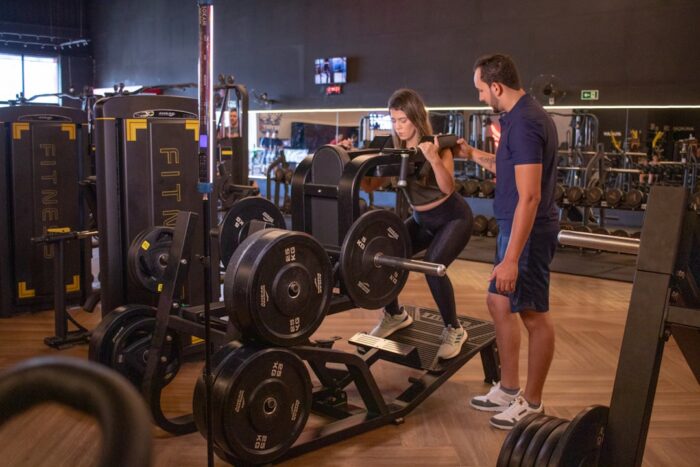
Legs: squats and building mass for real
Legs don’t usually grow from running through the machines once a week and hoping for the best. My experience says something simpler: when your squat progresses, your volume is sufficient and your recovery isn’t left to chance, the picture slowly starts to change.
I’m not writing this from the position of genetic luck. Quite the opposite. My legs have never been a body part that grows from the mere sight of a barbell. That’s exactly why the average lifter probably has more to take from this than from the program of some supremely gifted athlete.
Why legs need more than a circuit of machines
Leg training comes with one uncomfortable truth: the real work is hard. On chest day you get a pump quickly, your arms look full in the mirror and your mood lifts. Legs are a different story. Squats, lunges and Romanian deadlifts take your breath away and force you to focus.
Over the years I’ve seen that many people train legs almost out of obligation. A bit of leg press, a bit of extension, a few sets for the calves, and done. That’s enough to stay mobile, but it’s rarely enough to build leg mass. If the goal is visible progress, a workout needs a clear purpose.
The cornerstone of my own leg development has been the squat. It’s hard to put an exact percentage on it, but honestly, I attribute most of my progress to squatting. Not just chasing a heavy one-rep max, but using different schemes, different volumes and different frequencies in different periods.
After the spring season of 2014, when I could no longer squat properly, my competition plan changed too. Take the squat away and a big chunk of leg training is missing for me. You can do other exercises, but they don’t always give quite the same foundation.
That doesn’t mean everyone has to train like Estonia’s strongest bodybuilders. Hats off to the very talented men, but the average lifter can’t get their legs simply by copying their program. What matters is understanding what works for your body and then developing it patiently.
How to make your legs grow with the squat
The squat isn’t just an exercise where you put a barbell on your upper back and grind your way up with the weight. It can be strength work, volume work, a long set, a wave-style week or a technique day. If the goal is muscle mass, it makes no sense to stick to just one rep range.
I’ve used very different schemes: 5×5, 6×6, 7×7, 8×8, 10×10, 10×6, 10×5 and several other variations. The point wasn’t to chase numbers for their own sake. The point was to progress at different volumes and with different weights so that the leg muscles could grow from several angles.
It’s important to understand that progress doesn’t mean only a one-rep max. A one-rep max is a nice metric, but for building mass it’s often far more important whether you can move, say, your 5×5 or 8×8 weight up over the course of a year. When the same scheme moves up, your work capacity usually moves up too.
Looking through my training log, I found that in 2007-2014 I did 7×7, 8×8 and 10×10 squats alone 62 times. The weights mostly fell between 90-155 kg. That works out to one higher-volume scheme squat session roughly every 38 days, and in between came other squat days and accessory exercises.
10×10 squats were a chapter of their own. I did them 24 times during that period, with the lightest weight at 60 kg and the heaviest at 135 kg. On one occasion I even tried 10×10 squats three times in a day: 90 kg in the morning, 95 kg at midday and 100 kg in the evening. Today I wouldn’t recommend that lightly, but as an experience it showed clearly what volume does to the body.
Long sets gave a lot too. For example, progressively longer sets with the same weight: 8, 12, 16 and 20 reps. Or 10, 15, 20 and 25 reps. This approach suits days when your body doesn’t want to get going right away with heavy weight. Set after set you feel better, and the work gets done.
Splitting the work across two leg days has also worked well. One day, say, 5×5 or 6×6, the other day longer sets with the same weight. You can move forward gradually in both. The same idea works on the leg press, if the squat doesn’t suit you for some reason or your training load needs some variety.
Frequency matters here. I don’t believe training once a week is the best solution for most body parts, especially if the goal is progress. My best periods came when my legs got trained on average two to three times a week. In some periods I squatted once a week, in some even four times.
When it comes to four squat days, I have to mention the first three weeks of the Smolov squat program right away. It was a powerful tool for building leg muscles, but definitely not something to do while only half recovered or out of mere curiosity. That kind of training load demands sleep, food and an honest sense of how you feel.
Legs and set length: don’t live in one box
When we talk about intensity, I mean the weight relative to your one-rep max. The longer the set, the lighter the weight. That’s logical. But for building mass it isn’t enough to occasionally put a very heavy barbell on your back. You need volume too.
With the squat, my working volumes have often fallen between 25-100 reps per workout. 10×10 is an extreme and can’t simply be thrown into a program. If a day like that is in the plan, the whole week’s leg training has to be planned accordingly. Meanwhile, 5×5, 6×6, 7×7 and 8×8 twice a week has been perfectly ordinary work for years.
I have never believed that sets of only five or only six reps are the best route for building the leg muscles. When squatting, I have used a rep range of roughly 3-30 repetitions. Short sets keep your strength up. Longer sets build work capacity and give the muscle a different kind of tension.
Here is one practical connection. When your 5×5 weight goes up, the weight you can use for 10 or 15 reps will probably improve too. So a long set and a heavy set are not opposites. They support each other when you put them into your program sensibly.
Undulating periodization is a very good tool for this. For example, 4×8 on Monday and 8×4 on Thursday. More repetitions on one day, shorter sets and a heavier weight on the other. The training load is different, it feels different, and your body doesn’t run into the same wall so quickly.
You can also undulate across three or four set lengths. Emphasize volume one week, heavy weights the next, and more technical work in the third. What matters is that the whole system keeps moving forward. If every workout is simply heavy at random, sooner or later a plateau will arrive.
Practical tips for training your legs
The squat is important, but your whole leg training doesn’t have to consist of squats alone. During some periods, the Jefferson squat and the barbell hack squat gave me great gains. They are not the first exercises people do in every gym, but they can be very useful for fine-tuning certain details.
For me, the Jefferson squat has been a good exercise for loading the inner thighs. It doesn’t suit everyone because the stance is unfamiliar, but done correctly it gives a completely different feel from a regular squat. I did a lot of barbell hack squats in 2010, and they worked well too.
For the hamstrings, the exercises I have used most are the Romanian deadlift and leg curls. In my opinion, the Romanian deadlift is one of the best exercises for the hamstrings, as long as your technique is in order. A deadlift with completely straight legs has never suited me. The tension on the lower back becomes too great and the risk of injury rises quickly.
With leg curls, it’s worth trying heavier schemes too, but your technique has to stay intact. I have used variations such as 6×4, 6×5, 5×6, 4×8, 5×8, 7×7 and 8×8. The principle is simple: don’t throw the weight up. Keep the movement under control and rather leave a little in reserve.
Lunges are also a very strong foundational exercise. I wouldn’t make them the first exercise of leg day, because your legs need to warm up first. They do fit well after squats or the leg press, though. A longer stride loads the glutes and hamstrings more, while a shorter stride puts more of the work on the quads.
If I had to say honestly what I have done too little of, I would name the hamstrings and calves first. I should have prioritized them earlier. I have also done few front squats, because the position of the barbell on my shoulders is uncomfortable for me and takes a lot of energy. I have rarely used supersets on leg day.
A simple summary would go like this: make the squat the central tool of your leg training, but don’t always do it the same way. Use sets of different lengths, progress through the schemes, train your legs two to three times a week in periods, and add exercises that cover the quads, hamstrings, glutes and calves.
And one more thing. Training your legs doesn’t have to be a heroic tale every time. Some workouts are heavy, some technical, some high-volume. What matters is that the weeks and months move in the right direction. Legs grow slowly, but they do grow when the work is consistent.
FAQ: legs and leg training
Do legs grow from squats alone?
They don’t grow from squats alone, but for many people the squat is the strongest foundation. Add the Romanian deadlift, lunges, the leg press, leg curls and calf work, and the picture becomes much more complete.
How many times a week should you train your legs?
A good starting point is twice a week, if your recovery allows it. One day can be heavier and the other higher in volume or with longer sets. Three times a week already suits a more experienced lifter better.
Are long sets necessary for the legs?
Yes, long sets can be very useful, especially for mass and work capacity. You don’t have to do them in every workout, but from time to time they give the leg muscles a training load that short, heavy sets can’t replace.
Author: Janar Rückenberg
Come and train! ArtGym




