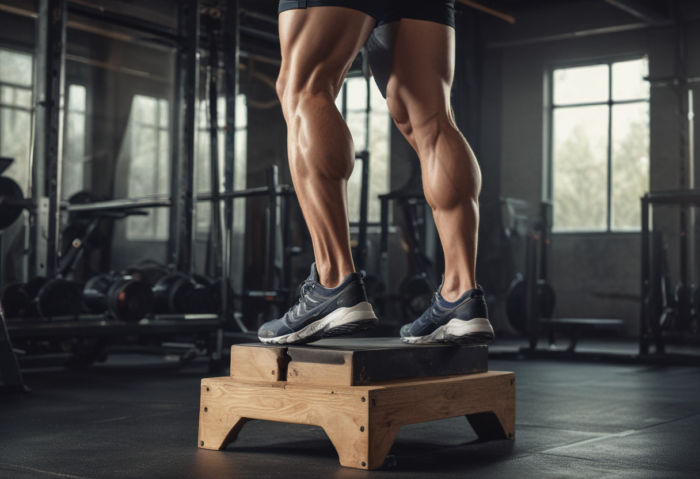
Ideas for training your calves
Let’s be honest with ourselves…calves are often exactly the body parts that get neglected in training. Yes, we may well do our 3 little sets of calf raises consistently on every leg day, but often without any real passion, more out of a sense of duty, just to “get it done.”
I’m not going to try to convince you that calves also deserve strong, wholehearted training. It comes down to a simple choice…you either want a perfect physique or you don’t. There is no other option.
What I will say is this: if you’re also one of those people who does an easy 3 x 10 calf raises after an exhausting squat workout, then stop with the talk of “bad genetics.” Don’t even mention that phrase!
Unfortunately, that “easy 3 x 10” at the end of leg day is exactly how most people train their calves. And it isn’t only beginners who do this. Even serious lifters pay little attention to their calves and look for excuses in genetics. It’s easy to fall into this “trap,” since calves are generally very stubborn when it comes to growing — unless, of course, you’ve “chosen the right” parents (the ones with good genetics).
It is true, of course, that genetics plays a big role with calves, both in how well they can be developed and in their shape. Chad Waterbury also admits that “calves are weird and complicated body parts (muscles).” “If they’re small, making them bigger is not a problem, but if the calf muscle insertion is very high (a long tendon and a small muscle belly), you can put your best effort into training them, yet the end result is still only a calf that’s barely half the size of an orange. But still, even that is better than having them be only half the size of a tangerine.”
So yes, genetics does set certain limits. But that doesn’t mean you’re already at yours, especially if you’ve spent years approaching your calves in the “easy 3 x 10” style at the end of a draining leg workout. That’s why we’ve gathered a few good exercises, methods and tricks to help you improve your calves. Before we get to the main content, here’s a bit more essential information.
Let’s use Steve Reeves from the steroid-free era as an example and look at some measurements for building an aesthetically pleasing, harmonious physique. Reeves’s neck, upper arm and calf were all the same size. He was 185 cm tall and weighed 97 – 98 kg. Reeves’s neck, calf and upper arm circumference were each 47 cm. Out of curiosity, measure yourself too — how do your numbers compare???
“Two words” on calf anatomy…
Without dragging it out, in general terms the calves consist of two muscles: the soleus and the gastrocnemius. The soleus does most of the work in a calf raise when the knee is bent. The gastrocnemius takes the main load when the knees are locked and the legs are straight. So if you do only one variation of the calf raise for your calves (either straight-leg or bent-knee), you’re tapping into only half of your calves’ growth potential. No wonder progress isn’t at its best.
The soleus, or m. soleus, consists mainly of slow-twitch muscle fibers, while the calf’s gastrocnemius is dominated by fast-twitch fibers. Basically, this means that when training the gastrocnemius you should mostly use shorter sets (3 – 6 reps) and we should train the soleus with a higher rep count (12 – 15 reps) and even more. So we could do standing calf raises as shorter sets and seated calf raises as longer sets…that could be a rule of thumb. At the same time, don’t forget that rules are made to be broken, and from time to time, for the sake of shocking the muscle, you should do everything mentioned above the other way around.
As a rule, calf training should use a full range of motion, in both the concentric and eccentric phases. For maximum results, add a brief pause in the bottom stretched position. Waterbury says: “Anyone who wants mass should make a brief pause in the bottom position. This is so that the elastic energy built up by stretching the muscle and tendons dissipates.” It’s important to work with the muscle, rather than do the work on the elastic energy generated by stretching the tendons…if muscle mass matters to you. Once the elastic energy is gone, the muscle has to do more of the work itself to lift the weight. Calves are “masters” at seeking help from elastic energy. So if you want your calves to grow, you have to force them to work harder without cheating. A pause in the stretched position is one way to do that. In other words, partial reps are not the way to move calf development forward. Hold the stretched position for several seconds before coming up.
Translator’s note: I really can’t agree with this. I believe partial reps have their own definite place in calf training. Whether to use partial reps all the time is another matter, but they certainly belong in calf training.
Enough dry theory. Let’s look at some interesting approaches and options for training calves. As Christian Thibaudeau likes to say: “Let’s add some meat to our calves!”
1. The two-minute calf raise
I have nothing against the good old calf raise, but I think most people either abuse it or, rather the opposite, don’t use it enough to maximize results. Here’s a little trick recommended by kinesiologist Tim Henriques. The exercise is the standing calf raise on a machine.
1.1. Take a weight that is 50 – 75% of what you would normally use for a set of 15 reps.
1.2. Rise onto your toes and squeeze hard at the top, then lower your heels until your calves are at maximum stretch. Hold that position for 10 seconds, using a timer or a watch if you need to.
1.3. Do the next rep the same way, again with a 10-second pause in the bottom stretch. Repeat for 12 – 15 reps. If you’ve stuck to these conditions, those 12 – 15 reps should add up to about 2 minutes.
1.4. Do 3 such sets in total.
1.5. Avoid stairs over the following days, because it’s going to be a painful experience.
2. Poliquin’s tough, quick fix for calf development
Talk to coaches and bodybuilders and you’ll always hear that calves just won’t grow. In many cases, the classic strength training approach doesn’t seem to work on the calves. That is also why many people approach calf development only through various shock techniques.
One such technique comes from Charles Poliquin:
2.1. Do standing calf raises (on a machine) for 8 reps, with a 2-second pause in the bottom phase of each rep.
2.2. Rest for 10 seconds.
2.3. Next, load the barbell with 25% of your body weight. Take the barbell onto your upper back, drop into a squat position and lock that position in. Now, from that position, with minimal knee extension, do 30 quick hops or quick calf raises using your calves alone as much as possible. The eccentric micro-tears that occur on landing are an excellent stimulus for hypertrophy.
2.4. Do 4 such supersets.
“If this doesn’t make your calves grow, nothing will!” says Poliquin.
3. DeFranco’s 1-minute seated calf raise
For those who like to train calves at the end of their workout, DeFranco recommends doing calf raises for time.
“I like this option myself too, since my legs can barely carry me at the end of my leg workout anyway,” admits DeFranco.
And there’s no other magic here: do it like a regular set, with the reps extremely controlled, but go by time… do 60-second sets, 2 – 3 sets in total. It works very well.
4. Luke Sauder’s notorious calf program
This is a cycle made up of two days. There are 48 hours between the individual workouts, so you train your calves twice within five days. One workout is high-volume; the other uses heavy weights with lower volume. Both will leave you properly limping.
Day 1: High volume
A1 – Seated calf raises
3 x 10 – 5 – 5 (first you do a set of ten, then a set of five, and then another set of five). Lower the weight for 1 second with no pause, and take 1 second to lift it as well.
A2 – “Donkey”
3 x 30 – 50 (tempo again 101)
As soon as you finish exercise A1 (10 – 5 – 5), go straight into A2 and do it right after. After each such superset, rest for 2 minutes and continue.
B1 – Standing calf raises
10 x 10 – 30 (tempo 111, 10-second pause after ten reps)
In other words, you do one long set and rest for 10 seconds after every ten reps, while also reducing the weight slightly. From the translator: I have done it this way myself, but without reducing the weight.
Already after the first day you’ll probably need a “fire extinguisher” to somehow relieve that burning sensation in your calves.
Day 2: Low volume (48 hours after Day 1)
A1 Triple drop set of standing calf raises
3 x 10 – 10 – 10 (in other words, you do three sets of ten in a row, dropping the weight each time). Tempo is 121, and rest between the triple sets is 90 seconds.
*** The two-second pause is taken in the bottom, stretched position.
According to Poliquin, this calf program should add serious mass to your calves.
5. The “Donkey” with a twist
Arnold did the “Donkey” with a whole pile of sweaty men on his back. You can also do this exercise by putting a weighted belt around your waist, placing a block under your toes, bending forward, bracing yourself and rising onto your toes. You can do it on either both legs or one.
Poliquin says this exercise is very good for the calves because it puts the calf (gastrocnemius) under a special stretch right from the starting position. You may have “killed” your calves with endless sets of standing calf raises, and those may no longer have much effect – but the “Donkey” will always make your calves sore.
Final word
Looking at the various approaches to calf training, and considering that the calves are a hard-to-develop muscle, it stands out that the calf training frequency that gives good results is 3 – 6 workouts a week. If you decide to try 6 workouts a week for a while, don’t forget to take a week off training that muscle afterwards. In general, overload your calves for three weeks, then take it easier in the fourth week and give them time to recover fully. Chad Waterbury thinks the same: if the calves won’t grow, he considers it necessary to train them 6 times a week. Before you blame your parents for bad genetics, try these exercises and techniques. “Sweat and hard work are the best cure for bad genetics,” says Chris Shugart.
Now get to it!
Original article HERE.
Author: Janar Rückenberg (translation)
Come and train! ArtGym