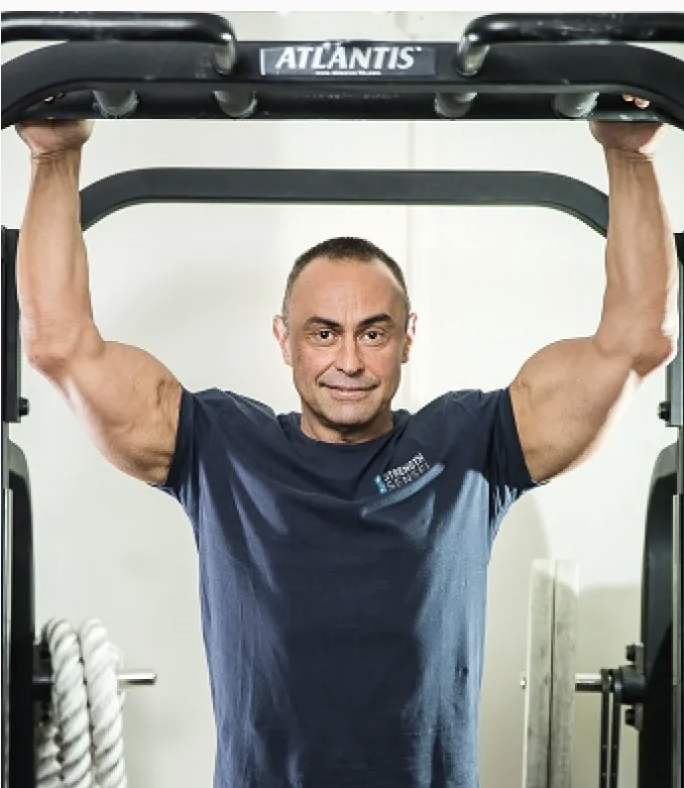
Charles Poliquin’s rules for strength training
Charles Poliquin didn’t see strength training as a random sequence of exercises. His thinking was simple: your program must serve a purpose, your body needs time to recover, and your training load must change over time.
Below, his principles are explained in a way that makes them easier to apply to your own training. The aim is to understand them, not copy them blindly.
Charles on the real purpose of a training program
Every training program can improve some things at the expense of others. Even a well-designed program has strengths and weaknesses. The question is whether it suits your goals, your level and your ability to recover.
Elite athletes’ programs are fascinating to explore and can give you ideas. But they usually aren’t suitable for the average trainee to follow as written, because training volume, technique, recovery and training background are very different.
Frankly, this is one of the most common mistakes: taking a strong person’s program and expecting the same results. Your body develops through an appropriately dosed training load, not through copying someone else.
Charles emphasized recovery and nutrition
Aerobic training can affect adrenal cortex hormones and their secretion. Too much of it, or poor timing, can compromise your progress in strength training. That doesn’t mean endurance training is bad. It means you need a clear goal.
Optimal nutrition and appropriate supplement use are important for a high work capacity. Eating well helps you handle greater intensity and training volume. Post-workout nutrition is especially important here, as it helps lower cortisol levels and replenish muscle glycogen stores.
Depending on training intensity and the athlete’s ability to recover, repairing the tissues stressed during training and realizing the benefits of increased protein synthesis takes 48-96 hours. If you train the same muscle again too soon, supercompensation won’t occur. If you wait too long, the stimulus for progress fades.
How should you adjust your strength training?
A program becomes less effective each time you do exactly the same thing. Beginners can make progress month after month on a fixed program, but that period won’t last forever. Later on, a lack of changes can lead to a plateau or injuries.
Consider changing a key training load variable every 2-4 weeks: frequency, exercise selection, the number of exercises, exercise order, rep count per set, the number of sets, rest interval duration, rep tempo or workout duration. After your warm-up, the main part of your strength training workout should last around 60 minutes.
The general rule is simple: consider substituting, replacing or varying an exercise in your program every 6 weeks. Advanced trainees and elite athletes need more frequent changes because their bodies adapt to the training load more quickly.
Charles Poliquin’s 34 practical rules
- Every training program has positives and negatives, no matter how well it is designed.
- Elite athletes’ training programs are interesting to analyze, but they usually aren’t suitable for the average trainee.
- Aerobic training affects adrenal cortex hormones and can therefore slow your progress in strength training.
- Optimal nutrition and appropriate supplement use help you achieve a high work capacity.
- Post-workout nutrition should include carbohydrates to help lower cortisol and replenish glycogen stores.
- After a hard workout, tissue repair and the benefits of protein synthesis can take 48-96 hours to materialize.
- If two workouts for the same muscle are too far apart, the supercompensation effect is lost and performance can return to baseline.
- If workouts are too close together, supercompensation also fails to occur and you won’t make progress.
- A program’s effectiveness depends on how much it challenges your body.
- Only beginners can make progress month after month on the same training program.
- Failing to change your training program can eventually lead to injuries.
- The number of exercises is determined by the athlete’s main sport and its demands.
- After your warm-up, the main part of your strength training workout should last around 60 minutes.
- Muscles with a higher proportion of slow-twitch fibers, such as the soleus in the calf, can tolerate a higher training frequency.
- Muscles with predominantly fast-twitch fibers need a different training frequency and longer rest.
- Consider changing frequency, exercise selection, reps, sets, rest periods, rep tempo or workout duration every 2-4 weeks.
- You can use the vertical jump and standing long jump to check whether your program is improving speed or reducing it.
- Before choosing exercises, be clear about what you want your program to achieve.
- Don’t neglect balanced development, but focus primarily on the muscles and movements that contribute most to your goal.
- Strength measures, including both absolute and relative strength, are important in gymnastics too.
- Do plyometric exercises at the start of your workout, after your warm-up.
- Do snatches, jerks and cleans at the start of your workout too, or after plyometrics.
- A chain is only as strong as its weakest link; your exercise selection should help strengthen weak links.
- Train large muscle groups and perform exercises that involve them at the start of your workout or in its first half.
- Compound exercises involve many large muscle groups and are also suitable for a general warm-up.
- Training with dumbbells generally requires more effort than performing the same exercise with a barbell.
- Unlike machines, barbells and dumbbells allow a wide range of exercise variations.
- The barbell clean is an excellent exercise for developing explosive strength throughout the body.
- The Olympic lifts aren’t well suited to strength endurance training because technique is difficult to maintain during long sets.
- Elite athletes and advanced trainees need to change exercises more often.
- As a general rule, consider varying an exercise every 6 weeks.
- Antagonistic muscles work in opposite directions; for example, you can pair one triceps exercise with another for the biceps in a superset.
- When developing maximal strength or speed-strength, aim for 2-7 different exercises per workout.
- If your sport requires you to produce force in different directions, you should also train at the corresponding angles in the gym.
FAQ: Charles and strength training
Should you follow an elite athlete’s training program?
Usually not. Take an idea or a specific principle from it, but adapt the training volume, frequency and exercises to your level.
How often should you change your strength training program?
A practical starting point is to adjust a training variable every 2-4 weeks and vary your exercises roughly every 6 weeks.
Should you do plyometrics at the end of a workout?
It is better to do plyometric exercises after your warm-up at the start of your workout, when your nervous system is fresh and you can maintain better technique.
Translated by Janar Rückenberg
Come and train! ArtGym