
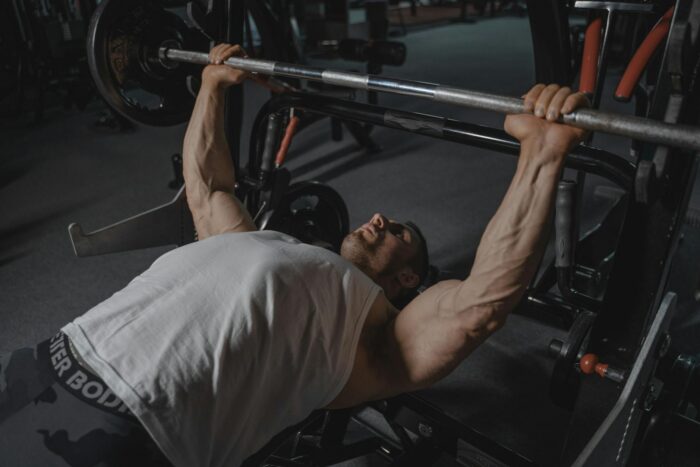
Chest workout: mass and strength
Chest growth doesn’t come from simply adding weight to the barbell and hoping for the best. Here is an honest look at how high volume, hard effort and smarter choices can build the chest, and also at when you need to ease off.
Why the chest gets so much attention
The chest muscles change the impression your upper body makes right away. I’d even go so far as to say that if some other muscle group still needs catching up but the chest is well developed, the physique still looks powerful. This isn’t just vanity. The chest works together with the shoulders, triceps and back in almost every pressing movement.
I won’t deny that I’ve been down this road myself. Only now is my chest slowly coming into proportion with the rest of my body. There’s one simple reason for it: for a while I trained my chest as little as possible, about 8 working sets, while training my back and legs with higher frequency and intensity.
I’ve been thinking quite often lately about how it all began. I’m fairly convinced that good genetics played a part in my case. My chest simply responded to training incredibly well. My mother still says that when we went swimming in the summers, the boy had remarkably big pecs and a well-developed upper body, visible from a distance. There was no serious training to speak of back then; I was only 7–8 years old.
Still, genetics isn’t the whole story. The chest and biceps are the two muscles on a man’s body that even someone who knows next to nothing about strength training will notice. Almost everyone knows what a biceps, biceps curls and the bench press are. When I started out, I focused on exactly those. In hindsight, the lion’s share of my chest development came during my university years at the Jakobi Street gym in Tartu.
Back then I wasn’t exactly brilliant on the knowledge side. The principle was simple: the more, the better. The chest was my favorite muscle, and doing 25 sets was normal. Even 30 sets or more didn’t seem like anything special. Looking back now, I’ll be honest: wild volume. But every set was done with real effort, not just to tick a box.
What chest training looked like back then
A typical chest workout wasn’t complicated, but it was long and heavy. I played around with the exercises in almost every workout. Sometimes I changed the order, sometimes I swapped an exercise, sometimes I left one out. The main thing was that the intensity stayed high and the rest periods were kept in check.
- Bench press 6–10 sets
- Parallel bar dips 4 sets
- Incline dumbbell flyes 4 sets
- Flat bench flyes 3–4 sets
- Butterfly (Peck Deck) 4 sets
It wasn’t a scientifically refined plan. But it had consistency. I never did a single set just for the sake of it. When the timer ran out, the next set began. You could say that sometimes it was down to the second. There was nowhere to let up.
So-called chest marathons were also fairly common, and I did them about every 1.5 – 2 months. I got the inspiration from Arnold’s squat days in the woods, which he described in his autobiography. My version was simple: on chest day I’d do, for example, 50 sets of nothing but bench press.
The aim was to move up and down in a pyramid, using weights that let me stay in a rep range of 6–12 reps. For example, a workout could start like this:
- 100 kg x 12
- 110 kg x 12
- 120 kg x 9
- 125 kg x 7
- 130 kg x 6
- 120 kg x 7
- 115 kg x 7
- 110 kg x 7
- 100 kg x 9
- 90 kg x 11
- 85 kg x 12
- 90 kg x 10
And so on, constantly changing the weights, until all 50 sets were done. I haven’t done anything like that in years. Looking back now with more wisdom, I’d like to say it was foolish. At the same time, I don’t dare to say that for real, because maybe it was exactly those extremes that built a strong foundation for my chest.
Why am I telling you this? Not to show off my inexperience. Rather because I’ve seen how many people have a problematic chest. For some it simply won’t grow, no matter how diligently they press. In that case, high volume can be one possible tool. Not forever, but as a phase.
Chest development: volume, strength and recovery
The early years were defined by high volume. The weights I trained with weren’t remarkable. They weren’t small, but they certainly weren’t big either. The reason was simple: with that many sets, you can’t keep using heavy weights indefinitely. Still, that work built mass in my chest.
But people get tired of everything, and I was no exception. It started to bother me that my training weights weren’t going up. At the same time, more and more people were saying you don’t need to train with that much volume. Over time, the number of working sets in my chest workouts dropped to 15, though out of old habit I sometimes still went up to 18 sets.
My bench press sets changed too. I used to do long sets, usually 8-12 repetitions. Today I find that this is mostly unnecessary. I don’t recommend going above 10 reps on the bench press at all. Most of your working sets should fall in the 5-8 rep range.
So what happened? My training weights and my bench press max started to climb quickly. In 2002 my bench press record was broken 6 times, from 145 kg all the way up to 170 kg. Flipping through my training log, I’m still amazed: 35 kg added in a year. And if my current record is still 185 kg, I have to ask myself what I’ve been doing these 5 years.
There is no single answer. First, this was a period when my bench press max was the No. 1 priority, and I focused on it body and soul. Second, the high-volume mass-building work had already laid a strong base. Third, my pressing sets became shorter, which favored the development of strength more than hypertrophy.
In recent years my bench press max hasn’t mattered as much to me. I’ve increasingly come to understand that the chest can also become overdeveloped. When your upper-body proportions start to suffer, it makes no sense to keep chasing the same muscle at any cost. Sometimes it’s better to leave the chest alone for a while and bring up your back, shoulders or legs.
What to do if your chest isn’t growing?
If you want to bring up your chest, train it on a day of its own. It’s old advice, but it works. On chest day, focus on the chest. It doesn’t always have to be the first day of the microcycle, but don’t train shoulders or triceps hard for at least 2 days before chest. Otherwise you’ll very likely ruin your chest workout.
I recommend 15-16 working sets as the optimal number. That’s the middle-of-the-road option. Now and then do workouts where the set count reaches 20-25 or even more, but don’t do it all the time. Have some chest workouts with only 10-12 working sets as well. How you feel, your recovery and your drive to work should decide.
If you feel you can give your maximum for 20-25 sets, then do it. If that happens for several workouts in a row, it’s not the end of the world. But it won’t last forever. At some point you’ll recognize it yourself: I can’t go that long today, I’ll stick to 10 sets. Listen to yourself. The main thing is to be honest.
Depending on the day, there could be 3-5 exercises. The bench press can be part of almost every chest workout, but it’s not set in stone. You can leave it out from time to time. For the sake of variety, it’s actually quite good to do a workout with no pressing at all.
For presses, both on the incline bench and the flat bench, the rep count should mostly stay between 5-8. In some workouts it can go lower. Keep your technique clean: no bouncing and no excessive bridge. My personal conviction is that press repetitions should always be fast and explosive. Let the weight be heavy, the reps low and the movement sharp.
Flyes and the stretch hold
If your goal is chest muscle mass, then alongside presses, flyes at different angles are very important: flat, decline and incline. I sincerely believe that flyes may be the key for many people. In my own case, too, I think a large part of my mass came thanks to them.
There are two important things about flyes. First, your sets should fall in the 8-15 range. Second, perform the movement slowly rather than fast. Emphasize the negative phase and hold the stretch in the bottom position. Try different lengths: 3, 5, and sometimes even 10 seconds. This can make the chest work extremely hard.
If it’s said that a set duration of 40-70 seconds, sometimes even 90 seconds, supports hypertrophy well, then time your flye sets. With a slow negative phase and a stretch hold, they often land in the 50-90 second range. That is productive as long as your technique stays under control.
Breaking the routine
Don’t stick to your usual plan all the time. The sequence of bench press, flyes, incline flyes and pec deck is familiar to many people. It’s logical, but it’s worth reversing the order from time to time. Start with the pec deck, then do incline flyes, then regular flyes, and only at the end the press.
Your weights will drop at the end, of course, but the effort can be greater, because you know your usual pressing weights and try to get close to them. That is exactly what forces the muscle to work. You also don’t have to do 3-4 exercises in every workout. When you’re feeling stale, do one exercise really well. For example, just pressing, just flyes at different angles, or 12-15 sets on the pec deck alone.
In my opinion, the pec deck is a very good exercise for chest mass. Many people may disagree, but I believe the pec deck builds mass. This is especially true of the variant where the arms are brought together in front with a slight bend at the elbow. In the eccentric phase the muscle is stretched out, and this works the chest very hard.
Don’t use only the usual 10-12 or 8-12 repetitions on the pec deck. Sometimes do sets where you go to 20, 30 or more reps. Keep the reps slow. Feel both the contraction and the stretch. You’ll have to reduce the weight for long sets, but that isn’t a problem.
Supersets are also worth trying. Do a press and follow it straight away with flyes. Or do flyes and go straight into the pec deck. This thoroughly fatigues the chest muscle. Finally, stretch. Not for the sake of pride, but so that the muscle doesn’t stay tight and shortened.
FAQ
Do you always have to bench press for chest?
Not always, but the bench press is a strong staple exercise. In most cases it’s worth keeping in your program, though sometimes you can do a chest workout with only flyes, the pec deck or other press variations.
Are 20–25 sets for chest too many?
If you keep it up constantly, it can be too much, especially if your recovery suffers. For certain periods 20–25 sets can help, but there should be lighter days in between, for example with 10–12 working sets.
Why isn’t my chest growing even though my press is getting better?
Getting stronger doesn’t always mean gaining mass. If you press short sets and focus only on your max, your feel for the chest muscle can stay weak. Add controlled flyes and work in the stretched position.
Author: Janar Rückenberg
Come and train! ArtGym




