
At a glance:
- The foundations of deadlift technique are a straight back, shoulders over the barbell and strength generated by extending your legs, rather than through your lower back.
- As a beginner, you can place a block under your feet to increase the range of motion and use a mixed grip or lifting straps for a stronger grip.
- You can avoid injuries by learning the movement with a light weight and keeping the barbell close to your body throughout the lift.
The deadlift is one of the most valuable strength exercises: it trains your back, glutes and thighs simultaneously and teaches your body to lift weight safely from the floor. Yet your deadlift technique determines whether the exercise builds strength or strains your lower back. In Ervin Liebert’s “Weight training” manual, the deadlift is exercise number 58 and comes with several practical tips that beginners can put to use straight away. In this guide, we look at how to get started with deadlifts correctly, which variations to try and how to avoid injuries.
What is the correct deadlift technique for beginners?
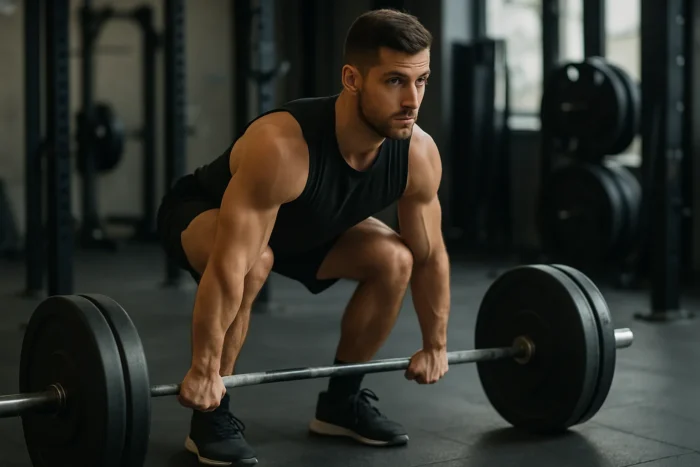
Liebert recommends taking hold of the barbell with an overhand grip, with your hands about 40 cm apart. In the starting position, your feet are under the barbell, your back is straight and your shoulders are over the barbell. Stand up by extending your knees and hips, keeping the barbell close to your body throughout the movement — it should slide up along your shins and thighs. Liebert offers two useful tips: you can place a block (about 10–20 cm) under your feet to increase the range of motion, and turn one hand underhand to form a mixed grip for a stronger hold. If your grip gives out before your muscles do, you can also use lifting straps designed for the purpose. It is essential to keep your back straight in a neutral position without rounding it — a rounded back transfers the load directly to your spine. Remember that the deadlift and squat are different movements, as explained in The deadlift is not a squat: in a deadlift, your hips move further back and the load falls on the posterior chain.
Which deadlift variations are worth trying?
Once you have mastered the conventional deadlift, you can try the stiff-legged deadlift (Liebert’s exercise no. 70). In this variation, your knees bend only slightly and your hips move back, placing the emphasis on the biceps femoris at the back of your thighs. This variation teaches you to hinge at the hips and develops your hamstrings. Beyond the basic deadlift, it is worth understanding how grip width and foot position affect the exercise: a narrower or wider stance changes which muscles do the most work. Deadlift — conventional or sumo provides a detailed comparison of conventional and sumo technique. Choose a variation that suits your body proportions and mobility — there is no single best version for everyone.
How can you avoid injuries when deadlifting?
The key to avoiding injuries is technique, rather than caution alone. Learn the movement with a light weight and only add weight once you can keep your back consistently straight throughout every repetition. The most common mistake is rounding your back under load — this transfers the load to your spine and is the main cause of lower back injuries. Another common mistake is letting the barbell move away from your body, which increases the lever arm acting on your lower back. Always warm up thoroughly before heavy sets, and do not chase maximum weights until your technique is automatic. Experienced athletes’ recovery stories show how important gradual progression is — see Champions after injuries. The World Health Organization recommends muscle-strengthening training at least twice a week (WHO guidelines on physical activity), but quality always comes before quantity. If you feel sharp or radiating pain in your lower back, stop the exercise and consult a doctor or physiotherapist.
How can you work on deadlift technique in your training?
Because the deadlift is a demanding exercise that taxes the nervous system, 1–2 deadlift workouts per week are enough for a beginner, each consisting of 3–4 sets of 5–8 repetitions. Perform deadlifts in the first half of your workout, when your body is fresh and your focus is sharp, as technique breaks down fastest when you are tired. Always warm up with an empty or light barbell and add weight gradually, rehearsing the key points of deadlift technique in every warm-up set: a straight back, shoulders over the barbell and the barbell close to your body. Following the principle of progressive overload, increase the weight in small increments only when you can complete every repetition with good form — patience is the best way to prevent deadlift injuries. If your grip starts to tire before your muscles do, use a mixed grip or lifting straps, but do not let your grip become an excuse for sloppy technique. Good deadlift technique will serve you for years if you establish it correctly from the start. Pay attention to your breathing, too: take a deep breath before the lift and tighten your abdominal muscles to stabilize your core and protect your lower back. Proper abdominal tension, known as bracing, is just as important as leg strength, as it maintains your spine’s neutral curve under a heavy barbell.
References
- Ervin Liebert. “Weight training”. Online edition, atleetvoimlemine.fitness.ee (exercises no. 58 and 70).
- WHO (2020). Guidelines on physical activity (muscle-strengthening training at least 2 times a week).
- NSCA (National Strength and Conditioning Association). Deadlift technique and injury prevention.
Frequently asked questions
How wide should your deadlift grip be?
Liebert recommends that beginners use an overhand grip with their hands about 40 cm apart. For a stronger grip, you can turn one hand underhand to use a mixed grip, or use lifting straps if your grip tires before your muscles do.
Why place a block under your feet?
A block (about 10–20 cm) under your feet increases the range of motion, making your muscles work through a greater range. Liebert recommends this technique in his book to make the exercise more effective.
How does a stiff-legged deadlift differ from a conventional deadlift?
In a stiff-legged deadlift, your knees bend only slightly and your hips move back, placing the emphasis on the back of your thighs, specifically the biceps femoris. This teaches you to hinge at the hips.
How can you keep your back healthy when deadlifting?
Keep your back straight in a neutral position, keep the barbell close to your body and generate strength by extending your legs. Learn the technique with a light weight and only add weight once your form is correct.
Come and deadlift! ArtGym




