
Dorian Yates back workout: a tough session
The back was the central theme of this workout: at Reval-Spordis I got to train together with 6x Mr.Olympia Dorian Yates. It wasn’t a long session, but dense, heavy work where every set had to count.
If you’ve read about Dorian Yates’ training, you know the drill. Few sets, big weights, low reps and a very clear focus on the muscle doing the work.
Why does the back matter in Dorian Yates’ workout?
Who else could be the star of Tegijate Treening but Dorian Yates in person, on his visit to Estonia? I suggested training together, and since Dorian had one small workout planned in Estonia anyway, we agreed on a time. The location: Reval-Spordis.
This time we took on a back workout. Dorian doesn’t chase a long list of exercises. His idea is simple: do less, but do it in a way that leaves the muscle nowhere to hide. Honestly, that’s harder than it looks on paper.
For the back, that means control. You don’t just swing the weight from point A to point B. You have to feel how the latissimus dorsi muscle works, how the shoulders stay in place and how every repetition ends with a strong effort rather than momentum.
Warm-up before a back workout
Before every workout, Dorian Yates uses his supplements from the Dorian Yates Ultimate line. He takes Lean Gain 1h before training and NoxPump 15-20 min before, to wake up mind and body and get the blood flowing into the muscles.
I had managed to eat only once before the workout, and that was 5-6h earlier. My muscles were pretty empty of glycogen and food. Still, it felt like NoxPump kicked the body into gear. What would it have been like if I had eaten properly? That’s another story.
Before every workout, Dorian does a warm-up in a 10min + 10min style. First, 10 min of running on a treadmill. Then sprints on a cross trainer: 1min at an easy pace and 30 sec at more or less maximum pace. By the time Mr.Yates finishes, sweat is probably pouring from every pore.
After that comes a little stretching for the lower and upper back. Before the main workout he also does small movements with light dumbbells for different muscle groups. Only then does the hard work begin.
How do you get your back working with these exercises?
Machine pulldowns 3 x 10 – 6
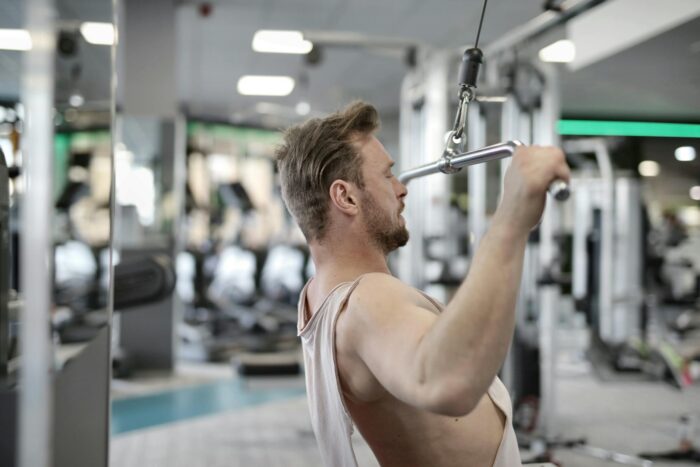
The first exercise is pulldowns on a cable pulley. Reval-Spordis had a special machine where you can load plates for weight and lock your knees under a support. Reportedly it isn’t the best machine for feeling the back muscles, but it gets the job done.
Dorian uses the pyramid principle: weight is added from set to set. The first of the 3 sets is a half-work, half-warm-up set. Even though the weights are big and the repetitions low, you have to hold the peak contraction in every exercise. That very moment is what forces the muscle to really work.
Dumbbell rows to the stomach 2 x 10⁻⁶
The second exercise is the bent-over dumbbell row to the stomach. The exercise itself is familiar, but Mr.Yates stresses one thing: your back must be as parallel to the floor as possible. This engages the lower attachment points of the latissimus dorsi muscle better.
It’s best to support one knee and one hand on the bench. The leg that stays on the floor helps maintain balance and the right height. When you lift the dumbbell, pause briefly and carry on. Since Reval has no dumbbell heavier than 62kg, Dorian sticks with that.
We do the exercise in turns: first one side of the back, then a short rest while I do my side. Then his other side. That makes 2 sets in total. In his training there are usually just two working sets, preceded by one or two warm-up sets. Rest breaks are of medium length.
Seated cable rows 3 x 10⁻⁶
The final exercise for the latissimus dorsi muscle is the seated cable row. We use a wide grip. A small difference is that the bar isn’t pulled directly to the stomach but rather to the chest. This puts more training load on the upper part of the latissimus dorsi muscle, near the trapezius.
I had used this trick on my own before as well. The weight can’t be very big, but a bodybuilder’s goal isn’t just to move weight. The goal is to build muscle. Sometimes you have to put your ego aside.
Back extensions on a hyperextension bench 2 x 10⁻⁸
The final exercise is for the lower back. If your own upper-body weight isn’t enough, you can add a barbell plate. Movements must be controlled and your attention kept on the lower back doing the work. Not on speed. Not on flailing.
Practical tips when the back is your goal
A simple truth: quality matters more than quantity. To follow this rule, though, you do need some gym experience. In every set and every repetition you have to give your maximum, while keeping your technique together.
There are no miracle exercises. There are just a few small things that make an ordinary row better. Keep your body position fixed. Don’t let your shoulders slump forward. Pull with your elbow, not just your arm. Pause for a moment at the point where the muscle is working hardest.
Oddly, the warm-up tended to run longer than the strength training itself. But after a session like that, you didn’t feel that anything had been left undone. What’s it like to train with a 6x Mr. Olympia? No comments!
FAQ
Does your back always need a lot of exercises?
Not always. Dorian Yates’s example is more the opposite: fewer exercises, but every set performed with intense focus. This suits a lifter who knows how to feel the muscle working.
Why are such low repetitions used?
A lower repetition range lets you use heavier weights, but only if your technique stays under control. Once momentum starts doing the work, the point of the exercise is lost.
Should a beginner do the same program?
Rather cautiously. This workout calls for experience, good technique and the ability to really push yourself in a set. A beginner should first learn the movements.
Author: Joker
Source: Turg.Fitness.ee
Come and work out! ArtGym




