
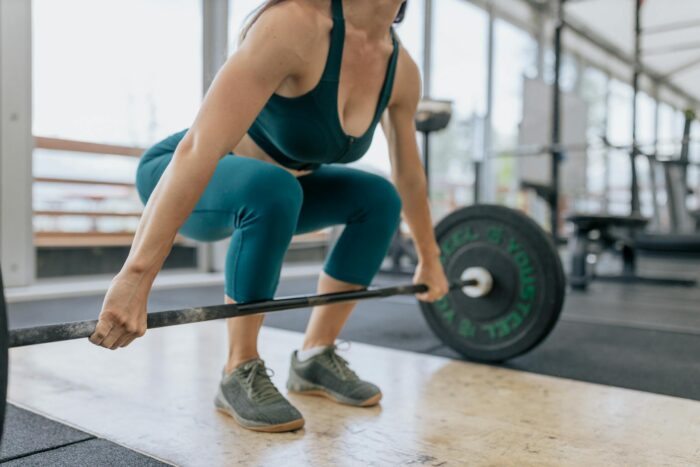
3 lower-body and 3 upper-body exercises every woman should do
Browsing the internet, I have often come across articles along the lines of:
“Five exercises every woman should do”,
“Recommended exercises for women” or
“The three best strength exercises for women”.
I have thought about translating one of these pieces, but I have always given up on the idea. Why? Because every one of these recommended lineups has included at least one exercise that, in my opinion, is not among the most important and effective ones.
So I decided to put together my own TOP 6 — three upper-body exercises and three lower-body exercises that should be in every woman’s training program.
Of course, there can be no new “miracle exercises” in this ranking. But I am presenting it with the emphasis that women, too, should be doing these exercises. Many of you probably won’t be able to do some of the exercises listed yet. That simply means that women who train should also start working toward the level where these exercises become second nature, both in technical skill and in physical ability. Why? Because these are the very exercises whose progressive application gives you 70–80% out of a possible 100% of your progress. These are the exercises that deliver results and pay off in time, strength and muscle growth.
Lower body
Barbell back squat
The squat has had plenty of praise, but there’s no way around it: this is an exercise that has been, is and will remain the leader of every ranking of strength exercises. The benefits of the squat for women are in fact exactly the same as for men. It is functional, energetically costly and lets you use heavy weights. Although the lower body does the main work of going down and coming back up with the barbell, in the end the whole body takes the heavy training load. An estimated 200+ muscles are working in a squat. Try different squat variations and squat with different set lengths. For women, I want to stress the latter in particular. Don’t be afraid of 5 x 5 training systems. The secret to a toned, trim lower body is not those 30-day bodyweight squat challenges, but heavier weights and short sets. Believe me, it’s true.
Sumo deadlift
Also a great exercise for the whole lower body, but in the sumo deadlift a great deal of the training load also falls on the back of the thigh and on the glutes. The fronts of the thighs work too, of course, but because of the wide stance, the load shifts especially onto the inner thighs. The same goes as for the squat: don’t be afraid of heavy weights. For this exercise, you could do sets of 5 – 10 repetitions.
Lunges
I thought for quite a long time about which exercise to put second and which third, and I’m still not sure I got it right in putting lunges in 3rd place. Because this really is a good exercise. If I’m being completely honest, lunges leave my legs sorer than even squats do. I don’t know whether it’s just that I’ve done so many squats or what the reason is, but that’s how it is. Lunges are certainly not an exercise for building raw, wild strength, but they are exactly the exercise for building muscle mass and tone. All the lower-body muscles work: the glutes, quadriceps, hamstrings and calves. The longer the step you take, the more the posterior chain (the back of the thigh and the glutes) is stretched, and the more training load that area of the lower body receives. The shorter the lunge step, the more you drive through the quadriceps. You can emphasize the front of the thigh even more if, as you step or rise back up out of the lunge, you let the heel lift slightly off the floor and push up through the ball of the foot.
There is an endless number of combinations for how to do lunges or how to progress in them. You can combine this exercise with squats and use added weight (barbell on your back, dumbbells in your hands, etc.). On the technical side, perhaps the most important thing of all is that when you take the lunge steps, your upper body has to stay straight/vertical. Otherwise you automatically take a large share of the tension off the lower body, and the exercise’s training effect drops significantly.
There are also very many set lengths you can use for this exercise. In ordinary leg workouts, sets average 20 – 60 steps. But that is an average. I recommend trying even longer sets than 60 steps — why not even aim for 100 steps? It can also be quite motivating to cover a set distance, for example 20-meter stretches, a lap of a stadium and so on. There are many options, but most importantly, lunges are an exercise that women should definitely do.
Upper body
Pull-ups
The king of upper-body exercises is the pull-up. Women should know it and do it too. In fact, I have never understood where the attitude comes from that there are “men’s exercises” and “women’s exercises”. Complete nonsense! As a PE teacher at school, in my early years I heard from quite a few know-it-alls that “girls don’t need to do push-ups” or “don’t need to be able to”. Why, I ask? I realize most women can’t do pull-ups, but let’s be honest, neither can most men. Everything is possible if you want it enough, and for anyone who has any interest at all in upper-body development, in every sense, getting to the point of being able to do pull-ups, learning them and working them into your program will take your upper-body development to a whole new level in a short time. In physical development you can hardly ever say that “something can be achieved quickly or in a short time”. But working on pull-ups and including them in your program is one of those things where we can say that it gives results quickly.
Start with underhand-grip pulls, then try simply hanging with your chin over the bar, then attempt negative pull-ups, then try even a small “jerk” upward, and use resistance bands that make pulling yourself up easier. What matters is getting that first pull-up; after that, the rest will start to come. And to begin with, it is enough to progress in a pattern like 10 x 1, 10 x 2, 10 x 3, 8 x 4 and so on.
Standing barbell press
Once again I faced the dilemma of which exercise to include, the standing barbell press or the bench press. I stuck with the former, because, first, let’s be honest, the bench press gets done anyway, and second, the standing press is considered somewhat more functional than the other pressing variations. In the standing press the whole body works considerably harder. I recommend using both versions of this exercise: the strict press as well as the standing version with help from the legs, the so-called push press (swing press). It is an excellent exercise for training the shoulders, but the triceps and the upper chest muscles also get a solid training load. On average I recommend sets of 6–12, but from time to time I also recommend more extreme set lengths, such as 15–30 repetitions.
Parallel bar dips
A basic upper-body exercise. It works the chest muscles, the front delts and the triceps. If you dip with a wider gap between the bars and lean your body further forward as you go, the emphasis is on the front delts and the chest muscles. With a narrower gap and a more upright body position, the emphasis of the training load shifts more to the triceps. The same applies here as with pull-ups: you first need to reach the level where you can get the first 2–3 repetitions. Begin by simply holding yourself at the top, then just lower yourself a little, then try to go progressively deeper. But for this exercise in general, and for everyone, I recommend that you don’t overdo the depth, as it may not be good for the triceps attachments. Likewise, I recommend that everyone learning this exercise start with a medium gap between the bars, because a very wide gap can, in many people, cause an unpleasant “tearing” sensation in the chest muscles around the sternum. But this is a good exercise, and I wouldn’t really set any limits on the rep count. One more thing: it is quite enough for the average exerciser to simply do this exercise with their own bodyweight for several of their first training years.
Women, put your strength to work!
Author: Janar Rückenberg
Source:Turg.Fitness.ee
Come and train! ArtGym




