In short:
- Fall prevention is most practical when home safety and balance-and-strength exercises go hand in hand.
- The most important steps at home are clearing walkways, improving lighting, reducing slipping hazards and providing stable support points.
- Exercises should mainly build lower-body strength, balance, reaction ability and confidence in everyday movements.
- If you have fallen repeatedly, get dizzy while standing or have recently had a change in medication, it is worth discussing your risk factors with your GP or a physiotherapist.
Fall prevention is not just about walking more carefully; it means looking at your home, your body and your everyday movement together. In older age, muscle strength, balance, vision, reaction speed and the demands of the home environment become more important in relation to one another. Evidence-based fall prevention starts where a person actually moves: the hallway, bathroom, stairs, kitchen and the usual training corner.
How does fall prevention at home work?
Fall prevention works when you reduce two types of risk at once: tripping or slipping caused by the environment, and instability coming from the body. Hazards at home are often small: a loose rug, a dim hallway, a low-lying cable, a slippery bathroom floor, a missing handrail or getting up too quickly at night. They are not a problem only when a person is weak; they become a problem the moment attention, balance or strength is briefly lower than the situation demands.
A Cochrane review found that interventions reducing home fall hazards lowered the rate of falls by about 26%, and by about 38% in people at higher risk (Clemson, 2023). That does not mean removing every rug gives the same result. The effect is stronger when the changes are based on the person’s own movement, the layout of the home and past tripping spots.
A practical start is simple: walk through an ordinary day at home. Notice where you turn, where you get up, where you carry something in your hands and where you move around in dim light. The same idea can be linked to a home exercise habit: Why and how to work out at home helps you think about how to fit training into your home routine, but from a fall-risk point of view the training spot itself also needs to be in order.
Which home changes reduce fall risk?
Start with the floor and walkways. Remove or secure loose rugs, move cables against the wall, keep nighttime routes to the toilet clear, and avoid furniture arrangements that force tight turns. In the bathroom, a non-slip surface, a dry floor and, where needed, a grab bar are important. On stairs, a handrail, clearly visible step edges and good light all count. At night, your first step should not happen in the dark.
In the kitchen and storage areas, one common risk is climbing up high. If everyday items are kept up high, a person starts using a chair, a stool or an unstable aid. It is safer to place frequently used things at a height between the shoulder and the hip. If you do need a step aid, it must be designed for the purpose and be stable, not a random piece of furniture.
When it comes to preventing falls, WHO stresses the combined effect of education, training and a safer environment: WHO overview of falls. That is a good framework: a home does not have to become like a hospital ward, but it must support the person’s actual movement. For example, an active person who does strength exercises at home needs enough free floor space, a sturdy chair and a non-slip surface. For further reading on this: How to work out smartly at home.
Which exercises help prevent falls?
The exercises that best support reducing fall risk are those that challenge balance and strengthen the lower body. In a large meta-analysis, training reduced the rate of falls among community-dwelling older people by 21%, and the greater benefit was linked to programs that challenge balance (Sherrington, 2017). That does not mean every workout has to be hard or frightening. An effective exercise is one that is challenging enough but doable under controlled conditions.
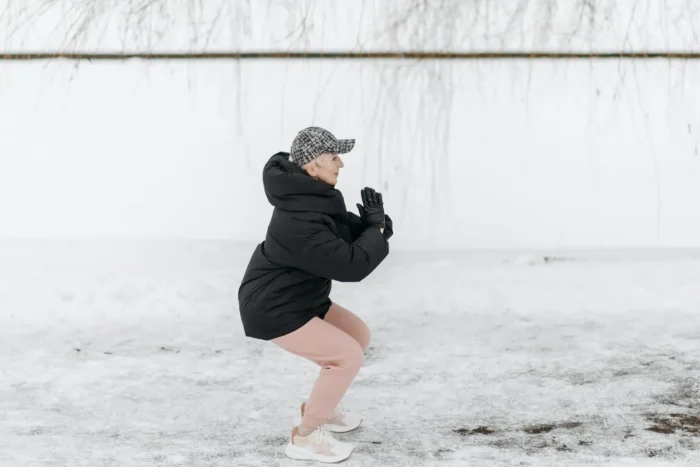
Good home options are sit-to-stand, calm heel raises, toe raises, side steps next to a counter or chair, the tandem stance, a single-leg stance near a support, and a slow, controlled step forward and back. If your balance is unsteady, a sturdy support should be within arm’s reach. The aim of the exercises is not bravery but better control in situations that resemble real life: getting up from a chair, turning at the door, stepping onto a stair and carrying a shopping bag.
Strength training is particularly important in the context of sarcopenia. In the EWGSOP2 approach, low muscle strength is the key feature of sarcopenia, and a decline in muscle strength can affect walking speed, rising to stand and everyday independence (Cruz-Jentoft, 2019). ACSM recommends that older adults avoid inactivity and include aerobic activity, muscle-strengthening exercises and mobility work in their activity plan (American College of Sports Medicine, 2009). In practice this means that walking alone may not be enough: the thigh, glute and lower-leg muscles also need strength work.
How often should you practice balance and strength?
Exercise frequency needs to be realistic. Short, consistent sessions are better than a long plan that gets skipped. ACSM’s positions support regular, varied physical activity in older age, including training that strengthens muscles and supports mobility (American College of Sports Medicine, 2009). Sherrington’s review suggests that fall-preventing training should include a balance challenge, not just general activity (Sherrington, 2017).
For a home routine, it works well to tie strength and balance exercises to things you already do: a few controlled sit-to-stands after your morning coffee, calm side steps at the counter during the day, and heel raises and a balance stance near a support in the evening. If training causes fatigue in your leg muscles, that is a normal response to the training load; if you feel pain, dizziness, chest discomfort or new unsteadiness, stop exercising and seek advice if needed.
Besides muscle performance, it’s worth keeping an eye on cramps, fluid intake and recovery. If calf or foot cramps happen often, the background reading Muscle cramps may help, but recurring or unexplained symptoms need a medical assessment.
When does fall risk need a professional assessment?
Professional help is a good idea if a person has fallen recently, falls repeatedly, is afraid to walk, avoids stairs, or notices that getting up from a chair and turning around have become unsteady. The same applies if dizziness appears when standing up, vision has changed, shoes don’t stay on well, or medication use has recently changed. A fall is not always just a matter of weakness; the cause can be blood pressure fluctuations, a vision problem, a drug interaction, a nervous system disease or an injury that hasn’t healed.
A physiotherapist can assess strength, balance, gait pattern and how suitable the exercises are. An occupational therapist can help review the home environment: whether the handrails, lighting, bathroom setup and walking routes suit the person’s abilities. A family doctor can assess illnesses, medications and the causes of dizziness. If a fall involved a head injury, loss of consciousness, severe pain or new weakness, home training is not the first step.
In older age, maintaining strength and independence is not only about avoiding risks. It is also about being able to do, at home, the activities that preserve confidence and the courage to move. The story The Bronze Woman back home can serve as inspiration, but every person’s plan must be based on their own health, home and current ability.
References
- Clemson L, Stark S, Pighills AC, Fairhall NJ, Lamb SE, Ali J, Sherrington C (2023). Environmental interventions for preventing falls in older people living in the community. Cochrane Database of Systematic Reviews. PMID: 36893804. DOI: 10.1002/14651858.CD013258.pub2
- Sherrington C, Michaleff ZA, Fairhall N, Paul SS, Tiedemann A, Whitney J, Cumming RG, Herbert RD, Close JCT, Lord SR (2017). Exercise to prevent falls in older adults: an updated systematic review and meta-analysis. British Journal of Sports Medicine. PMID: 27707740. DOI: 10.1136/bjsports-2016-096547
- Cruz-Jentoft AJ, Bahat G, Bauer J, Boirie Y, Bruyere O, Cederholm T, Cooper C, Landi F, Rolland Y, Sayer AA, Schneider SM, Sieber CC, Topinkova E, Vandewoude M, Visser M, Zamboni M (2019). Sarcopenia: revised European consensus on definition and diagnosis. Age and Ageing. PMID: 30312372. DOI: 10.1093/ageing/afy169
- American College of Sports Medicine, Chodzko-Zajko WJ, Proctor DN, Fiatarone Singh MA, Minson CT, Nigg CR, Salem GJ, Skinner JS (2009). American College of Sports Medicine position stand. Exercise and physical activity for older adults. Medicine and Science in Sports and Exercise. PMID: 19516148. DOI: 10.1249/MSS.0b013e3181a0c95c
- Tricco AC, Thomas SM, Veroniki AA, Hamid JS, Cogo E, Strifler L, Khan PA, Robson R, Sibley KM, MacDonald H, Riva JJ, Thavorn K, Wilson C, Holroyd-Leduc J, Kerr GD, Feldman F, Majumdar SR, Jaglal SB, Hui W, Straus SE (2017). Comparisons of Interventions for Preventing Falls in Older Adults: A Systematic Review and Meta-analysis. JAMA. PMID: 29114830. DOI: 10.1001/jama.2017.15006
Frequently asked questions
Does fall prevention mean I have to remove all the rugs from my home?
Not always. What matters is whether a rug slides, has a curling edge or lies along your usual walking route. If so, it needs to be fixed in place, replaced or removed.
Is walking alone enough to prevent falls?
Walking is good for overall health, but to reduce fall risk you also need exercises that build balance and lower-body strength.
When should I see a doctor instead of doing exercises?
If a fall involved a head injury, loss of consciousness, severe pain or new weakness, or if you have recurring dizziness or frequent falls, it’s worth seeking medical advice before continuing training.
Do balance exercises have to be hard?
They need to be challenging enough, but still controllable. At home, practice near a sturdy support and avoid situations where a loss of balance could end in a fall.
Come and train! ArtGym