Fitness5 is a strength sport competition from Scandinavia in which an athlete performs five heavy exercises in a row, with exactly 100 seconds for each one. A simple idea, hard to execute — because by the last event your arms are already like jelly and your lungs are puffing like a steam engine. Below you’ll find the rules, the order of events and a practical training plan.
What fitness5 is and where it comes from
In Scandinavia, fitness5 developed as a popular counterpart to classic powerlifting: less chasing a single max, more overall strength endurance. In Estonian gyms the sport began to take root in the mid-2010s, when Tallinn clubs such as Arigato and a couple of others started holding open championships. The Nordic rule set is still the basis today.
The rules are simple: five exercises, a fixed order, 100 seconds for each. Only repetitions approved by the judge are counted. Categories are divided by sex and body weight — women up to 60 kg and over 60 kg, men up to 80 kg and over 80 kg. Juniors usually get a separate ranking. If a weight category has fewer than four competitors, the categories are combined.
The five fitness5 events
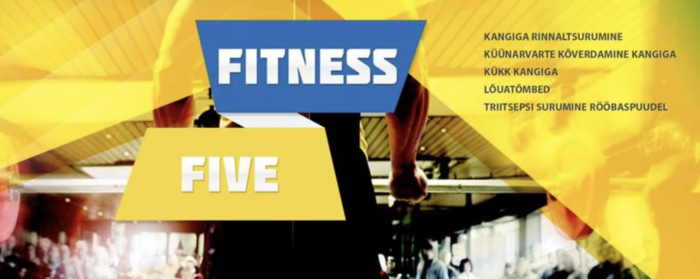
The order of exercises is always the same, and it matters — the heaviest multi-muscle-group movement comes first, while the smaller muscles are left for the end, where your energy is gone anyway.
- Barbell squat. Chest up, eyes straight ahead, thighs parallel to the floor or lower. 100 seconds, as many clean repetitions as you can manage.
- Barbell bench press. Lying on the bench, the barbell touches your chest, full extension at the top. Your butt must not come off the bench — the judge is watching.
- Pull-ups. Chin over the bar, arms back down to almost straight. A slight sway of the upper body is allowed, but violent kipping doesn’t count as a repetition.
- Deadlift. Conventional or sumo, lock out the barbell with your knees extended and shoulders back. This event drains the lower back so much that the fifth exercise can feel dreadful at first.
- Triceps dips on parallel bars. Shoulders below elbow level, full extension at the top. By now your arms are made of lead — this is where it becomes clear who has trained technique and who has trained only strength.
The whole competition takes about half an hour including breaks. The pauses between events are short, so your heart rate doesn’t have time to recover — and that’s the point. Fitness5 tests strength, endurance and the mind’s ability to keep the body from slipping out of control, all at once.
What fitness5 training looks like
The first thing worth understanding: regular gym training won’t get you into fitness5 shape. A 100-second set at 65–70% of your max is a completely different world from three sets of five repetitions. Your training has to include high-rep work (12–25) at a pace that doesn’t let you settle down.
A practical approach: for each of the five events, choose a weight you can use for 12–15 clean repetitions, and do three sets within a 100-second window, resting 2–3 minutes between them. The first set feels easy, the second leaves you gasping, and the third turns your technique watery. If you can do the third set at the same pace as the first, increase the weight next week.
Technique is gold. Under maximal effort, 100 seconds turns into a moment in which every second repetition is rejected by the judge — and that’s wasted time. Film yourself in the gym for a couple of weeks, compare it against the rulebook and polish whatever wouldn’t count as a repetition. Honestly, fitness5 competitions are usually won by cleaner technique, not a bigger max.
Fitness5 FAQ
Is it worth entering a competition as a beginner?
It is, if you’ve been training in the gym for at least a year and all five exercises are technically safe for you. At an open competition, a poor result is no reputational disaster — several Estonians started right there and eventually made it to the European Championships.
How much does it cost to take part?
The Estonian open championships have typically cost 10–15 € per competitor. Taking part in the European Championships requires Estonian citizenship and passing local qualification — generally the two best in your category.
What is the difference between fitness5 and CrossFit?
CrossFit WODs vary every time, while the five events of fitness5 are always the same. CrossFit uses more bodyweight exercises and Olympic lifts, whereas fitness5 sticks to classic barbell exercises. Both push you into the same breathless state, but fitness5 is predictable — you know exactly what to train.
More information and archive
In the Estonian fitness5 community, one of the more active organizers in 2015–2018 was the Arigato sports club in Tallinn. The event page for the 2017 open championships can still be viewed on Facebook: archive event on Facebook. A more direct link to the same event is FB event 751341821719650.
Author:Turg.Fitness.ee
Come and train! ArtGym