
After abs, arms are without a doubt the muscles people admire and covet most. Every man wants thick upper arms. Instead of torturing you with boring, dry physiology, let’s get straight to it. This article brings together the five-star arm routines of bodybuilding history – the most productive biceps and triceps programs I’ve dug out of my training logs and tried myself over the years.
I’m not going to dress this article up with jargon or hand you a single miracle program. This time we skip the science and theory and stay practical. If you want your sleeves packed full, you’ve landed on the right article.
Why five-star arm exercises work
How did this list come about? I rummaged through my old training logs and dug out my “five-star” workouts. That was my old rating system: I wrote down how effective each workout was, judged by intensity and how I felt, on a scale of one to ten. After one cycle (4–6 weeks), I rated the specific routine on a 5-point scale.
If a routine scored 1 or 2, I forgot about it immediately. If it scored 3 or 4, it went up for a retest – I made some changes and tried again. If it still scored 3 or 4 on the second attempt, it went in the “trash”. But if it scored a five, the routine went into my five-star notebook and waited for the moment I wanted to specialize on arms again.
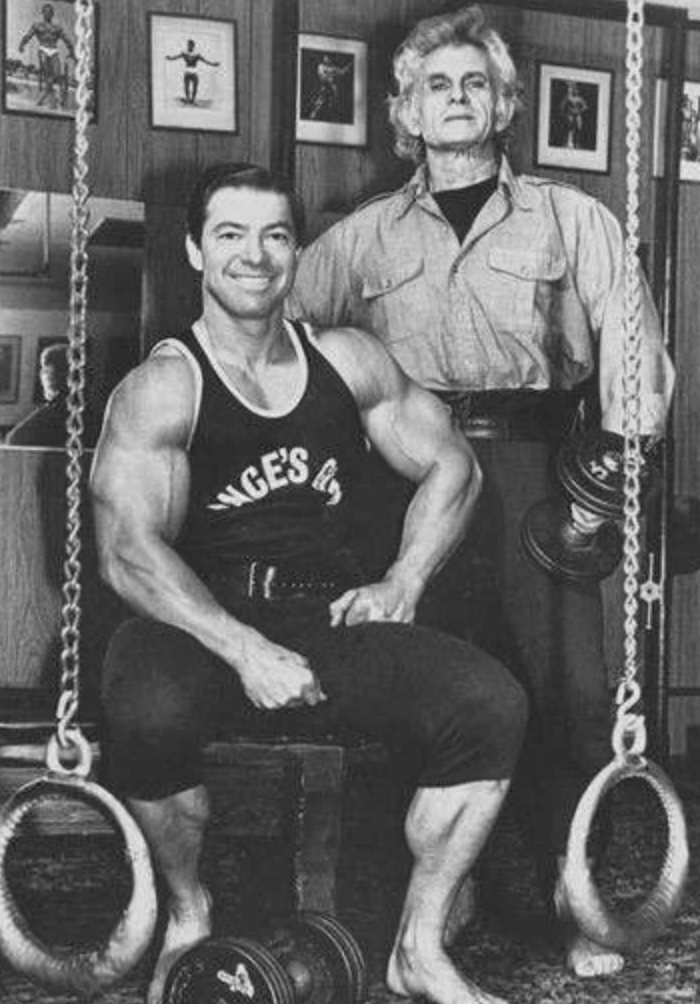
Naturally, I’m not trying to take credit for inventing these routines. They’re borrowed from the greatest coaches in bodybuilding history – Vince Gironda, Larry Scott, Charles Poliquin, Don Ross, Ian King, Robert Kennedy. I’ve only tweaked and adjusted a few of them slightly.
Basic principles of arm training
Before I get to the routines, a few important points. These principles apply to every program below.
Training frequency
I recommend training the following routines no more than 2 times a week and no less than once a week. Frequency depends, of course, on your overall split. For most routines, a pattern of 2 workouts, 1 day off and so on works well. If you feel drained and aren’t recovering, you can occasionally take two rest days instead of one. In any case, you should train arms on their own at least once a week.
Tempo
Tempo is the speed at which a repetition is performed. I mostly use a 4-part tempo code. For example, a 4020 tempo means:
- eccentric phase 4 seconds
- stretch pause/pause between the eccentric and concentric phases 0 seconds
- concentric phase 2 seconds
- contraction (pause at the top) 0 seconds
If no tempo is given, use the classic controlled execution – a slowed-down eccentric phase, slightly slower than the concentric. Many authors give 3020 as the classic tempo, and with that you’re on the right track.
Progression
With most routines, you should increase the weight consistently. In every workout, even if only minimally. Since arms are small muscles, follow micro-loading – the weights go up by barely noticeable amounts, but they still go up. For most biceps and triceps exercises, a 1 kg increase works. It’s unthinkable to add 2.5 or even 5 kg in every arm workout.
Antagonist supersets
Using supersets in arm training is extremely effective. For arms, an antagonist superset means that biceps and triceps exercises are done back to back, either with no rest at all or with minimal rest. We label them A1 and A2, where A1 is the first exercise and A2 is the second.
Supersets for the same muscle
With this option, two exercises for one muscle – biceps, for example – are done back to back. There’s no rest between the two exercises, otherwise the point of the superset is lost. Personally, I think that for bodybuilding goals (mass) this option is the better fit. Antagonist supersets are also effective, but they tend to build arm strength instead. I recommend experimenting with both.
Tri-sets
Tri-sets mean performing three sets in a row, either with short pauses or with none at all. They’re another step up in intensity and let you get a very large amount of work done in a short time. Larry Scott, Vince Gironda and many others have advocated supersets and tri-sets specifically for arm training. Why? Because in practice it works.
The best five-star arm routines
Enough theory. Here they are – the arm routines that have earned their five stars.
Multi Grip Tri-set: tri-sets with different grips
Routines that vary grips and hand positions within a single workout have been used for decades. Charles Poliquin combined different variations and pieced together his own version. He goes into more detail in his book “Winning the Arms Race”.
How it works: pick three exercises, each with a different palm position – one pronated (palms down), one neutral (palms facing each other), and one supinated (palms up). The exercise with the weakest grip is usually done first and the one with the strongest position last, but you can change the order depending on how the different parts of the muscle are developing.
- A1 EZ-bar biceps curl, palms down 3 x 6-8
- A2 Dumbbell biceps curl, palms facing each other (hammer curls) 3 x 6-8
- A3 Standing barbell biceps curl, palms up (classic barbell curl) 3 x 6-8
- B1 Cable pushdown, palms up 3 x 6-8
- B2 Cable rope pushdown, palms facing each other 3 x 6-8
- B3 Cable pushdown, palms down (classic) 3 x 6-8
Multi Angle Tri-set: tri-sets with different angles of one exercise
This routine is similar to the previous one. It uses exercises that work the muscle from different angles – different variations of the same exercise, to put the emphasis on different parts of the muscle and different phases of the range of motion.
A classic example for the triceps: the lying triceps extension with a barbell (or an EZ-bar), where in the first set you lower the bar to your chin, in the second to your forehead, and in the third behind your head. This is a tri-set – all three back to back, or with minimal rest. Poliquin refined the method by adding a 10–15-second rest between sets, which lets you increase the load considerably.
- A1 Seated dumbbell biceps curl on an incline bench (stretch position) 3 x 6-8
- A2 Seated dumbbell biceps curl (midrange) 3 x 6-8
- A3 Dumbbell preacher curl (90-degree incline) (peak contraction) 3 x 6-8
- B1 Seated triceps extension with an EZ-bar 3 x 6-8
- B2 Triceps extension with an EZ-bar to the forehead 3 x 6-8
- B3 Triceps extension with an EZ-bar on a decline bench 3 x 6-8
Unilateral Multi Grip Bicep Routine
To be honest, I don’t remember exactly where I found this, but I vaguely recall that it may have belonged to the Australian coach Ian King. What can I say – Ian (or whoever invented it) deserves a medal. Try it and you’ll find out why I think so. Do 10 repetitions per set, as tri-sets, with a 10-second rest between sets.
- A1 Dumbbell preacher curl, Zottman variation 3 x 10
- A2 Preacher curl (classic) 3 x 10
- A3 Hammer curls on a preacher bench 3 x 10
The Zottman biceps curl is a lift in which the eccentric phase is performed with the palm down (pronated) and the concentric phase supinated – palm up.
Unilateral Multi Grip Bicep Routine 2
This is a variation on the previous one. In place of the Zottman biceps curls, I put palms-down biceps curls with emphasized negatives – you can use your other hand to help. I also swapped the order of the second and third exercises. The rep count is slightly lower (6–8), so the weight is heavier.
The workout consists of three tri-sets. The rest between exercises is 0 seconds, and the rest when switching arms is also 0 seconds – you finish one arm, then go straight to the other.
- A1 Dumbbell preacher curls, palms down, with emphasized negatives 3 x 6-8
- A2 Dumbbell hammer curls on a preacher bench 3 x 6-8
- A3 Preacher curl (classic) 3 x 6-8
Rest between tri-sets: 1–1.5 minutes.
Gironda balanced 6 x 6 routine
This is a variation on Vince Gironda’s famous “Balanced Arms” routine. Like other bodybuilding gurus, Gironda stressed that you must perform the prescribed routine exactly, with no deviations. Shame on me, but after trying the original version I couldn’t resist experimenting.
The routine consists of three pairs of supersets. Each exercise in each superset is performed for 6 sets of 6 repetitions (6 x 6). There is no rest between the two consecutive exercises, and the rest between supersets is 90 seconds. Gironda recommended doing the routine 3 times a week, but I have tried different frequencies and got the best results training every 4–5 days. I definitely wouldn’t recommend doing it more than 2 times a week.
- A1 Preacher bench biceps curl (straight barbell) 6 x 6
- A2 Drag Curls 6 x 6
- B1 Overhead triceps extension with a rope (leaning forward and in a lunge stance) 6 x 6
- B2 Pullover + close-grip press with an EZ barbell 6 x 6
- C1 Underhand-grip barbell wrist curls 6 x 6
- C2 Drag Curls, palms down 6 x 6
Volume training 8 x 8
In Gironda’s 8 x 8 program, one exercise is chosen per body part. Each workout trains half the body (about 5 exercises) – 40 sets in total. You do 4 workouts a week, and each muscle is trained no more than 2 times a week.
Every repetition is performed while feeling a proper, full contraction. Consciously monitoring your tempo is mandatory. Rest between sets is 30 seconds or less, but never under 15 seconds. With a 3021 tempo (6 sec per repetition), a set lasts 48 seconds. With 20-second rest intervals, each 8 x 8 takes 9 minutes – five exercises, 40 sets in total, which makes a 45-minute workout.
This is clearly an aerobic-type workout. By using basic compound exercises (squats, bent-over rows, etc.) that involve a lot of muscle groups, you burn a fair amount of fat with this kind of routine. This program doesn’t call for extra cardio – and if it does, only a minimal amount.
An example of an arm routine within 8 x 8:
- A1 Dumbbell biceps curl with a non-locked grip (thumb below), hands supinated 8 x 8, tempo 3021
- B1 Close-grip EZ barbell bench press 8 x 8, tempo 3020
Volume training 8 x 8 for advanced lifters
This is a variation of 8 x 8 that Vince Gironda put together for elite and genetically gifted bodybuilders (one of them Mohammed Makkawy). The routine is done on a 3–4-day split, with each session focusing on two body parts at a time. Because this is a high-volume program, the tempo is slightly faster – 2020 or 2010. The routine can be completed in 40–45 minutes.
You can also try two exercises per muscle – in that case you should get through the routine in about 30 minutes. Still 8 sets of 8 repetitions.
- A1 Barbell Drag Curl 8 x 8
- B1 Seated incline dumbbell biceps curl 8 x 8
- C1 Hammer curl 8 x 8
- D1 Close-grip bench press 8 x 8
- E1 Triceps extension on a flat bench with two dumbbells 8 x 8
- F1 Press on parallel bars 8 x 8
Rest intervals are 30 seconds, as in the standard 8 x 8 above. It’s no sin to take 45–50 seconds either, if you need more.
Volume training 10 x 10 (German volume training)
This program was originally promoted by Vince Gironda. We know it better under the name it was given when it was revived later, “German Volume Training”, and it was popularized again (with some additions) by Charles Poliquin.
After its initial “market launch”, the original 10 x 10 was forgotten – for many it was too routine and boring, and people didn’t believe that a single exercise would be enough. Meanwhile, a new trend started to take over: three exercises per muscle, 3 working sets of each exercise. But 10 x 10 thoroughly wrecks the entire motor neuron pool, and repeated efforts in the same exercise work the whole muscle over properly. The result is unprecedented muscle growth.
The method is simple: pick one exercise per muscle or muscle group and perform 10 sets of 10 repetitions. It is important that the weight stays the same throughout every set. This is not a method where you train to failure or at high intensity (negatives, forced reps).
Choose a weight that is 60% of your normal strenuous 10-rep set. Rest exactly 90 seconds between sets, and perform all the sets at roughly the same speed. Usually two, less often three, body parts are trained per workout, on a 3–4-day split. Each muscle is trained once every five to six days.
- A1 Seated incline dumbbell biceps curl 10 x 10 – same weight
- A2 Seated triceps extension with an EZ barbell 10 x 10 – same weight
Translator’s note: it goes without saying that the training weights increase from workout to workout.
Drop supersets
This routine holds the best bodybuilding technique of all time – drop sets combined with supersets. You pick two exercises for one muscle or muscle group. You perform both back to back with no rest, 6–8 repetitions each. Then you quickly reduce the weight (in under 10 seconds) and repeat the same superset with the lighter load. And you do that two times.
Have the weights set up in advance – the lighter barbell or dumbbells should already be waiting. The process described above makes up just one drop superset (2 exercises x 3 supersets = 6 sets in total in one drop superset). Rest for 2 minutes and repeat the whole process 1–2 more times. Two times is usually enough. The weight is typically reduced by about 10–15%.
A short break of up to 10 seconds between supersets takes a little of the edge off the burning sensation from lactate and lets your strength reserves recover slightly – which is why the weight shouldn’t drop too drastically. It makes a difference whether you do the set straight through or with a 10-second pause. Those 10 seconds are a whole “eternity” of rest in a set this grueling.
- A1 Standing hammer curls 2-3 x 6-8 – with 18 kg
- A2 Standing alternating dumbbell biceps curl, palms facing outward 2-3 x 6-8 – with 18 kg
- Rest 0–10 seconds
- A3 Standing hammer curls 2-3 x 6-8 – with 16 kg
- A4 Standing alternating dumbbell biceps curl, palms facing outward 2-3 x 6-8 – with 16 kg
- Rest 0–10 seconds
- A5 Standing hammer curls 2-3 x 6-8 – with 14 kg
- A6 Standing alternating dumbbell biceps curl, palms facing outward 2-3 x 6-8 – with 14 kg
After completing one drop set, rest for 2 minutes and repeat the sequence 1–2 more times. The weights in the plan above are only examples.
Larry Scott’s favorite exercise
Larry Scott was the first Mr. Olympia, and to this day he is best known for his biceps and triceps routines. Scott’s favorites were exercises on the preacher bench, also known as the Scott bench – the bench is in fact named after Larry Scott.
Larry believed that triceps develop best with supersets and biceps grow best with tri-sets (and who wants to argue with him on that?). Scott’s favorite biceps routine was indeed a tri-set on the preacher bench, with various superset combinations for the triceps. At the end of every set, Larry also used plenty of “burns”, half reps and quarter reps.
BICEPS
- A1 Dumbbell preacher curl, looser execution (loose form) 3-4 x 6 + 4-5 burns
- A2 Straight barbell preacher curl, controlled execution (strict form) 3-4 x 6 + 4-5 burns
- A3 Standing EZ-bar curl with an overhand grip (looser execution) 3-4 x 6 + 4-5 burns
TRICEPS
- B1 Close-grip EZ-bar press 4-5 x 6 + 4-5 burns
- B2 Kneeling rope triceps extension (kneeling twin pedestal tricep rope extension) 4-5 x 6 + 4-5 burns
If you don’t have a dedicated triceps bench, a regular overhead triceps extension, performed in a lunge stance, works ideally too.
Pre-exhaustion routine (Pre-exhaust)
Pre-exhaustion was widely popularized by Robert Kennedy in Muscle Mag International. The method is to first perform an isolation exercise for the muscle and immediately follow it with a compound exercise, with no rest interval between the two. For the biceps, a good compound exercise is the underhand-grip pull-up with palms close together. The number of sets is 3–5, depending on your split and level.
- A1 Standing barbell biceps curl 3-5 x 8-12
- A2 Underhand-grip pull-ups with palms close together 3-5 x to failure
- B1 Rope triceps extension 3-5 x 8-12
- B2 Close-grip bench press 3-5 x 8-12
Don Ross’s system of 4 sets of different lengths
In bodybuilding literature you’ll find plenty of set schemes with different rep counts. This system is taken from Don Ross’s book “Muscle Blasting”. How it works: pick 4 different exercises for the muscle, and perform each exercise with a different rep count. The sets are straight sets, not supersets. You rest 60–90 seconds after every set. For most people, two rounds are enough; three is the maximum.
- A1 Seated incline dumbbell curl 2-3 x 6
- B1 Hammer curls 2-3 x 8
- C1 Barbell preacher curl 2-3 x 12
- D1 Overhead Pulley curl 2-3 x 20
- A1 Close-grip press 2-3 x 6
- B1 Lying triceps extension on a decline bench with two dumbbells 2-3 x 8
- C1 Kickbacks 2-3 x 12
- D1 Cable rope triceps extension 2-3 x 20
Feel free to use the same method with three exercises (three sets of different lengths) or even with two exercises (sets in the range of 6–20 repetitions). In any case, the heavier weights and lower repetitions come first – you move toward a higher rep count and less resistance.
Gironda’s system of 4 sets of different lengths
In this system, you do 4 sets of each exercise, with each set a different length. In his system, Don Ross preferred the 12, 8, 6, 20 variation. Vince Gironda’s variation is 10, 8, 6, 15.
- A1 Seated incline dumbbell curl 10, 8, 6, 15
- B1 Barbell curl 10, 8, 6, 15
- A1 Close-grip bench press 10, 8, 6, 15
- B1 Lying triceps extension on a decline bench with two dumbbells 10, 8, 6, 15
These are not supersets.
Poliquin’s tri-set system: 6-12-25
Once again, this is a system in which every set has a different rep count. The 6-12-25 method was one of Charles Poliquin’s favorites. The idea: pick three exercises. The first stretches the muscle (stretch position emphasis – the muscle’s range of motion is at its maximum). The second loads the middle of the working range (mid range emphasis). The third emphasizes peak contraction. Unlike in the Gironda and Ross systems, these are performed back to back, as a tri-set.
- A1 Seated incline dumbbell curl 2-3 x 6
- 10 sec rest
- A2 Barbell curl 2-3 x 12
- 10 sec rest
- A3 Cable curl lying on a bench (overhead cable curls) 2-3 x 25
Rest 2 minutes between tri-sets. Perform 2–3 tri-sets.
- B1 Kneeling cable pushdown with a V-handle 2-3 x 6
- B2 Lying barbell triceps extension (to the forehead) 2-3 x 12
- B3 Kickbacks 2-3 x 25
Rest 2 minutes between tri-sets. Perform 2–3 tri-sets.
Frequently asked questions
How often can you train arms?
No more than 2 times a week and no less than once a week. If your recovery drops, do one workout instead of two and add a rest day.
Should you start with supersets or the classic 3 x 6-8 scheme?
For beginners and intermediate lifters, it’s smart to start with classic sets – within a couple of years, the muscle learns to tolerate the effort. Supersets and tri-sets are tools for advanced lifters and are better suited to the time when classic progress has slowed down.
How long should you stick with one routine?
One cycle lasts 4–6 weeks. After that, assess the routine honestly – if it brings progress, keep using it. If not, swap it out. The muscle adapts, and the same stimulus doesn’t work forever.
Translated by Janar Rückenberg
Source: WHO – physical activity.
Come and train! ArtGym




