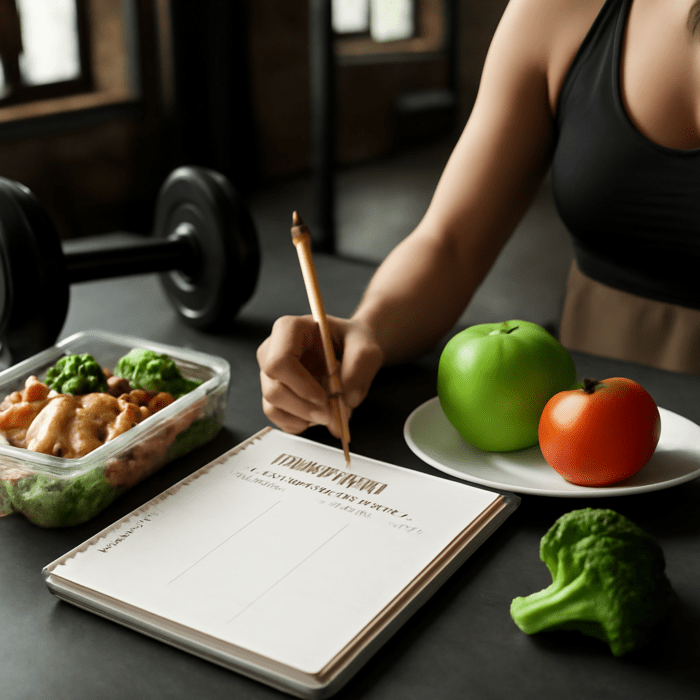
Food diary: a simple way to get in better shape
A food diary gives you an honest picture of what you actually eat throughout the day. If your weight has stalled, your physique isn’t changing or you’ve lost sight of your goal, writing things down quickly makes the picture clearer.
I’ve been keeping a food diary for years. I used to use it only when preparing for competitions, but now the habit has carried over into the periods between competitions too. Although I’m not currently preparing for a competition, I’ve still recorded everything I’ve eaten and calculated the calories for the past four months. I don’t do this all year round or obsessively. It’s more something I do for a while whenever I need to get myself back on track.
Why does a food diary work?
“Food diary” is a funny term. It still makes my wife laugh, but for some reason, at one point she started writing down what she ate too. She’s now been following much the same routine as me for several weeks.
Of course, no one has to keep a diary. It’s entirely voluntary. The real question is how well you understand what you’re doing. What do you want? Do you have a clear goal for your appearance, health or body weight? And how much do you actually want to achieve it?
If you have a goal and are working toward it by adjusting your diet and physical activity, a food diary can only help. Given how many articles describe nutrition as the deciding factor in the final outcome, it’s strange that keeping a training diary is considered standard practice, yet food diaries get far less attention.
How does a food diary build discipline?
Here’s a simple truth: what you have to write down becomes visible. And something you can see is much harder to hide from yourself.
- You start making more conscious choices in favor of cleaner, healthier and more natural foods. Why? Their calorie content is much easier to estimate. It’s easy to calculate the calories in a 100-gram packet of buckwheat once cooked, but try doing the same for 100 grams of borscht.
- You start cutting out snacks between meals. The reason is simple: weighing and recording every bite becomes tedious. At the same time, you quickly see that on some days, those little bites can add quite a lot to your daily calorie intake.
- You start to realize how little food it takes for the calories to add up. This is the biggest surprise for many people: it’s very easy to eat more calories than you burn. People tend to overestimate the calories they burn during training and underestimate the calories they get from food.
- You learn how much energy different foods provide. That knowledge stays with you even when you no longer keep a diary every day.
- Recording your calories gets you as close to the true picture as possible. By tracking your diet, you discover the calorie intake at which your body weight stays stable, starts to fall or increases.
Honestly, it’s uncomfortable at first. No one wants to discover that “a couple of little bites” actually amounted to a substantial extra portion. But that discomfort is precisely what makes the diary useful.
When should you use a food diary?
You don’t have to keep a food diary all year round. Quite the opposite: taking a break from it occasionally can even be helpful. If every mouthful becomes something you constantly monitor, the process can become tiring and too rigid.
A practical approach is to use it for periods at a time. For example, track what you eat for 2-4 weeks, then carry on as usual for 1-2 months without counting calories. That way, you stay in control while giving your mind a break too.
A food diary is definitely worth using when you aren’t making progress toward your goal. Perhaps your weight loss has stalled even though you think you’re doing everything right. In that situation, there’s no need to keep guessing. You need to look at what’s actually happening.
I’ve emphasized this before: people tend to equate habits with needs. A habit is not a need! Very often, people eat or snack simply because that’s what they’ve always done. Not because their body actually needs nutrients.
Practical tips for recording what you eat
Start simple. Don’t overcomplicate it. Write down the food, the amount, the time and, if relevant, how you felt: did you eat out of hunger, habit or boredom? That alone tells you a great deal.
If you weigh your food, take a sensible approach. A kitchen scale is useful at home, but when eating out, you sometimes have to estimate by eye. What matters is an honest picture over time, rather than perfection. If you make the same mistake every day, it will show up in your diary.
It’s also worth knowing that if you’re struggling with your weight and plan to commission a nutrition plan from a trainer, many trainers will want an overview of your current diet anyway. They’ll often ask you to record how much you eat, at what time and what you eat over 5-7 days. So you won’t really get around tracking your food.
Once you have your plan, you still need to keep a rough eye on portion sizes and calorie intake as you follow it. A food diary is not a punishment. It is a tool that shows whether your plan and your actual habits are heading in the same direction.
If you want to get something out, you have to put something in…
FAQ: food diaries and daily monitoring
Does a food diary have to be a paper notebook?
No. You can use paper, your phone, a spreadsheet or a nutrition tracking app. What matters is that you use it consistently and honestly.
Do you have to count calories every day?
No. For many people, tracking periodically is enough. If you are making progress toward your goal, a diary can simply be a tool you use to check in from time to time.
What should you do if keeping a diary becomes tedious?
Take a break. A food diary should help you, not dictate your entire life. Start using it again when you need a clearer picture of your weight, fitness or how you feel.
Author: Janar Rückenberg
Come work out! ArtGym