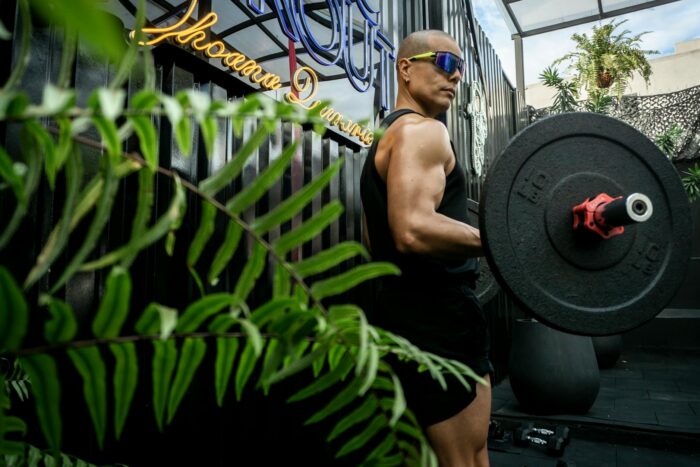
Forearms and a strong grip in training
Forearms are the foundation of your grip, and in the gym a weak grip gives itself away quickly. If the barbell slips out of your hands before your back or legs get tired, the work is left unfinished. Here is a practical way to train your forearms so that the strength carries over to deadlifts, rows and heavy holds.
Why do forearms determine grip strength?
Tom Prince put this idea into one simple sentence: the forearms are the epicenter of strength. It sounds grand, but in the gym it is easy to see. When pressing from the chest, grip can be a side issue, but in deadlifts, barbell rows, pull-ups and carrying heavy dumbbells, grip often decides how long a set really lasts.
Many people train their chest, biceps and legs very precisely, but the forearms get left out of the plan. Then comes that odd moment: the target muscle still has strength left, but your fingers can no longer hold on. It wasn’t the back that gave out. Not the traps. The grip simply ran out.
This doesn’t mean every workout should end with burning wrists. It’s better to treat the forearms as a small but important link. When that link is weak, the whole chain starts to rattle.
How do you build stronger forearms?
For thick, strong forearms, light, endless repetitions alone are not enough. In the original, Tom Prince emphasized heavy weights and lower repetitions. His experience was specific: at 21, he trained his forearms with very heavy weights to failure. That helped him use heavier weights in other exercises too.
A simple truth: muscle tissue needs tension. If the training load is always too light, you may get the blood flowing, but strength gains stay modest. At the same time, not every set has to be a stubborn fight. The forearm already does a lot of work in back, shoulder and biceps exercises, so the extra training has to be smart, not just painful.
A good place for forearms is the end of biceps day. Prince used the same idea: if biceps training has already tired your grip and arms, there’s no need to take giant weights to give the forearms a proper training load.
Overhand and underhand grips
Split the plan in two. Do some exercises with an overhand grip and some with an underhand grip. The overhand grip loads the upper side of the forearm more and helps balance what regular biceps training often doesn’t cover. The underhand grip gives the wrist flexors and the grip strong work.
The original recommendation was 12 sets in total for this body part. Those 12 sets are divided between four exercises: two with an overhand grip and two with an underhand grip. For overhand work, 7-10 repetitions per set is a good fit. For underhand work, you can go to failure, which should arrive somewhere around the sixth repetition.
Forearms need training load and caution
This is where you should leave your ego at the door. The original said that the forearm contains about 100 smaller and larger bones. Anatomically the wording is clumsy, but the point stands: the wrist and hand region is a delicate system, and raising the training load too abruptly can lead to a painful setback.
If your wrist gives you sharp pain, the set is no longer training. It’s a warning. Ordinary muscle tension and fatigue are okay, but stabbing pain in the wrist, near the elbow or in the fingers calls for a pause and a lower training load.
Start with a weight you can control through the whole range of motion. Don’t bounce the wrists. Don’t twist your body along with the movement. When the movement turns into jerking, you’re training your nervous system’s tolerance more than your forearm.
A practical plan with a forearm focus
One simple structure is to do forearms after biceps or back. Then your grip is already warm and ready for work. Choose four exercises: two overhand wrist extensions or barbell holds, and two underhand wrist flexions or a dumbbell variation.
- Keep the movement slow and controlled.
- Use the full range of motion, but don’t push through wrist pain.
- The weight should be heavy enough that the last repetitions demand effort.
- If your grip is already completely spent on back day, reduce the number of extra sets.
- Write down your weights, because forearm progress is otherwise hard to judge.
Honestly, forearm training doesn’t need to be long. A short, clear and consistent block is better than squeezing your wrists empty once a month. A strong grip grows over time.
FAQ: forearms and grip
Do you need to train your forearms separately?
If you do a lot of deadlifts, rowing and pull-ups, your forearms already get training load. Separate training is useful when grip is the limiting factor in other exercises or when you want to visibly build stronger arms.
When should you put forearm exercises into your workout?
A practical choice is to do them after biceps or back. That way a tired grip doesn’t interfere with the main lifts, and you still get strong work with a lighter weight.
Do wrist straps ruin grip development?
Straps are not a bad tool when you use them at the end of heavy sets. But if you use them on every pull, your grip doesn’t get enough work. Balance is better than extremes.
Come and arm wrestle! ArtGym
Author: Mikk-Alvar Olle, translated by Flex
Source: WHO – physical activity.