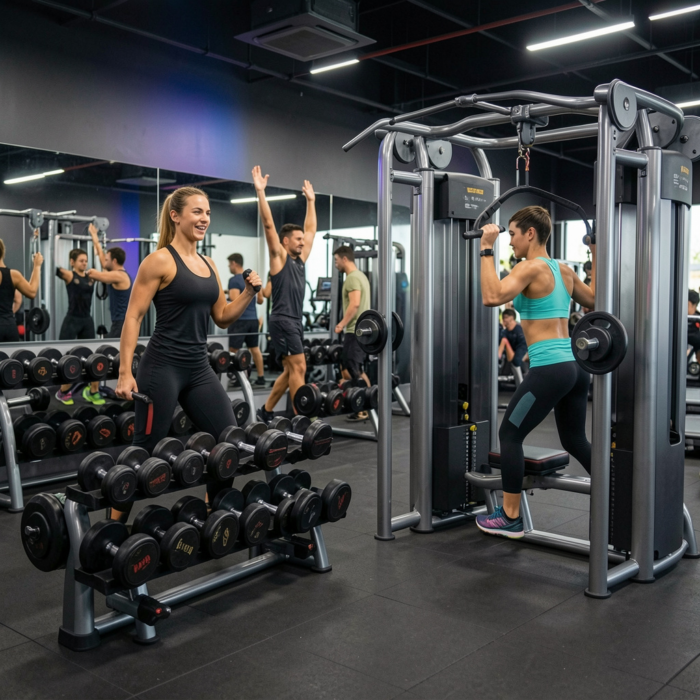
Free weights vs machines: which is more effective?
Free weights or machines: this question comes up at the door of every gym. The short answer: both have a place, but your goal decides. Below we look at when each option makes sense, who each one suits and how to combine them so that you actually get the results.
Why free weights develop more muscles
With free weights (dumbbells, barbell, kettlebell) you have to control the load yourself. The stabilizing muscles work along with you throughout the whole movement. That means a single barbell squat loads your thighs, glutes, abs and the back muscles that hold your body upright. A leg press done on a machine doesn’t give the same feeling: you sit on a fixed track and only extend your legs.
It’s exactly this “whole-body” side that makes free weights more functional. When you carry grocery bags home with two hands or lift a child out of a car seat, you use the same stabilizers. A machine trains a muscle; free weights train a movement.
What else? You choose your own range of motion. That lets you adapt the exercise to your body’s proportions. A fixed machine may simply fit a long-legged person badly, because the distances between its seat and lever are designed for average height.
Free weights vs machines: the main differences
Instead of a table, a couple of concrete examples so you can feel the difference.
Muscle isolation. Want to work only your triceps? On a cable machine you’ll manage that faster and more cleanly than with dumbbells. Machines are best when you want to target one muscle group deliberately: in rehabilitation, in the finishing phase of a bodybuilding cycle, or when another muscle is sore at the moment and you don’t want to involve it.
Injury risk. For a beginner the risk is higher with free weights: poor technique under a barbell can be hard on the back. A machine forces you into the correct track. That’s why many coaches recommend learning all the movements mainly on machines for the first months and only then going under the barbell.
Time and versatility. With one dumbbell you can do ten different exercises. A machine usually does one thing. When the gym is packed at peak hour and all the machines are taken, the dumbbell corner is a lifesaver.
Long-term progress. Free weights let you increase the load in very small steps: half a kilo here, one plate there. Machines often have big jumps (5–10 kg), which becomes limiting for an advanced lifter and eventually forces you over to free weights anyway.
How to start: free weights for beginners
If you’ve never been to a gym before, then honestly, there’s no need to dive straight under a barbell. A sensible plan looks something like this:
- The first 4–6 weeks: basic exercises on machines plus simple movements with dumbbells (dumbbell bench press, dumbbell row, seated shoulder press). You learn the feel of the movements and proper form.
- After that: add the basic barbell exercises: squat, bench press, deadlift, barbell row. Start with a light weight, with a coach or at least using a mirror.
- Going forward: a program where 70–80% is free weights and the rest is machines for isolation exercises (leg extension, cable biceps curl, calf machine).
A warm-up before and stretching after always apply, whichever method you use. Going under a barbell with cold muscles rarely ends well.
One common mistake: a beginner sees on Instagram someone squatting 100 kilos with a barbell and tries to copy it within the same week. Your back gives out. Lift the weight at which you can complete ten clean repetitions, then add a small step.
FAQ
Can you build muscle with machines?
Absolutely. In studies, muscle mass gains are similar with both methods when total volume and intensity are equivalent. The difference shows up more in functionality and in the stabilizer muscles.
How often should you alternate between machines and free weights?
There’s no need to switch from one session to the next. It makes sense to split it so that for each muscle group the program has 1–2 free-weight exercises and 1 machine exercise to finish. Variety keeps progress going and reduces boredom.
Which is better for burning fat?
Neither is inherently “better” at burning fat. What matters is your total training volume, the cardio side and your nutrition. Free weights often burn slightly more calories per session because more muscles are involved, but the difference is small.
Edited by: Arnold Tokko
Come and train! ArtGym