
In short:
- Healthy aging doesn’t mean stopping the clock; it means preserving mobility, muscle strength and independence for as long as possible.
- The biggest practical gain comes from consistent aerobic activity and strength training, not from a single perfect training program.
- In studies, simply reaching the recommended amount of activity is associated with a lower mortality risk, but the benefit also depends on your starting level and health status (Arem, 2015).
In a training context, healthy aging is above all about preserving functional ability: strength, endurance, balance, joint mobility and the ability to do everyday activities without undue help from others. The WHO describes healthy aging as the process of developing and maintaining the functional ability that enables well-being in older age: WHO Healthy ageing and functional ability. Training doesn’t make you immortal and it doesn’t replace medical care, but it is one of the best-studied behavioral ways to influence disease risk, muscle function and quality of life.
How does healthy aging work through training?
Healthy aging works better when the body regularly receives a signal to maintain the tissues that everyday life demands. Aerobic training challenges the heart, blood vessels and energy metabolism; strength training challenges muscles, tendons and bones; balance and mobility exercises help maintain control over posture. The ACSM position stand on exercise and physical activity for older adults stresses that a training program should ideally include aerobic work, muscle-strengthening exercises and flexibility exercises (Chodzko-Zajko, 2009).
At the biological level, training is not a single mechanism but a whole network of signals. Reviews in geroscience link regular physical activity with several hallmarks of aging, including mitochondrial function, inflammatory signaling, proteostasis and cellular stress resistance (Garatachea, 2015). In practical terms, this means training helps the body tolerate load better, recover from everyday stressors and keep a reserve for situations where illness or injury would otherwise quickly reduce independence.
It’s important to avoid too narrow a view. If longevity is the goal, it isn’t enough to only track body weight or only count steps. Body composition, muscle strength, aerobic fitness, sleep, nutrition and the treatment of chronic diseases all go together. Fat burning and training helps unpack the topic of body weight and energy expenditure, but the central measure of healthy aging is capability, not just the number on the scale.
How much training do you need to support your lifespan?
Epidemiological data point to a clear dose-response relationship: compared with inactive people, a lower mortality risk was visible even in those who did less than the recommended minimum, and at the recommended minimum the mortality risk was considerably lower (Arem, 2015). In the pooled analysis by Arem and colleagues, activity that met the recommended minimum was associated with a lower mortality risk, and a higher volume gave additional benefit up to a certain level (Arem, 2015). This doesn’t mean everyone has to train a lot; it means that moving from a completely inactive level to moderate regularity is a big step.
A practical starting point is to do several moderate-intensity sessions of activity per week and add strength training. Coleman and colleagues found in a large population-based cohort that even about one hour of aerobic activity per week was associated with a lower mortality risk, with additional benefit increasing up to roughly three hours per week (Coleman, 2022). The same study indicated that muscle-strengthening training one to two times a week was associated with a further reduction in mortality risk on top of aerobic activity (Coleman, 2022).
Spreading training across the week can be simple: walking, cycling, swimming or easy running for an aerobic base; the gym, bodyweight exercises or resistance bands for muscle strength; short balance and mobility blocks as part of the warm-up or cool-down. If movement needs to carry over directly into everyday life, What is functional training offers a useful framework: the aim is to train the movements a person actually uses.
Why is strength training so important in aging?
Muscle mass often declines unnoticed, but when it comes to function, muscle strength is an even more direct measure. The EWGSOP2 consensus treats sarcopenia as a muscle disease whose key feature is low muscle strength; low muscle quantity or quality confirms the diagnosis, and poor physical performance indicates a more severe condition (Cruz-Jentoft, 2019). This is why strength training in older age isn’t merely a matter of appearance or athletic ambition.
The effect of strength training on longevity has also been examined in population-based studies. In the meta-analysis by Momma and colleagues, muscle-strengthening activities were associated with a roughly ten to seventeen percent lower risk across several major chronic diseases and mortality (Momma, 2022). In the meta-analysis by Shailendra and colleagues, resistance training was associated with a lower risk of all-cause, cardiovascular and cancer mortality, although observational data cannot prove causality at the individual level in the same way a randomized trial can (Shailendra, 2022).
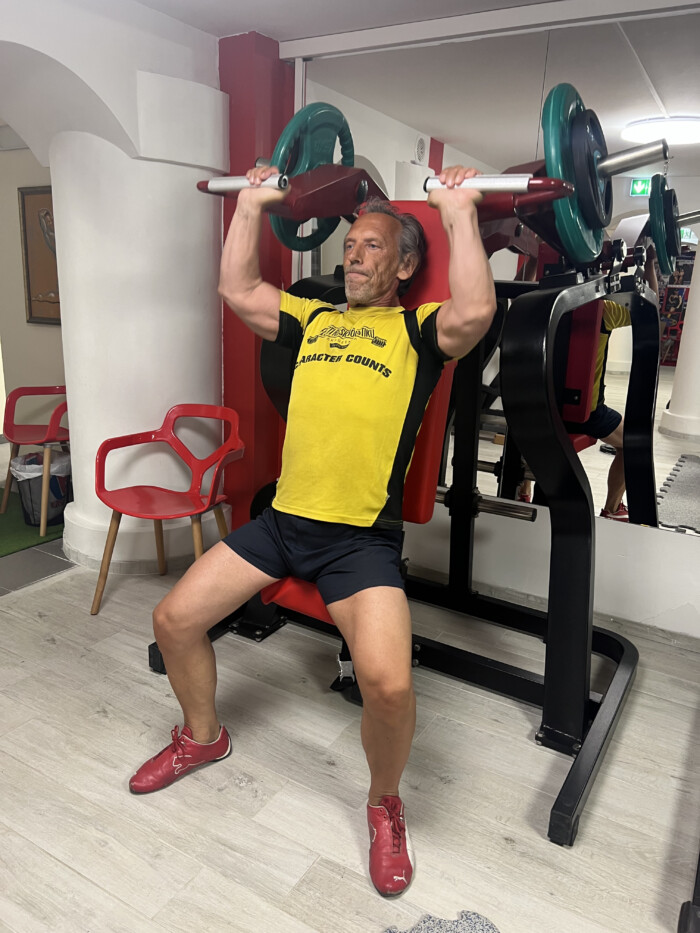
Good strength training to support aging doesn’t have to be extreme. The basic movements should cover a squat or sit-to-stand pattern, hip extension, pushing, pulling, carrying and core control. With age, illness or joint pain, the training load needs to be adjusted, but the principle stays the same: muscle needs an adequate, gradually increasing stimulus. Strength training and aging covers this topic in more depth.
Do hormones, fat burning and recovery affect longevity?
Hormones influence recovery, muscle mass, bone density and energy levels, but training shouldn’t be reduced to raising a single hormone. Testosterone, estrogens, insulin sensitivity, cortisol and inflammatory markers form a dynamic system. If the goal is healthy aging, it’s more useful to ask whether training improves function and recovery, rather than whether one marker moves up or down in the short term. Testosterone and training provides broader background on hormonal adaptation.
Fat burning matters too, but only if it isn’t mistaken for the sole goal of health. Excess visceral fat is linked to metabolic risk, but overly aggressive weight loss can erode muscle mass and strength in older age if strength training and protein intake stay inadequate. For longevity, it therefore makes more sense to build your program around strength, endurance and consistency rather than around calorie expenditure alone.
Recovery determines whether training becomes a constructive or a draining stressor. An older trainee may need longer to recover from the same training load than a younger one, but that doesn’t mean frailty. It means more precise dosing: start lower, raise the training load gradually, and keep an eye on sleep, joint pain and post-workout fatigue. If your motivation to move drops for several days after a workout, the dose was probably too high.
How to start if you haven’t moved much so far
It’s worth starting with the smallest routine you can repeat. The first goal isn’t the perfect program but breaking the pattern of inactivity. A walk, taking the stairs at an easy pace, a light strength circuit at home or a short bike ride can be a good enough start, as long as you keep repeating them. Arem’s pooled analysis showed that even activity below the recommended minimum was associated with a lower mortality risk compared with complete inactivity (Arem, 2015).
Safe progression can follow three principles. First, add frequency before intensity. Second, in strength exercises, put movement quality ahead of weight. Third, use training to support everyday life: getting up from a chair more easily, walking more confidently on slippery ground, getting less tired carrying shopping bags. If you have cardiovascular disease, diabetes, severe pain, dizziness or a recent surgery, discuss getting started with a healthcare professional.
References
- Arem H, Moore SC, Patel A, et al. (2015). Leisure time physical activity and mortality: a detailed pooled analysis of the dose-response relationship. JAMA Internal Medicine. PMID: 25844730. DOI: 10.1001/jamainternmed.2015.0533
- Chodzko-Zajko WJ, Proctor DN, Fiatarone Singh MA, et al. (2009). American College of Sports Medicine position stand. Exercise and physical activity for older adults. Medicine and Science in Sports and Exercise. PMID: 19516148. DOI: 10.1249/MSS.0b013e3181a0c95c
- Coleman CJ, McDonough DJ, Pope ZC, et al. (2022). Dose-response association of aerobic and muscle-strengthening physical activity with mortality: a national cohort study of 416 420 US adults. British Journal of Sports Medicine. PMID: 35953241. DOI: 10.1136/bjsports-2022-105519
- Cruz-Jentoft AJ, Bahat G, Bauer J, et al. (2019). Sarcopenia: revised European consensus on definition and diagnosis. Age and Ageing. PMID: 30312372. DOI: 10.1093/ageing/afy169
- Garatachea N, Pareja-Galeano H, Sanchis-Gomar F, et al. (2015). Exercise attenuates the major hallmarks of aging. Rejuvenation Research. PMID: 25431878. DOI: 10.1089/rej.2014.1623
- Momma H, Kawakami R, Honda T, Sawada SS. (2022). Muscle-strengthening activities are associated with lower risk and mortality in major non-communicable diseases: a systematic review and meta-analysis of cohort studies. British Journal of Sports Medicine. PMID: 35228201. DOI: 10.1136/bjsports-2021-105061
- Shailendra P, Baldock KL, Li LSK, Bennie JA, Boyle T. (2022). Resistance Training and Mortality Risk: A Systematic Review and Meta-Analysis. American Journal of Preventive Medicine. PMID: 35599175. DOI: 10.1016/j.amepre.2022.03.020
Frequently asked questions
Does healthy aging mean that illnesses won’t appear?
No. In the WHO’s approach, a person can age in better health even with a chronic condition, as long as the condition is under control and functional ability stays as good as possible.
Is walking enough to support longevity?
Walking is a good aerobic base, and even a smaller amount of activity is associated with a lower mortality risk compared with inactivity (Arem, 2015). For better muscle and bone function, it’s worth adding strength training too.
How many times a week should you do strength workouts?
In population data, muscle-strengthening training one to two times a week was associated with an additional reduction in mortality risk alongside aerobic activity (Coleman, 2022). The exact volume depends on health, training experience and recovery.
Is strength training dangerous in older age?
Properly dosed strength training isn’t automatically dangerous because of age. The risk rises when the training load, technique or recovery doesn’t match the person’s condition; if needed, start with the help of a coach or a healthcare professional.
Come and train! ArtGym




