
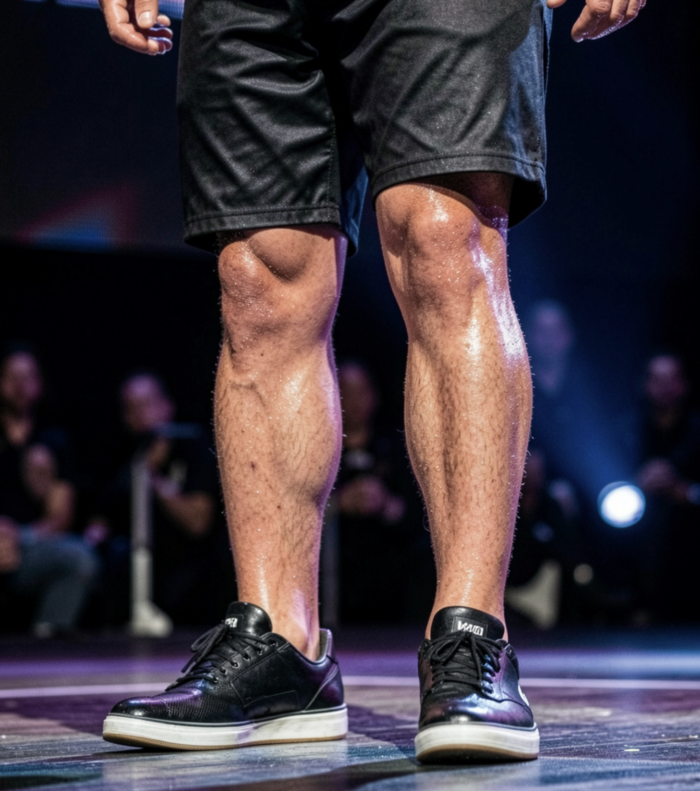
Jay Cutler’s old-school calf training
Translated by: Taavi Madiberk
Calf training is the part of leg day that many people would happily skip. For Jay Cutler it was the opposite: along with his shoulders and thighs, his calves were one of the reasons he was taken seriously next to Ronnie Coleman. Here is an old-school look at why calves are so hard to grow and what you can learn from Cutler’s training.
Why does calf training feel so brutal?
From the day Jay Cutler rose to fame as the man who could knock even the great Ronnie Coleman off the throne, there was a lot of talk about his overall size and muscle density. But before that, people had already noticed three body parts: shoulders, thighs and calves. Especially the calves. On the Olympia stage, this was the body part where Cutler simply seemed to be ahead of many of his competitors.
To be honest, calves are not easy to develop. Genetics plays a role here. Ronnie Coleman gave it 100% and more, yet the calves were never discussed in the same tone as the front and back of the thighs. That says something: hard work is necessary, but the shape of the calf and its muscle insertions also make a big difference.
That doesn’t mean training is pointless, though. Chris Dickerson, Mike Matrazzo, Dorian Yates and Jay Cutler didn’t get powerful calves by chance. They trained them regularly. Jay hit his calves hard once a week, sometimes even twice. If your calves are lagging, a couple of lazy sets at the end of your workout won’t be enough.
The shape of the calf is determined mainly by two large muscles. The soleus muscle gives the calf its width and works hard when the knee is bent. The gastrocnemius muscle creates the familiar diamond-like shape in the upper calf. Shawn Ray was a good example of a man whose calves were strong but whose insertions sat higher than Cutler’s or Yates’s.
So what actually happens when your calves start to burn? The calf muscles are a very sensitive area. There are many nerves and a rich blood supply, which is why the burning sensation arrives quickly. That’s also why calf training often feels more painful than working a larger muscle group. It’s not an excuse, it’s a fact you have to reckon with.
How did Jay Cutler’s calf training work?
Cutler’s approach wasn’t complicated. There was no secret that only the pros know. He used classic exercises, a full range of motion and very hard effort. The simple truth: calves don’t grow well if your repetitions are partial and the set ends before the really hard part.
Seated calf raises
Seated calf raises work mainly the soleus muscle. This exercise helps give the calf width and a full, well-developed lower calf. Jay sat at the machine with his knees under the pads and slowly lowered his heels to get a deep stretch.
Then he pushed up onto the balls of his feet. At the top he didn’t just let the movement fade out, but aimed for maximum contraction. The original even described it as an extra, prima ballerina-style movement: up as high as possible on the toes, a brief pause and a little extra squeeze at the end. Three to four sets of 10 to 12 repetitions were enough to pump the calves up properly.
Standing calf raises
Standing calf raises put more emphasis on the gastrocnemius muscle. This is a mass-building exercise. Jay placed his shoulders under the machine pads, straightened his legs and let his heels hang down off the platform. The stretch was deep and controlled.
From the bottom position he slowly pushed the weight up. At the top came a peak contraction again. With calves, this is the key point. If you just bounce your heels up and down, a large part of the work goes undone. Jay did the next nine repetitions on the same principle: control on the way down, a strong push up, and putting up with the pain until the end of the set. Three to four sets of ten repetitions was his working template here.
Calf raises on the leg press
Calf raises on the leg press were a change of pace for Cutler, even though the previous two exercises held the main places in his routine. He placed his feet on the edge of the leg press platform so that his heels could move freely. From that position he pushed with the balls of his feet, not with the whole leg.
Safety is especially important here. Your feet must not be too close to the edge, because slipping off a leg press can end very badly. The safety stops must be in place. The point of the exercise is a stretch at the bottom, a strong push up and a clear peak contraction, not showing off your ego.
Calf training: practical pointers
Before you run to the gym and start bravely inflicting pain on yourself, it’s worth getting a few simple things straight. They don’t sound exciting, but they make a big difference.
- Don’t wear bulky, thick-soled shoes. A thick sole reduces your range of motion, the deep stretch and the peak contraction.
- Make sure the soles of your shoes have good grip. The last thing you want is to slip off the calf press.
- Use drop sets sensibly. Once you’ve done your last repetitions with the heaviest weight, reduce the load and pump out a few more repetitions with a full range of motion.
- Change your foot position deliberately. Toes pointed inward emphasize the outer part more, while toes turned outward emphasize the inner part more.
- Don’t rush your repetitions. This isn’t a race. A slow tempo keeps the tension in the muscle, not in the joints.
One big trap is thinking that calves are some special muscle you can pound endlessly. They aren’t. The calf is a muscle like any other. If you want it to grow, it needs recovery after intense training. Two workouts a week is perfectly enough, especially if the sets are truly hard.
The second trap is using too little weight. High repetitions can work well for calves, but not when all the work is done moving 15 kilos and the effort stays comfortable. Try using heavy weights and high repetitions without letting your technique fall apart.
The third trap is a half-range movement. Too many people don’t let the heel drop low enough or rise high enough. Cutler’s example was the opposite: squeezing out the last bit of the range of motion. It’s the deep stretch and the strong end-range squeeze that give the calf a reason to adapt.
Marek Kalmus on the pain of calf training
Comment by: Marek Kalmus
Marek Kalmus agreed with Dorian Yates on calf training. Kalmus recalled that Yates once wrote, 10 years ago, that calves can be given training load 1x a week, for two, at most three sets. The sets should be 20 or more repetitions long.
The idea was simple. If only a set done with maximum weight forces a muscle to grow, why do a 4th, 5th or 10th set? If the third set really was done with maximum weight and you weren’t fooling yourself, the extra volume is often just accumulated fatigue.
On the pain, Kalmus was direct: that feeling arrives in the muscle somewhere after 12-15 repetitions. What helped Kalmus endure it was knowing how strong the feeling of release is that comes a moment after the set ends. The harder you can push during the set, the greater the relief afterward. It’s a harsh comparison, but in old-school bodybuilding language it’s a very clear message.
FAQ: calf training and Cutler’s principles
Should you train calves at the end of every workout?
If your calves have fallen behind in development, a couple of random sets at the end of a workout isn’t a good plan. Give them a place of their own in your program, work through the full range of motion and keep an eye on recovery.
Are high repetitions best for calves?
High repetitions work well, but only if the weight is demanding enough. If you simply chase the burn with a weight that’s too light, you may not get the tension needed for growth.
What’s the most important thing to remember from Jay Cutler’s calf training?
The most important thing is simple: a deep stretch, a strong peak contraction, controlled tempo and real effort. Nothing fancy. Good old hard work.
Author: Translated from the magazine Muscular Development
Come and train! ArtGym




